- Plants
- ›Vascular Plants
- ›flowering plants
- ›monocots
- ›Agaves, Orchids, Irises, and Allies
- ›Orchids
- ›Orchidoid Orchids
- ›Diurideae
- ›Diuridinae
- ›Orthoceras
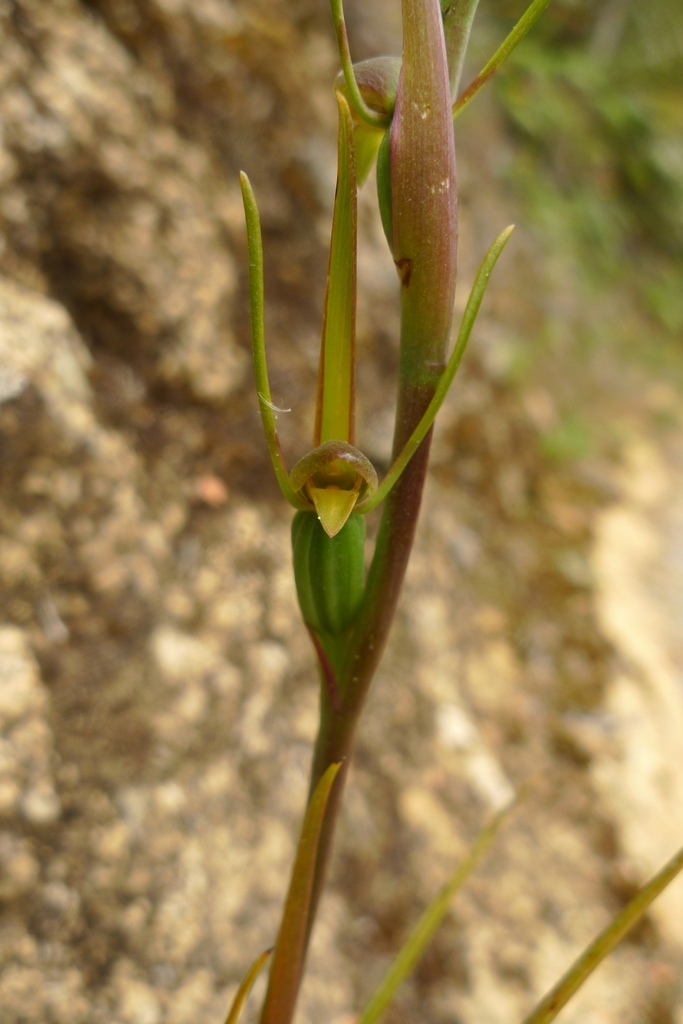
Birds mouth orchid
Orthoceras strictum
Orthoceras strictum, commonly known as the bird's-mouth orchid or horned orchid, is a species of orchid native to eastern and southern Australia, New Zealand and New Caledonia. It has between two and five linear leaves and up to nine yellowish green, brownish or blackish flowers with two long, erect to spreading lateral sepals.
From the article Orthoceras strictum on Wikipedia (CC BY-SA), quoted section by section
Description
Orthoceras strictum is a terrestrial, perennial, deciduous, herb with an underground tuber and a tuft of between two and five linear to thread-like, grass-like leaves, 150–300 mm (6–10 in) long and 2–3 mm (0.08–0.1 in) wide. Up to nine flowers 8–10 mm (0.3–0.4 in) wide are borne on a rigid flowering stem 300–600 mm (10–20 in) tall. Flower colour varies from blackish, brownish, maroon to yellowish green. The dorsal sepal is egg-shaped and forms a hood over the rest of the flower, 9–12 mm (0.4–0.5 in) long and 8–10 mm (0.3–0.4 in) wide. The lateral sepals are linear, horn-like, 20–25 mm (0.8–1 in) long, about 1 mm (0.04 in) wide and erect, spreading or curved. The petals are oblong, 8–10 mm (0.3–0.4 in) long, about 3 mm (0.1 in) wide and hidden inside the dorsal sepal. The labellum is 6–10 mm (0.2–0.4 in) long and has three lobes. The middle lobe is elliptic to egg-shaped, 6–7 mm (0.2–0.3 in) long, 5–6 mm (0.20–0.24 in) wide and the side lobes are 5–6 mm (0.20–0.24 in) long, about 1.5 mm (0.06 in) wide. There is a pyramid-shaped callus near the base of the labellum. Flowering occurs from November to February.
Range & habitat
The bird's-mouth orchid is widespread but uncommon and occurs in New South Wales, Queensland, South Australia, Tasmania, Victoria and New Caledonia. It grows in a wide range of habitats from grassy forest to heath. The differences between this species and Orthoceras novae-zeelandiae from New Zealand are "very slight and dubious".
Wikipedia: “Distribution and habitat”
Where it lives
Recorded sightings
—
geo-referenced records in GBIF, from museums, herbaria and field observers.
Drag the globe to turn it. Dots are where records exist, not a range map; darker means more records.
In the stacks
Searching the stacks…
Every page naming Orthoceras strictum in the Biodiversity Heritage Library →
This page is assembled live from iNaturalist, GBIF, Wikipedia, the Source Library and the Internet Archive. It is not yet part of the hand-edited codex. iNaturalist taxon 55664.