- Animals
- ›Arthropods
- ›Hexapods
- ›Insects
- ›Winged and Once-winged Insects
- ›Butterflies and Moths
- ›Butterflies
- ›Brush-footed Butterflies
- ›Checkerspots, Anglewings, Peacocks, and Allies
- ›Ladies, Anglewings, and Allies
- ›Araschnia
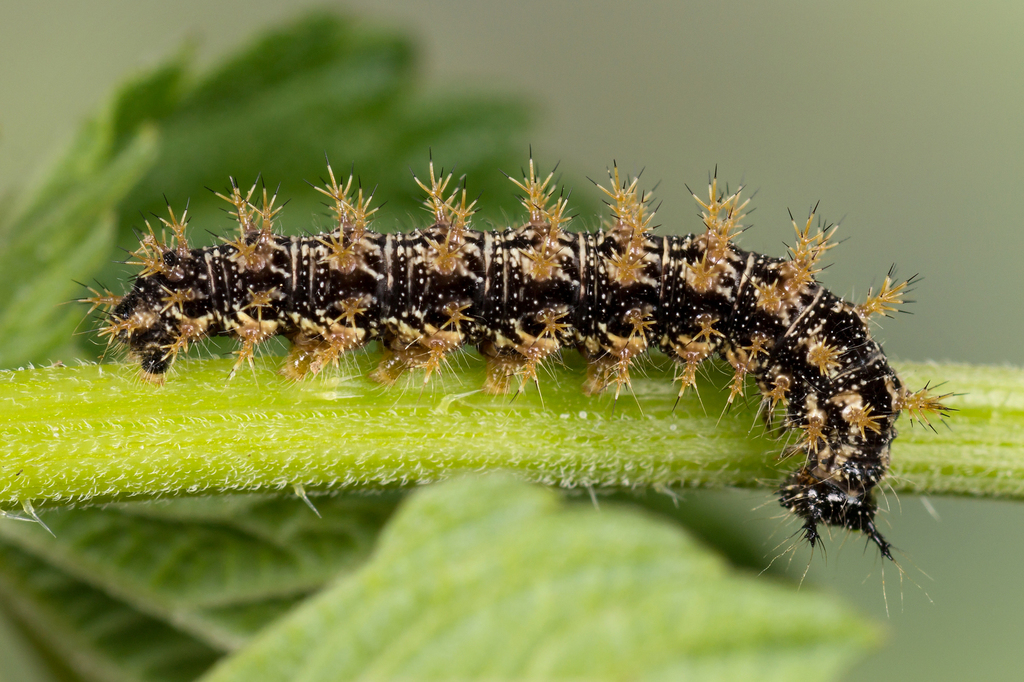
Map
Araschnia levana
The map (Araschnia levana) is a butterfly of the family Nymphalidae. It is found from Spain through Europe and east through the Palearctic to Central Asia and the Russian Far East to Korea and Japan.
The map exhibits seasonal dimorphism which means it has two different forms, depending on whether its larva grows in the summer or the winter. The summer form has black wings, while the winter form – adapted for diapause – has red wings. Before the butterfly was fully understood, these were thought to be two different species, with the summer form originally classified as A. prorsa. These are now referred to as morphs of A. levana, named levana and prorsa.
From the article Map (butterfly) on Wikipedia (CC BY-SA), quoted section by section
Description
A. levana L. (64d) has on a reddish ochreous ground a characteristic pattern of spots, some whitish subapical and distomarginal spots on the forewing and a row of blue bars near the distal margin of the hindwing. The underside of the forewing on the whole agrees with the upper, but the apical area bears violet dusting, the ground-colour is paler, and there are sharply defined white lines at the cell-spots; the hindwing is for the greater part red-brown, bearing in the centre a pale transverse band which widens behind, in places light lines traverse the wing and there is a dull violet smear in the distal area; the margin of both wings bears thin black lines. This is the first brood, which flies early in the spring (April–May). There occur among the ordinary form occasionally specimens in which the black basal and costal markings are confluent and both wings dark-margined, while the other markings of the wings (in the centre) are quite or nearly obsolete, these areas therefore being nearly uniformly red-brown. This is ab. frivaldszkyi Aigner. The summer-brood (July till August), sometimes also a third brood (September–October), is essentially different, being known as ab. prorsa L. (64d). Black, the forewing with white spots, the hindwing with a white transverse band; for the greater part red-brown beneath, with whitish lines and bands. …
Wikipedia: “Description in Seitz”
Range & habitat
The area of distribution of the map extends from Spain through Europe and east through the Palearctic to Central Asia and the Russian Far East to Korea and Japan.
Wikipedia: “Distribution”
Listen
Looking for field recordings…
Where it lives
Recorded sightings
—
geo-referenced records in GBIF, from museums, herbaria and field observers.
Drag the globe to turn it. Dots are where records exist, not a range map; darker means more records.
In the stacks
Searching the stacks…
Every page naming Araschnia levana in the Biodiversity Heritage Library →
This page is assembled live from iNaturalist, GBIF, Wikipedia, the Source Library and the Internet Archive. It is not yet part of the hand-edited codex. iNaturalist taxon 55643.