- Plants
- ›Vascular Plants
- ›flowering plants
- ›monocots
- ›Agaves, Orchids, Irises, and Allies
- ›amaryllis, onions, and allies
- ›onion subfamily
- ›Allieae
- ›Allium
- ›Anguinum
- ›Allium tricoccum
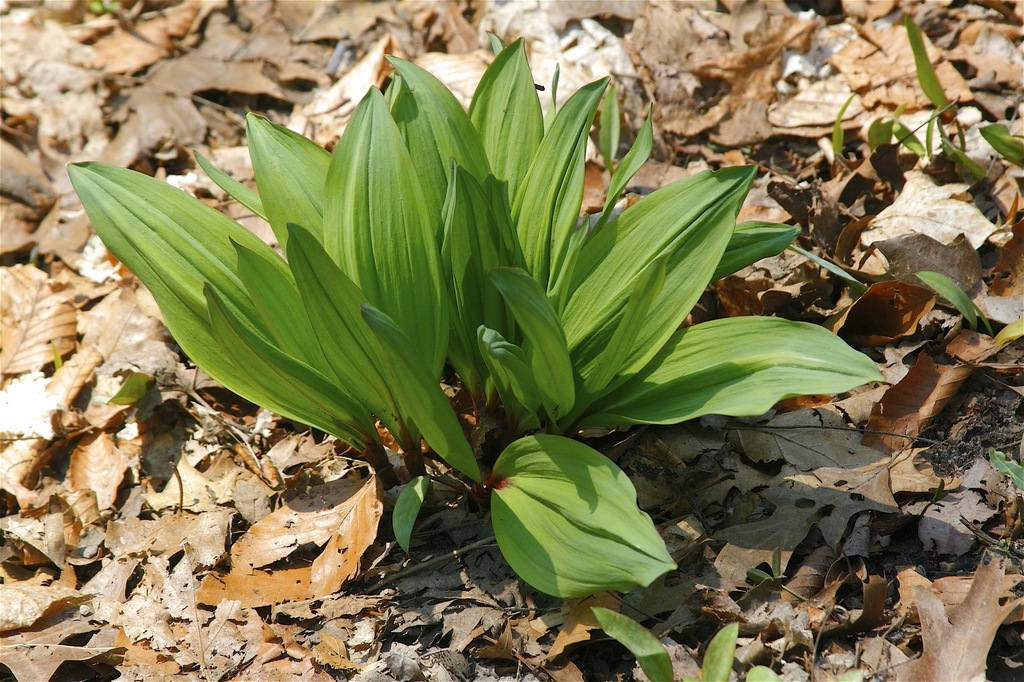
wide leek
Allium tricoccum
Allium tricoccum (commonly known as ramps, ramson, wild leek, wood leek, or wild garlic) is a bulbous perennial flowering plant in the amaryllis family Amaryllidaceae. It is a North American species of wild onion or garlic found in eastern North America. Many of the common English names for this plant are also used for other Allium species, particularly the similar Allium ursinum, which is native to Eurasia. An edible plant, Allium tricoccum is used in a variety of North American and indigenous cuisines, and has also been used by Native Americans in traditional medicine. A French rendering (chicagou) of a Miami–Illinois name for this plant is the namesake of the American city of Chicago.
From the article Allium tricoccum on Wikipedia (CC BY-SA), quoted section by section
Description
Allium tricoccum is a perennial growing from an ovoid-conical shaped bulb that is 2–6 cm (1–2 in) long. Plants typically produce a cluster of 2–6 bulbs that give rise to broad, flat, smooth, light green leaves, that are 20–30 cm (8–12 in) long including the narrow petioles, often with deep purple or burgundy tints on the lower stems. The bulbs are white and surrounded by brownish to grayish sheathing. Each cluster of bulbs gives rise to one flowering stem. The flowers are arranged into an umbel that has an erect scape that is typically 10–40 cm (4–16 in) long. The inflorescence has two ovate bracts that enclose the flowers before they open and fall away at anthesis. The flowering stem is persistent after fruiting. The flowering most commonly occurs after the leaves have died back, unlike the similar Allium ursinum, in which leaves and flowers can be seen at the same time. Ramps grow in close groups strongly rooted just beneath the surface of the soil. Flowering occurs in June or July into August. The flowers have white, cream or yellowish tepals which are 4–7 mm (1⁄8–1⁄4 in) long. The stamens are about as tall as the tepals and the filaments of the stamens have widened bases and are inserted on the corolla. After flowering and fertilization green fruits are produced that are three-lobed and open by way of three valves. The seeds are round, black, and shiny.
Range & habitat
The species is widespread across eastern Canada and the eastern United States. Allium tricoccum var. tricoccum is found in woods with rich soils with moist ground in depressions, and along streamside bluffs, and on colluvial slopes. Allium tricoccum var. burdickii is found growing in dry soils of upland woods.
Wikipedia: “Distribution and habitat”
At the table
Allium tricoccum is popular in the cuisines of the rural uplands of its native region. Both the white lower leaf stalks and the broad green leaves are edible. It is regarded as an early spring vegetable with a strong garlic-like odor and a pronounced onion flavor. Ramps also have a growing popularity in restaurants throughout North America. The plant's flavor, a combination of onions and strong garlic, is adaptable to numerous cooking styles. In central Appalachia, ramps are most commonly fried with potatoes in bacon fat or scrambled with eggs and served with bacon, pinto beans and cornbread. Ramps can also be pickled or used in soups and other foods in place of onions and garlic.
By Native Americans. The Menominee, Cherokee, Haudenosaunee, Potawatomi and Ojibwa all consume the plant in their traditional cuisines. The Menominee call it pekuac-sekākūhsyah. It was gathered in the woodlands to the south of Lake Michigan. The Cherokee eat the plant as a spring tonic, for colds and for croup. They also use the warm juice for earaches. The Ojibwa use a decoction as a quick-acting emetic. The Haudenosaunee use a decoction of the root to treat worms in children, and as a spring tonic to "clean you out". Some Native Americans used juice from the crushed bulbs to treat insect stings.
Wikipedia: “Uses”
In human culture
The city Chicago received its name from a dense growth of ramps near Lake Michigan in Illinois Country observed in the 17th century. The Chicago River was referred to by the plant's indigenous name, according to explorer Robert Cavelier, sieur de La Salle, and by his comrade, the naturalist and diarist Henri Joutel. The plant, called shikaakwa (chicagou) in the Miami-Illinois language spoken by the local indigenous people, was once thought to be Allium cernuum, the nodding wild onion, but research in the early 1990s showed the correct plant was the ramp. The ramp has strong associations with the folklore of the central Appalachian Mountains. Fascination and humor have fixated on the plant's extreme pungency. Jim Comstock, editor and co-owner of the Richwood News Leader, introduced ramp juice into the printer's ink of one issue as a practical joke, invoking the ire of the U.S. Postmaster General. The inhabitants of Appalachia have long celebrated spring with the arrival of the ramp, believing it to be a tonic capable of warding off many winter ailments. Indeed, ramp's vitamin and mineral content did bolster the health of people who went without many green vegetables during the winter.
Common name. According to West Virginia University botanist Earl L. …
Wikipedia: “In culture”
Where it lives
Recorded sightings
—
geo-referenced records in GBIF, from museums, herbaria and field observers.
Drag the globe to turn it. Dots are where records exist, not a range map; darker means more records.
In the stacks
Searching the stacks…
Every page naming Allium tricoccum in the Biodiversity Heritage Library →
This page is assembled live from iNaturalist, GBIF, Wikipedia, the Source Library and the Internet Archive. It is not yet part of the hand-edited codex. iNaturalist taxon 55634.