- Animals
- ›Arthropods
- ›Hexapods
- ›Insects
- ›Winged and Once-winged Insects
- ›Ants, Bees, Wasps, and Sawflies
- ›Narrow-waisted Wasps, Ants, and Bees
- ›Ants, Bees, and Stinging Wasps
- ›Spider Wasps, Velvet Ants, and Allies
- ›Velvet Ants
- ›Mutillinae
- ›Mutillini
- ›Mutilla
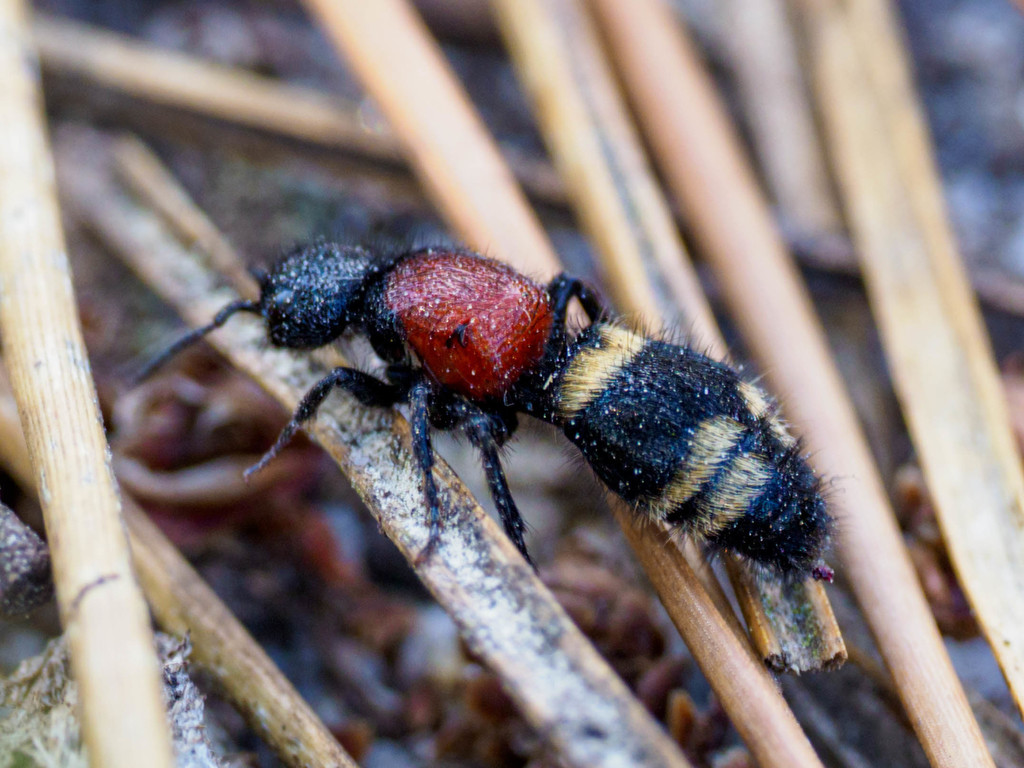
Large Velvet Ant
Mutilla europaea
Mutilla europaea, the large velvet ant, is a species of parasitoid wasps belonging to the family Mutillidae. It is a parasitoid on various species of bumblebees and is found in Europe, Asia, and North Africa.
From the article Mutilla europaea on Wikipedia (CC BY-SA), quoted section by section
Description
The males of M. europaea are dark red on the apex of mandible and the thorax. The first and second terga on the abdomen have bands of long silver setae, that on the second tergum may either be interrupted or wavy. The sides of the second tergum are clothed in long silver setae. The tip of the abdomen and the rest of the body are covered with long black, straight setae. The legs are largely covered in black setae, with a scattering of silver setae. Some variation occurs, and in some specimens, silver dominate setae dominate the hind legs, some males are completely black. In females, the mesonotum is red, and sometimes extends to parts of the pronotum. The first tergum has a band of long, silver setae, the remaining terga are spotted with silver setae along their flanks; they can be close together. The legs have some short, adjecting black and silver setae. The presence of the setae, or bristles, gives rise to the name "velvet ant".
Range & habitat
Mutilla europaea is a widespread species found in most of Europe and reaches as far as China in the east. It also occurs in Central Asia, the Middle East, and North Africa. In Great Britain, it is locally distributed, mainly in the south and east, but has recently been recorded as far north as Aberdeenshire.
Wikipedia: “Distribution”
Listen
Looking for field recordings…
Where it lives
Recorded sightings
—
geo-referenced records in GBIF, from museums, herbaria and field observers.
Drag the globe to turn it. Dots are where records exist, not a range map; darker means more records.
In the stacks
Searching the stacks…
Every page naming Mutilla europaea in the Biodiversity Heritage Library →
This page is assembled live from iNaturalist, GBIF, Wikipedia, the Source Library and the Internet Archive. It is not yet part of the hand-edited codex. iNaturalist taxon 555495.