- Animals
- ›Chordates
- ›Vertebrates
- ›Mammals
- ›Therians
- ›Placental Mammals
- ›Primates, Rodents, and Allies
- ›Primates
- ›Monkeys, Apes, and Tarsiers
- ›Monkeys and Apes
- ›Apes and Old World Monkeys
- ›Apes
- ›Gibbons
- ›Hoolock
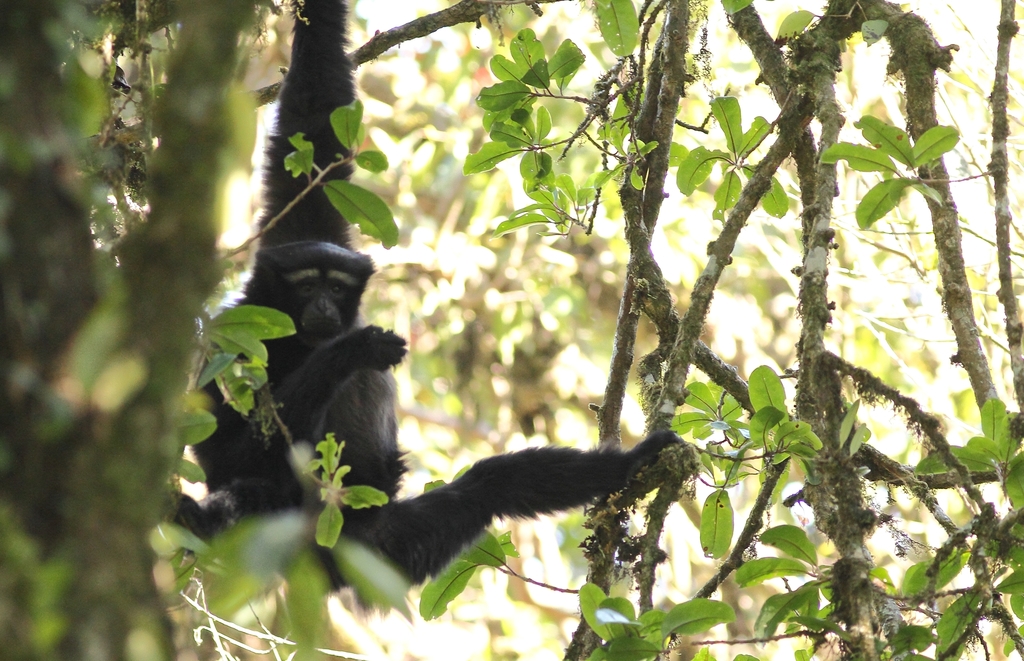
Skywalker Hoolock Gibbon
Hoolock tianxing
The Skywalker hoolock gibbon or Gaoligong hoolock gibbon (Hoolock tianxing) is an arboreal primate in the gibbon family Hylobatidae. It is one of three species of hoolock gibbon and was first described in January 2017 in the American Journal of Primatology. The Skywalker hoolock gibbon is one of two species of Eastern hoolocks: H. tianxing and H. leuconedys. Researchers estimate H. tianxing diverged from H. leuconedys roughly 490,000 years ago. The Eastern hoolock is vulnerable on the IUCN Red List, with a population of 310,000–370,000 individuals. Of this population, H. tianxing makes up less than 150 individuals, making the Skywalker hoolock gibbon an endangered species.
From the article Skywalker hoolock gibbon on Wikipedia (CC BY-SA), quoted section by section
Range & habitat
The Skywalker hoolock gibbon can be found in the montane forests of eastern Myanmar and southwestern China in the Mt. Gaoligong region, located between the Salween River and the Nmai tributary of the Irrawaddy River. Hoolocks were first recorded in this region in 1917, and this is the easternmost habitat of any hoolock species. Most of the H. tianxing population can be found in unprotected forests, and they live in small patches of forest with very rough terrain. 11 solitary and 32 groups of Skywalker hoolock gibbons have been recorded in the wild, but their total population is composed of less than 150 individuals.
Wikipedia: “Distribution and habitat”
What it does
Skywalker hoolock gibbons sleep in tall trees, on the thinner branches near the crown of the tree. They choose their sleeping tree for five different reasons: foraging abilities, range or resource defence abilities, thermoregulation abilities, comfort and hygiene, and antipredation reasons. They enter their sleeping trees before sunset in order to avoid nocturnal predators who are very active at that time, and once their tree has been selected, they move to it fast and directly before settling quietly for the night. They rarely spend consecutive nights sleeping in the same tree. During the cold season in Yunnan province, from November to March, the H. tianxing choose sleeping trees closer to food trees and at a lower elevation where it is warmer, and choose to sleep longer and huddle together to thermoregulate. Gibbons are known for having loud songs, specific to their species. They usually perform these songs from their sleeping trees just after dawn, and these songs last an average of 22.5 minutes.
Wikipedia: “Behaviour”
In human culture
The Skywalker hoolock gibbon is named after Luke Skywalker from the Star Wars franchise, as the scientists who described it are fans of the franchise. The specific name tianxing is the Pinyin transliteration of the Chinese terms 天 (tiān) meaning "heaven" and 行 (xíng) meaning "movement". The name is a reference to brachiation, the main locomotory mode of gibbons, and derived from the text of the I Ching, an ancient Chinese book of divination.
Wikipedia: “Etymology”
Listen
Looking for field recordings…
Where it lives
Recorded sightings
—
geo-referenced records in GBIF, from museums, herbaria and field observers.
Drag the globe to turn it. Dots are where records exist, not a range map; darker means more records.
In the stacks
Searching the stacks…
Every page naming Hoolock tianxing in the Biodiversity Heritage Library →
This page is assembled live from iNaturalist, GBIF, Wikipedia, the Source Library and the Internet Archive. It is not yet part of the hand-edited codex. iNaturalist taxon 554790.