- Plants
- ›Vascular Plants
- ›flowering plants
- ›monocots
- ›lilies, supplejacks, and allies
- ›lily family
- ›true lily subfamily
- ›true lilies and allies
- ›Lilium
- ›Archelirion
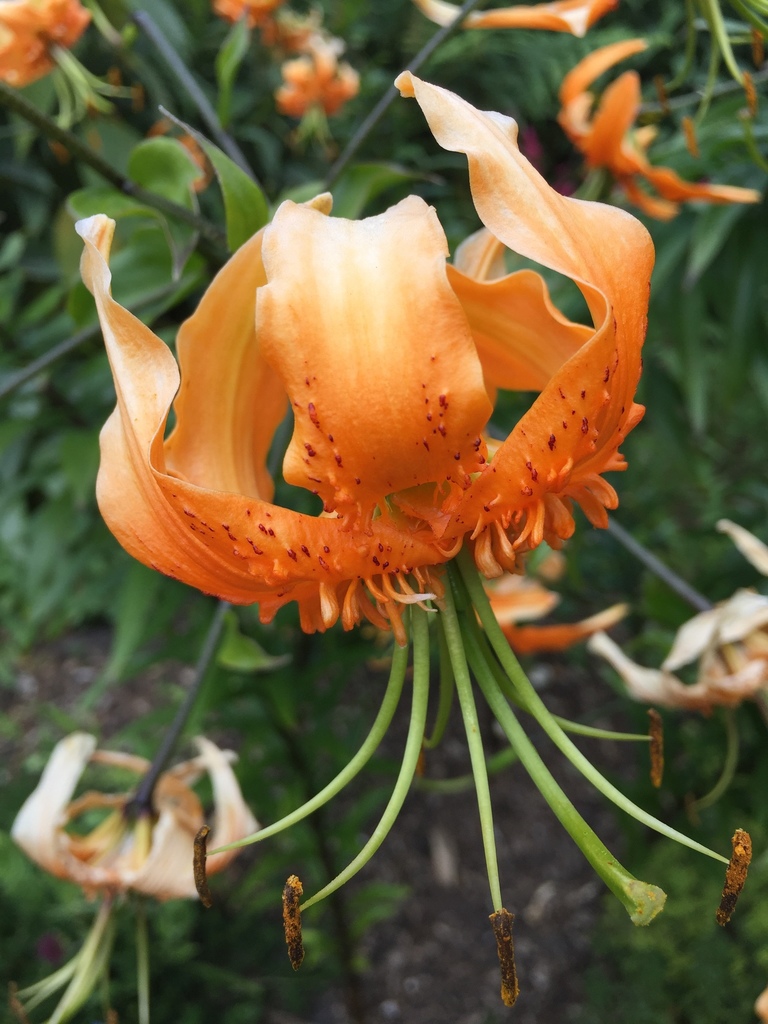
Henry's Lily
Lilium henryi
Lilium henryi (Chinese: 湖北百合; pinyin: Húběi bǎihé; lit. 'Hubei lily'), sometimes called tiger lily or Henry's lily, is a native lily of the mountains of central China (Provinces of Guizhou, Hubei, Jiangxi). The flowers are orange, spotted black, and unscented. The petals are recurving (bent backwards), and eventually resemble those of the more widespread Turk's-cap lily (though not when young).
From the article Lilium henryi on Wikipedia (CC BY-SA), quoted section by section
How it is grown
Typically it grows to about 1.5 m high in the wild, but vigorous cultivated plants can reach up to 2.5 m. It is likely to bend towards the light, and hence may need staking. It is useful as a garden ornamental plant for its long lasting flowers, its textured petals, and it is more tolerant than most lilies of lime in the soil. Henry's lily is easy to propagate from bulb scales. It was introduced into cultivation in Europe by Augustine Henry, and was named after him. This plant has won the Royal Horticultural Society's Award of Garden Merit.
Wikipedia: “Cultivation”
Where it lives
Recorded sightings
—
geo-referenced records in GBIF, from museums, herbaria and field observers.
Drag the globe to turn it. Dots are where records exist, not a range map; darker means more records.
In the stacks
Searching the stacks…
Every page naming Lilium henryi in the Biodiversity Heritage Library →
This page is assembled live from iNaturalist, GBIF, Wikipedia, the Source Library and the Internet Archive. It is not yet part of the hand-edited codex. iNaturalist taxon 554274.