On eBird ↗
Sooty Antbird
Live sightings near you, the range map, bar charts of when it is seen, and Macaulay Library photos and recordings.
Sooty Antbird
Hafferia fortis
The sooty antbird (Hafferia fortis) is a species of bird in the family Thamnophilidae. It is found in Bolivia, Brazil, Colombia, Ecuador, and Peru. Its natural habitat is subtropical or tropical moist lowland forests.
From the article Sooty antbird on Wikipedia (CC BY-SA), quoted section by section
Description
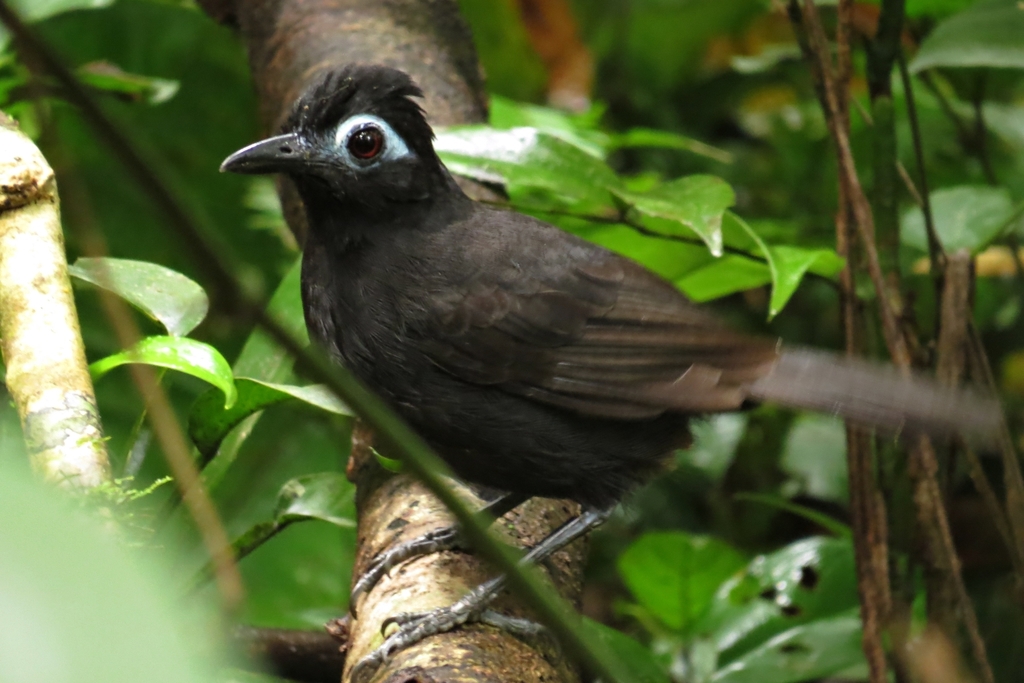
The sooty antbird is 17 to 19 cm (6.7 to 7.5 in) long and weighs 42 to 48 g (1.5 to 1.7 oz). Both sexes have a ring of light blue bare skin around their eye and a red iris. Adult males of the nominate subspecies are mostly very dark gray with a brown tinge on their wings and a seldom visible white line at the bend of the wing. Adult females have a rufous-chestnut crown with a black border. Their upperparts are grayish olive-brown that becomes reddish yellow-brown at the rump. Their wings are rufous and their tail dark brown. Their lores, face, throat, and underparts are gray with a tawny tinge on their flanks and crissum. Subadult males resemble adult females but are darker and grayer overall with a blackish gray crown. Subspecies H. f. incanescens is almost identical to the nominate; some authors state that it has a grayer back.
Range & habitat
The sooty antbird inhabits the western Amazon Basin, where the nominate subspecies is by far the more widely distributed of the two. It is found from the southern half of Colombia south through eastern Ecuador, eastern Peru as far as northern Puno Department, and northwestern Bolivia, and from them east into western Brazil south of the Amazon to the Madeira River. Subspecies H. f. incanescens is restricted to the vicinity of Tonantins, Brazil, on the right bank of the Upper Amazon (Solimões) in western Amazonas state. The species primarily inhabits the floor and understorey of terra firme evergreen forest and to a lesser extent transitional forest and occasionally várzea. It favors areas with dense undergrowth, often along watercourses and in viny openings caused by fallen trees. In elevation it reaches 300 m (1,000 ft) in Colombia, 600 m (2,000 ft) in Ecuador, and 1,300 m (4,300 ft) in Peru.
Wikipedia: “Distribution and habitat”
What it does
The sooty antbird feeds on a variety of insects and other arthropods. It typically forages singly, in pairs, or in family groups in dense vegetation, mostly on the ground and within about 1 m (3 ft) above it though occasionally to double that. It hops between short feeding stops, pumping its tail. It captures prey by gleaning, reaching, or pouncing to the ground from a perch and less frequently by short sallies to foliage and stems. It regularly follows army ant swarms to capture prey fleeing the ants; it often accompanies them for hours. It is often dominant over smaller ant-followers at swarms, though subordinate to larger ones. It occasionally joins mixed-species feeding flocks.
Wikipedia: “Feeding”
Listen
Looking for field recordings…
Where it lives
Recorded sightings
—
geo-referenced records in GBIF, from museums, herbaria and field observers.
Drag the globe to turn it. Dots are where records exist, not a range map; darker means more records.
In the stacks
Searching the stacks…
Every page naming Hafferia fortis in the Biodiversity Heritage Library →
This page is assembled live from iNaturalist, GBIF, Wikipedia, the Source Library and the Internet Archive. It is not yet part of the hand-edited codex. iNaturalist taxon 554112.