On eBird ↗
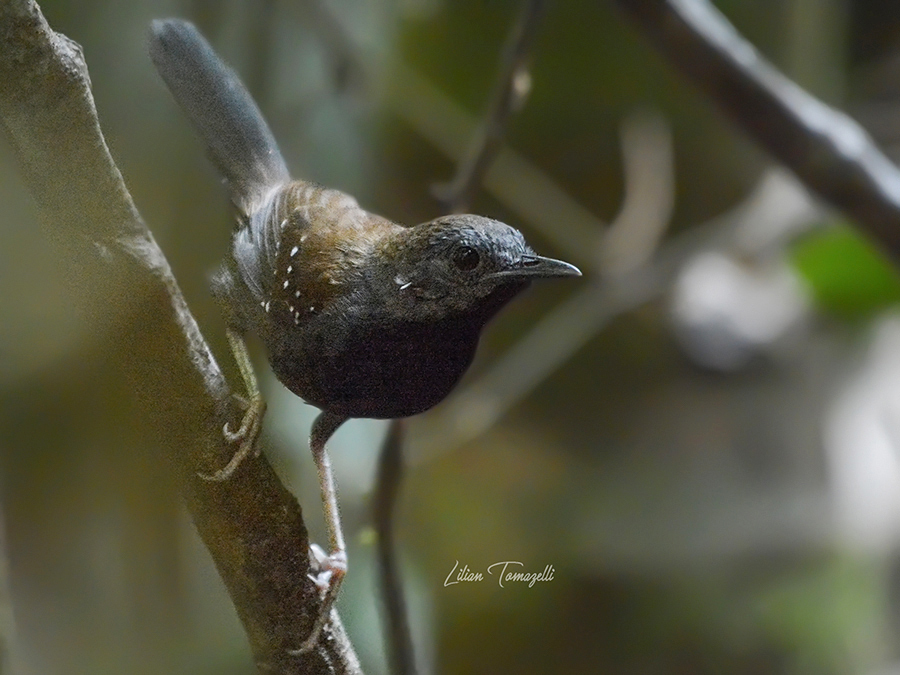
Black-throated Antbird
Live sightings near you, the range map, bar charts of when it is seen, and Macaulay Library photos and recordings.
Black-throated Antbird
Myrmophylax atrothorax
The black-throated antbird (Myrmophylax atrothorax) is a species of passerine bird in subfamily Thamnophilinae of family Thamnophilidae, the "typical antbirds". It is found in Bolivia, Brazil, Colombia, Ecuador, French Guiana, Guyana, Peru, Suriname, and Venezuela.
From the article Black-throated antbird on Wikipedia (CC BY-SA), quoted section by section
Description
The black-throated antbird is 13 to 14 cm (5.1 to 5.5 in) long and weighs 14 to 18 g (0.49 to 0.63 oz). Adult males of the nominate subspecies M. a. atrothorax have a gray face. Their crown and upperparts are dark yellowish olive-brown that becomes blackish on the rump, with a white patch between the shoulders. Their tail is blackish gray. Their wings are dark yellowish olive-brown with black and white tips on the coverts. The center of their throat and breast are black and the rest of their underparts gray. Adult females have a dull reddish yellow-brown crown and upperparts and dark brown wings with light buff tips on the coverts. Their chin and upper throat are white. The rest of their underparts are cinnamon-rufous with dark olive-brown flanks and crissum. Both sexes have gray legs. Subspecies M. a. metae has gray edges on the black breast feathers, giving a spotty appearance. M. a. tenebrosa has much darker upperparts than the nominate with much smaller light tips on the wing coverts. Males have blackish gray flanks and belly; females are darker all over than the nominate. M. a. maynana males have sooty gray upperparts with a faint brownish wash. M. a. melanura is quite variable in its differences from the nominate. In most areas males have a grayer forecrown and supercilium, an olive or light russet-brown rump, sooty gray uppertail coverts, and a paler belly. …
Range & habitat
The subspecies of the black-throated antbird are found thus:
M. a. metae: central Colombia's Meta and Guaviare departments M. a. atrothorax: southern Venezuela, extreme east-central Colombia, the Guianas, and northern Brazil from the Rio Negro east to Amapá state M. a. tenebrosa: north of the Amazon in eastern Ecuador, northeastern Peru, and northern Brazil east to the Rio Negro M. a. maynana: north-central Peru south of the Rio Marañón M. a. melanura: south of the Amazon in eastern Peru, northern and central Bolivia, and locally in western and central Brazil east to Mato Grosso state The black-throated antbird inhabits a variety of landscapes, many of which are closely associated with water. It much of its range it occurs in lowland terra firme, transitional, várzea, and igapó evergreen forest. It greatly favors forest edges, swampy areas along rivers, and regrowing clearings within forest. Along the upper rios Negro and Orinoco it tends to be in wet areas within savanna woodlands on white sand soils. In Peru and Bolivia it often associates with stands of Gynerium cane and Guadua bamboo. In all habitats it stays in the understorey.
Wikipedia: “Distribution and habitat”
What it does
The black-throated antbird feeds on arthropods, especially insects and spiders. It typically forages singly, in pairs, or in family groups and almost never joins mixed-species feeding flocks. It forages almost exclusively within 1 m (3 ft) of the ground though it will go as high as 3 m (10 ft). It mostly gleans prey from the surface of live vegetation, branches and vines while perched or standing, and by probing leaf litter and curled dead leaves usually without flipping them about. It also takes prey by reaching or jumping to glean from low-hanging leaves. It only rarely follows army ant swarms.
Wikipedia: “Feeding”
Listen
Looking for field recordings…
Where it lives
Recorded sightings
—
geo-referenced records in GBIF, from museums, herbaria and field observers.
Drag the globe to turn it. Dots are where records exist, not a range map; darker means more records.
In the stacks
Searching the stacks…
Every page naming Myrmophylax atrothorax in the Biodiversity Heritage Library →
This page is assembled live from iNaturalist, GBIF, Wikipedia, the Source Library and the Internet Archive. It is not yet part of the hand-edited codex. iNaturalist taxon 554084.