- Plants
- ›Vascular Plants
- ›flowering plants
- ›Dicots
- ›Roses, Elms, Figs, and Allies
- ›rose family
- ›brambles, roses, strawberries, and allies
- ›strawberries, cinquefoils, and allies
- ›strawberry subtribe
- ›Fragaria
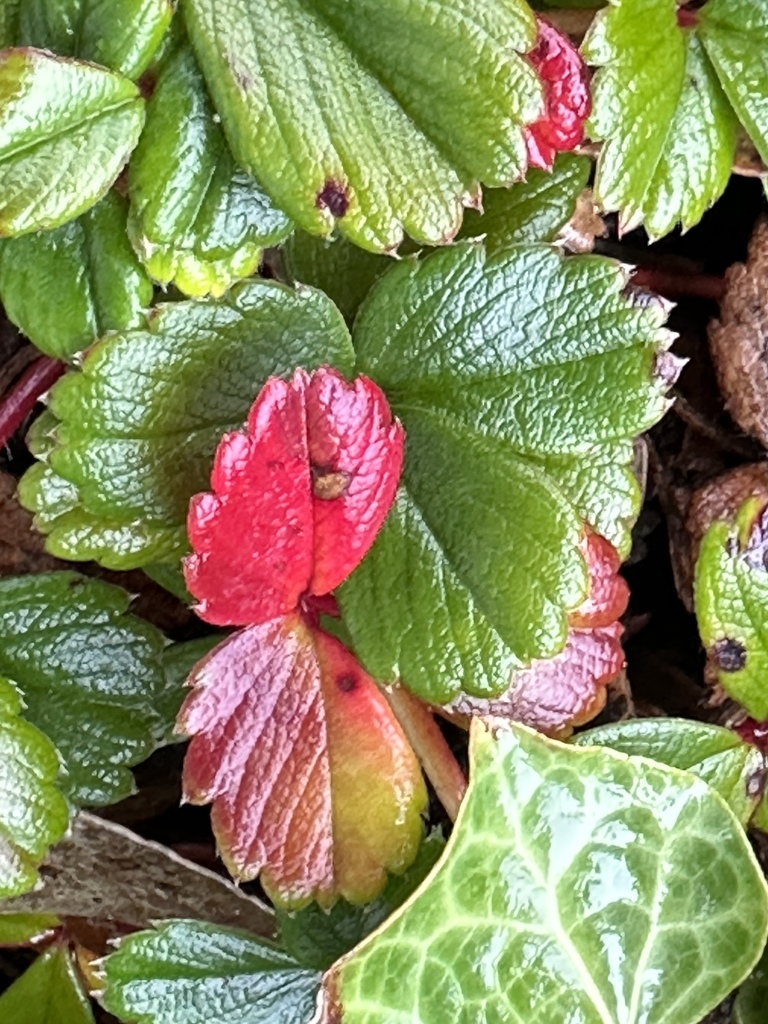
beach strawberry
Fragaria chiloensis
Fragaria chiloensis, the beach strawberry, Chilean strawberry, or coastal strawberry, is one of two species of wild strawberry that were hybridized to create the modern garden strawberry (F. × ananassa). It is noted for its large berries. Its natural range is the Pacific Ocean coasts of North and South America, and also Hawaii. Migratory birds are thought to have dispersed F. chiloensis from the Pacific coast of North America to the mountains of Hawaii, Chile, and...
From the article Fragaria chiloensis on Wikipedia (CC BY-SA), quoted section by section
Description
It is an evergreen plant growing to 15–30 centimetres (6–12 inches) tall. The relatively thick leaves are glossy green and trifoliate, each leaflet around 5 cm (2 in) long. The stems are covered with long hairs and the leaves sometimes have a dense fringe of hairs. The flowers are white, produced in spring and early summer. The fruit, a strawberry, is edible, red on the surface and white inside.
Genetics. All strawberries have a base haploid count of 7 chromosomes. F. chiloensis is octoploid, having eight sets of these chromosomes for a total of 56. These eight genomes pair as four distinct sets, of two different types, with little or no pairing between sets. The genome composition of the octoploid strawberry species has generally been indicated as AAA'A'BBB'B'. The A-type genomes were likely contributed by diploid ancestors related to F. vesca or similar species, while the B-type genomes seem to descend from a close relative of F. iinumae. The exact process of hybridization and speciation which resulted in the octoploid species is still unknown, but it appears that the genome compositions of both F. chiloensis and F. virginiana (and by extension the cultivated octoploid strawberry as well) are identical.
History. The cultivated garden strawberry — also known as F. × ananassa — developed in 18th-century Europe from a man-made hybridization of F. …
Range & habitat
The plant's natural range is the Pacific Ocean coasts of North and South America, and also Hawaii, where it grows mostly on sand beaches above the tidal zone in temperate to warm-temperate regions. Migratory birds are thought to have dispersed F. chiloensis from the Pacific coast of North America to the mountains of Hawaii, Chile, and Argentina. Amédée-François Frézier (1682–1773) was the first to bring back specimens of the species to the Old World.
Wikipedia: “Distribution and habitat”
What it does
Chaetosiphon fragaefolii, the strawberry aphid, is a bug species found to feed on F. chiloensis in Chile. It is a vector of the strawberry mild yellow-edge virus (SMYEV), a pathogen that impacts several species in the Fragaria genus. Sites with abundant aphids are associated with an increased incidence of SMYEV. With the presence of the aphid-borne virus, ecological consequences could result, such as reduced plant growth, vigor, and yield. Based on the genetic patterns of Chaetosiphon fragaefolii, human activities contribute mainly to their dispersal, while the dissemination to natural habitats is limited and not large-scale. Some clones of F. chiloensis, such as ‘Del Norte’ and ‘Yaquina’, are also found to be resistant to aphids. In field trials, fewer aphids were found on these clones compared to other cultivated strawberries, suggesting the future potential for breeding programs that could help boost the resistance of F. chiloensis.
Wikipedia: “Ecology”
At the table
Its fruit is sold as a local delicacy in some South American produce markets. The beach strawberry is gathered by several native groups, especially on the pacific coast of North America. The Makah, Quileute, and Quinault native groups in Washington, Wiyot and Pomo in California, gathered the fruit as a food source. Tribes also used different parts of the plant other than its fruit for medicinal purposes, such as the Quileute tribe that chewed the leaves and applied it as a burn relief paste. California tribes also brewed the leaves as a tea to ingest its high vitamin c content and the roots are used for stomach relief and dental/gum health.
Wikipedia: “Uses”
Where it lives
Recorded sightings
—
geo-referenced records in GBIF, from museums, herbaria and field observers.
Drag the globe to turn it. Dots are where records exist, not a range map; darker means more records.
In the stacks
Searching the stacks…
Every page naming Fragaria chiloensis in the Biodiversity Heritage Library →
This page is assembled live from iNaturalist, GBIF, Wikipedia, the Source Library and the Internet Archive. It is not yet part of the hand-edited codex. iNaturalist taxon 55367.