- Animals
- ›Arthropods
- ›Hexapods
- ›Insects
- ›Winged and Once-winged Insects
- ›Butterflies and Moths
- ›Owlet Moths and Allies
- ›Prominent Moths
- ›Phalerinae
- ›Phalera
- ›Phalera
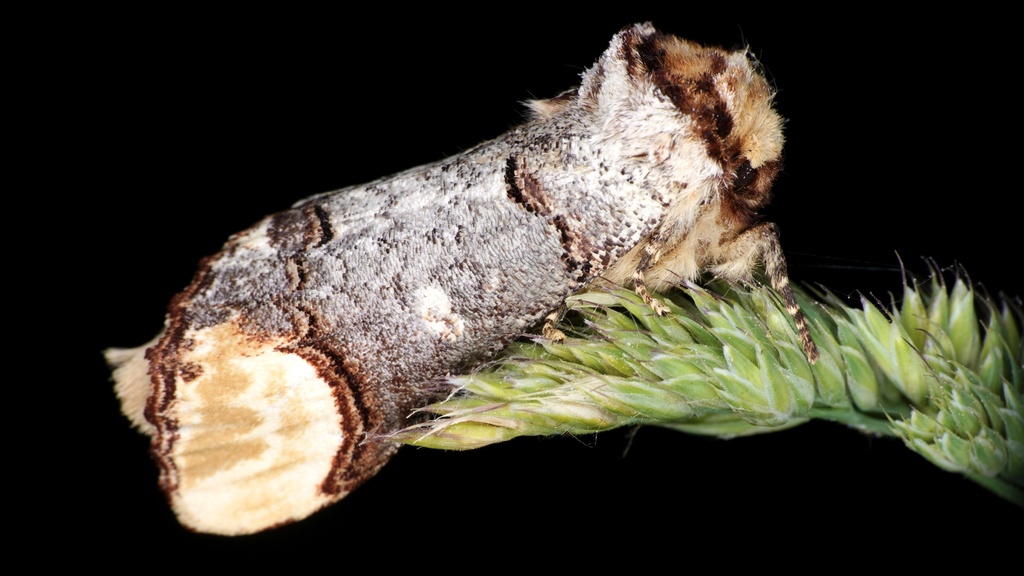
Buff-tip
Phalera bucephala
The buff-tip (Phalera bucephala) is a moth of the family Notodontidae. It is found throughout Europe and in Asia to eastern Siberia. The species was first described by Carl Linnaeus in his 1758 10th edition of Systema Naturae.
From the article Buff-tip on Wikipedia (CC BY-SA), quoted section by section
Description
The moth is a fairly large, heavy-bodied species with a wingspan of 55–68 mm (2.2–2.7 in). The forewings are grey with a large prominent buff patch at the apex. As the thoracic hair is also buff, the moth resembles a broken twig when at rest. The hindwings are creamy white. Seitz - Head, collar and centre of thorax brownish yellow, patagia greyish white with a black-brown double basal edge, on the transverse crest 2 black-brown transverse lines, hind margin greyish white. Abdomen yellowish grey to yellowish brown. Forewing greyish brown, broadly white at the base and along the hind margin, with prediscal dark brown and black double band; at the apex a large oval yellow patch reaching down to vein 4, proximally bordered by a dark red-brown semicircle, and traversed below the apex by a broad dentate dull ochreous submarginal spot; the black postdiscal band semicircular in the costal half, parallel with the dark border of the apical patch, and then dentate, accompanied on the outer side by a dark brown line; discal spot whitish; the scaling with a strong silky gloss, excepting the apical patch. Hindwing whitish grey, with a very slight indication of a dark median band. On the underside both wings have a prominent black-brown discal band, forewing moreover with a black-browia marginal line. …
At the table
For details see Robinson et al., 2010.
Acer – Norway maple Betula – birch Castanea - chestnut Corylus – hazel Ribes - currant Laburnum Populus – poplar Prunus Quercus – oak Robinia Rosa – rose Salix – willow Tilia – lime Ulmus – elm Viburnum
Wikipedia: “Recorded food plants”
In human culture
Historically, the buff-tip moth has been referred to as a pest due to their tendency to feast upon apple trees in Lithuania during the 1900s. Outbreaks of this species may increase in areas with high levels of environmental nitrogen compounds.
Wikipedia: “Natural history”
Listen
Looking for field recordings…
Where it lives
Recorded sightings
—
geo-referenced records in GBIF, from museums, herbaria and field observers.
Drag the globe to turn it. Dots are where records exist, not a range map; darker means more records.
In the stacks
Searching the stacks…
Every page naming Phalera bucephala in the Biodiversity Heritage Library →
This page is assembled live from iNaturalist, GBIF, Wikipedia, the Source Library and the Internet Archive. It is not yet part of the hand-edited codex. iNaturalist taxon 55361.