- Animals
- ›Arthropods
- ›Hexapods
- ›Insects
- ›Winged and Once-winged Insects
- ›Butterflies and Moths
- ›Owlet Moths and Allies
- ›Cutworm Moths and Allies
- ›Cutworms and Dart Moths
- ›Physetica
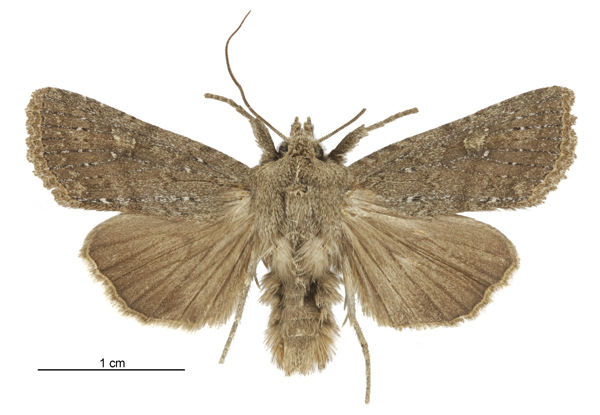
Physetica homoscia
Physetica homoscia is a species of moth of the family Noctuidae. It is endemic to New Zealand and is found throughout the country, including the Auckland Islands. This species inhabits areas where its host plants are common, and this includes costal dune habitats. It lives at a wide range of altitudes, from sea-level to at least 1750 m. The larvae of P. homoscia feed on Ozothamnus leptophyllus and Ozothamnus vauvilliersii. They are very active and drop to the ground when disturbed. Larvae are parasitised by a species of fly. This species pupates in the soil, and the pupa life stage lasts approximately 6 weeks. The adult moths are on the wing from September to June and are attracted to light. The adults of P. homoscia might possibly be confused with Ichneutica moderata however this latter species lacks the small white dots on the forewing veins of P. homoscia. Adults might also be confused with P. temperata but P. homoscia is significantly larger in size.
From the article Physetica homoscia on Wikipedia (CC BY-SA), quoted section by section
Description
Dugdale described the larva of this species as follows:
Body colour pattern in black and yellowish or greenish brown, variegated. Dorsal area longitudinally, darkly marbled, seta D1 on a small, and D2 on a large white patch, the D2 patch connected with a prominent pallid subdorsal line; zone between this and spiracle longitudinally marbled; spiracle on a dark patch, subspiracular line broadest behind, narrowest just in front of spiracle; subventral and ventral zones pallid, obscurely marbled; ventral line obscure to prominent. Meyrick originally described the species as follows:
Male. — 38 mm. Head, palpi, antennae, thorax, abdomen, and legs grey; antennae with short triangular transverse dentations (1⁄2), strongly ciliated; thorax with moderate anterior crest; anal tuft ochreous-tinged. Forewings moderately dilated, costa almost straight, apex obtuse, hindmargin crenulate, obliquely with two tolerably distinct series of white dots, preceded and followed by black marks, before first and beyond second lines; lines dark-margined, tolerably defined; orbicular and claviform hardly traceable; reniform indicated by whitish lateral margins; subterminal faintly paler, not dark-margined, waved: cilia grey. …
Range & habitat
This species is endemic to New Zealand. It is found throughout New Zealand, including in the Auckland Islands.
Wikipedia: “Distribution”
What it does
The larvae are very active and drop to the ground when disturbed. The adult moths are on the wing from September to June and are attracted to light.
Wikipedia: “Behaviour”
In human culture
Larvae of P. homoscia feed on Ozothamnus leptophyllus and Ozothamnus vauvilliersii. Hudson states that the larvae are parasitised by a fly species. The larvae pupate in the soil, and the pupa life stage lasts for approximately 6 weeks.
== References ==
Wikipedia: “Life history and host species”
Listen
Looking for field recordings…
Where it lives
Recorded sightings
—
geo-referenced records in GBIF, from museums, herbaria and field observers.
Drag the globe to turn it. Dots are where records exist, not a range map; darker means more records.
In the stacks
Searching the stacks…
Every page naming Physetica homoscia in the Biodiversity Heritage Library →
This page is assembled live from iNaturalist, GBIF, Wikipedia, the Source Library and the Internet Archive. It is not yet part of the hand-edited codex. iNaturalist taxon 551068.