- Animals
- ›Arthropods
- ›Hexapods
- ›Insects
- ›Winged and Once-winged Insects
- ›Butterflies and Moths
- ›Owlet Moths and Allies
- ›Cutworm Moths and Allies
- ›Cutworms and Dart Moths
- ›Physetica
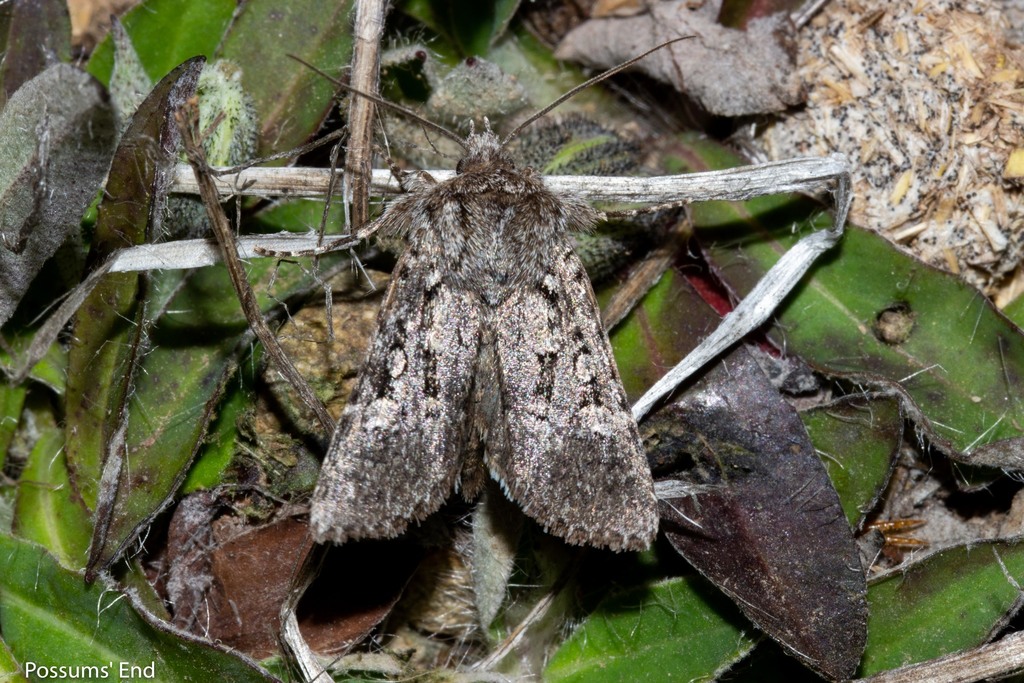
Physetica cucullina
Physetica cucullina is a species of moth of the family Noctuidae. It is endemic to New Zealand and can be found throughout the South Island, apart from in the Nelson district with the exception of the St Arnaud Range where it is present. It is likely to be also resident in Stewart Island. P. cucullina lives in shrubland at subalpine and alpine zones but can occur at sea-level in the more southern regions. The life history of this species is poorly documented. There is only one known record in the New Zealand Arthropod Collection of the larvae of this species having been reared. These larvae were reared on Leucopogon fraseri. Adults of this species is on the wing from October to March and are attracted to light. P. cucullina is almost identical in appearance to P. funerea. The only reliable distinguishing feature between the two species is the antennae of the male. P. cucullina is also very similar in appearance to P. sequens but P. sequens lacks the narrow black line on the forewing dorsum area that can be present on the forewings of P. cucullina.
From the article Physetica cucullina on Wikipedia (CC BY-SA), quoted section by section
Description
Guenée first described the species as follows:
It is scarcely the size of inceptura, and the wings are rather more obtuse. Superior cinereous, with intensely black terminal clots; the costa also marked with black dots, which indicate the origin of the ordinary lines, which are little visible; the half-line is the most apparent, formed of two arcs, one placed above the other; no basal line; subterminal indicated by a series of wedge-shaped blackish spots; and the central shade by a black dot on the inner margin; the two ordinary spots are visible, and of the normal form : inferior smoky-grey, without markings, and with a white fringe; their under-side whitish, with a large black cellular lunule, and a strongly defined border, which resembles that of the species of Anarta. Antennae stout, scarcely ciliated. The terminal joint of the palpi strongly projecting, but much shorter than the second, naked, and somewhat club-shaped. Thorax with a black line on each patagium.The male of this species has a wingspan of between 29 and 37 mm and the female has a wingspan of between 29 and 36 mm. This species has variable colouration of its forewings. P. cucullina is almost identical in appearance to P. funerea. The only reliable distinguishing feature between the two species is the antennae of the male. Male P. cucullina have antennae with distinct erect ciliations. …
Range & habitat
It is endemic to New Zealand. This species is found throughout the South Island apart from in the Nelson district with the exception of the St Arnaud Range where it is present. It is likely to be also resident in Stewart Island.
Wikipedia: “Distribution”
What it does
Adults of this species is on the wing from October to March and are attracted to light. They have been collected via a mercury vapour light trap.
Wikipedia: “Behaviour”
In human culture
The life history of this species is poorly documented. As at 2017, there is no description of the larvae and there is only one known record in the New Zealand Arthropod Collection of the larvae of this species having been reared. This record indicates the larvae were reared on Leucopogon fraseri.
== References ==
Wikipedia: “Life history and host species”
Listen
Looking for field recordings…
Where it lives
Recorded sightings
—
geo-referenced records in GBIF, from museums, herbaria and field observers.
Drag the globe to turn it. Dots are where records exist, not a range map; darker means more records.
In the stacks
Searching the stacks…
Every page naming Physetica cucullina in the Biodiversity Heritage Library →
This page is assembled live from iNaturalist, GBIF, Wikipedia, the Source Library and the Internet Archive. It is not yet part of the hand-edited codex. iNaturalist taxon 551066.