- Animals
- ›Arthropods
- ›Hexapods
- ›Insects
- ›Winged and Once-winged Insects
- ›True Bugs, Hoppers, Aphids, and allies
- ›Plant-parasitic Hemipterans
- ›Scale Insects
- ›Soft scales
- ›Coccinae
- ›Parthenolecanium
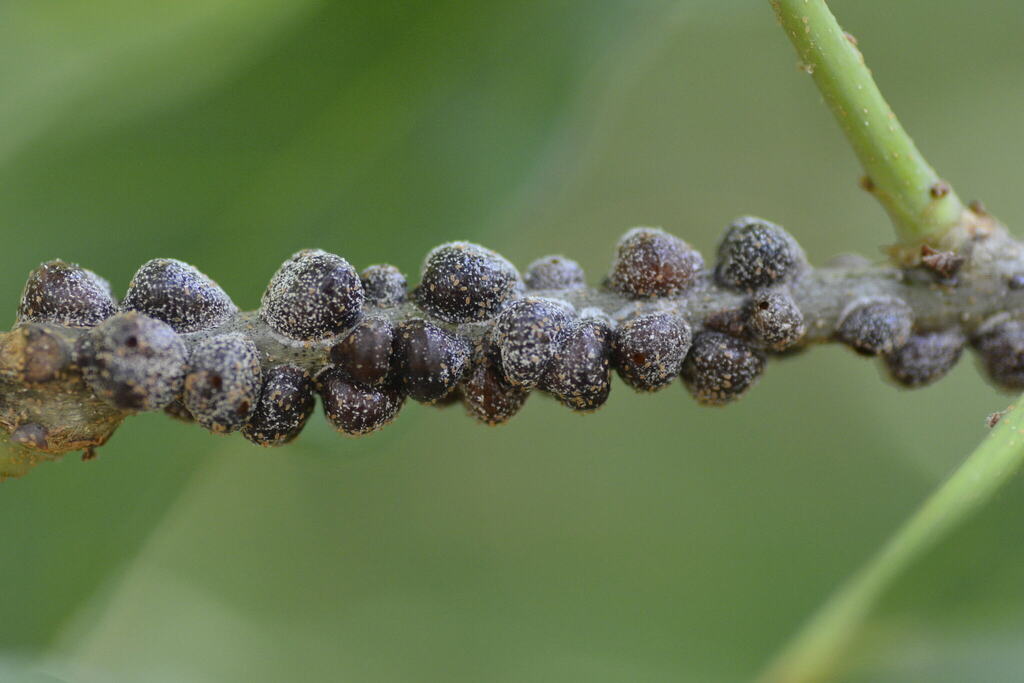
Oak Lecanium Scale
Parthenolecanium quercifex
Parthenolecanium quercifex, the oak lecanium scale, is a species of soft scale insect belonging to the family Coccidae within the order Hemiptera.
From the article Parthenolecanium quercifex on Wikipedia (CC BY-SA), quoted section by section
Description
Adult females have a hemispherical shape and measure 4–7 mm in length and 3–5 mm in width. They exhibit color variations of light to dark brown/gray, often featuring lateral humps on their back. The insect closely resembles other scale species, leading to uncertainty about its identity and the possible existence of a cryptic species complex.
Range & habitat
The species is prevalent in the eastern United States. It primarily infests oak trees but has been observed on other species, such as hickory and birch.
Wikipedia: “Distribution and habitat”
What it does
The oak lecanium scale undergoes one annual generation. Egg laying occurs in late May to June, and hatching takes place in June to early July. The egg count varies, influenced by multiple factors, with reports ranging from dozens to thousands per female. The young crawlers move to host plant leaves, where they feed on leaf undersides, mainly along the main veins, using piercing-sucking mouthparts. The initial instars are tiny, measuring less than 1 mm, and are pale yellow/brown. These insects molt into second instars in late summer/fall and return to woody tissues, such as host plant twigs, for overwintering. In spring, females grow and mature, adopting the distinctive hemispherical shape. Oak lecanium scales feed on tree and shrub phloem, causing issues such as stunted foliage, chlorosis, twig death, and dieback, primarily during April-May due to feeding female scales. Their feeding produces honeydew, which can lead to the growth of black sooty mold.
Wikipedia: “Ecology”
In human culture
The scientific name, Parthenolecanium quercifex, refers to the oak tree (Quercus) as its primary host.
Wikipedia: “Etymology”
Listen
Looking for field recordings…
Where it lives
Recorded sightings
—
geo-referenced records in GBIF, from museums, herbaria and field observers.
Drag the globe to turn it. Dots are where records exist, not a range map; darker means more records.
In the stacks
Searching the stacks…
Every page naming Parthenolecanium quercifex in the Biodiversity Heritage Library →
This page is assembled live from iNaturalist, GBIF, Wikipedia, the Source Library and the Internet Archive. It is not yet part of the hand-edited codex. iNaturalist taxon 551031.