- Plants
- ›Vascular Plants
- ›flowering plants
- ›Dicots
- ›Sunflowers, Bellflowers, Fanflowers, and Allies
- ›fanflower family
- ›Scaevola
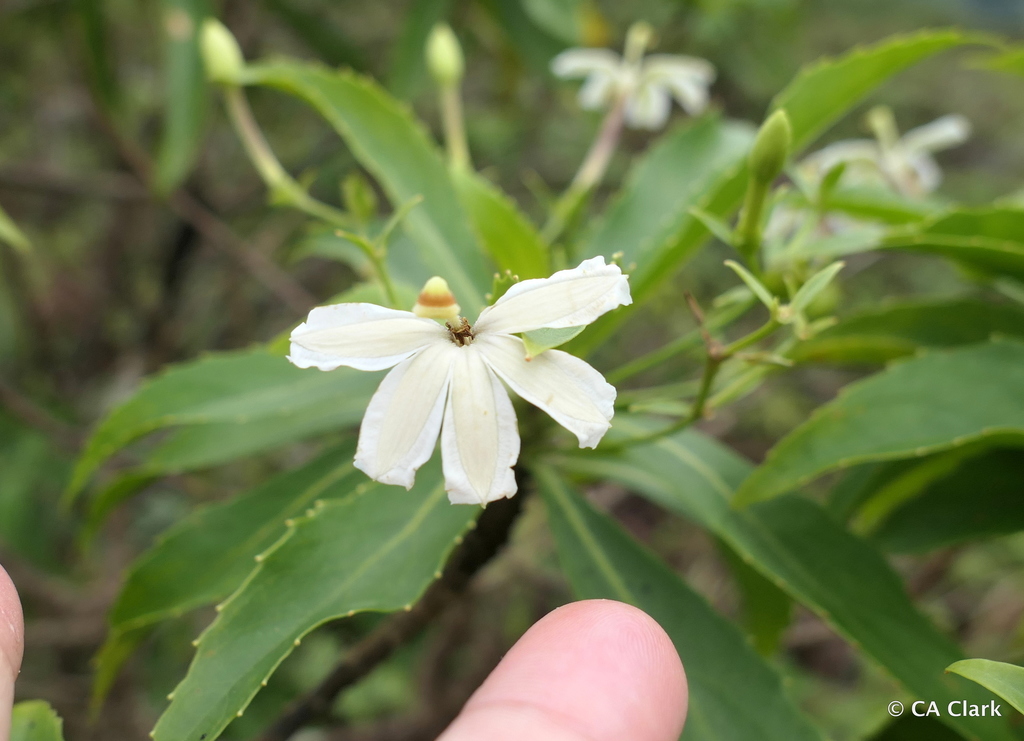
naupaka kuahiwi
Scaevola chamissoniana
Scaevola chamissoniana is a shrub in the family Goodeniaceae with a native range of the Hawaiian Islands, where it is known as the Mountain naupaka or Naupaka kuahiwi.
It is found in wet forests and open areas at elevations of about 1150 feet. It flowers yearround.
From the article Scaevola chamissoniana on Wikipedia (CC BY-SA), quoted section by section
Range & habitat
Naupaka flowers have 5 petals, spiral leaves, and have a single plane of bilateral symmetry. They belong to the subclass Asteridae and family Goodenia. They share many characteristics with many types of fanflower plants. There are eight species of Naupaka plants which are native to Hawaii. The two forms of the Naupaka never grow in the same place. The beach naupaka strictly grow in beach environments and are well adapted to grow with the heat from the sun and the salt spray from the ocean. The beach variations of Naupaka are pure white in color. The mountain naupaka needs to be high in elevation at a cooler and rainy area of the mountains. The mountain type of naupaka are all different shades of purple and violet. The beach and mountain Naupaka flower are exactly the same but also polar opposite in their habitat needs which is what makes it such a special plant.
Wikipedia: “Classification, distribution, and habitat”
What it does
The Napaka flowers bloom year round and sporadically. Naupaka flowers are primarily pollinated by native Hawaiian bees who are attracted to the flower’s distinct pistil due to the half shape of the flower structure. Beach naupaka relies on seeds dispersed by ocean currents and birds, allowing it to colonize coastal areas. Mountain naupaka depends on land-based animals and gravity to distribute its seeds within the mountain ecosystems. Both the beach and mountain naupaka have adapted their reproduction styles to their environment to ensure their long term survival.
Wikipedia: “Reproduction”
In human culture
There are two variations of the legend behind the Naupaka flower to explain why they have an incomplete appearance and why there is the beach naupaka vs the mountain naupaka that are the same flower but require different habitats and have different colors. The flower is named after a Hawaiian princess named Naupaka. She was in love with a commoner named Kaui. The two were not allowed to be together because of their class rankings. They ran away to find a kahuna (a Hawaiian priest, expert, secret keeper, or healer) to help them be together but he was unable to do anything for them. Naupaka was wearing a flower in her ear and out of sadness took it out, ripped it in half, and gave the other half to Kaui. She claimed that since the Gods wouldn’t allow the two to be together, she would live in the mountains and he would live down at the beach by the water. The next day, the naupaka plants started to grow everywhere between where the two were, between the shoreline and the top of the mountain. These plants would bloom in only half flowers which explains their fan-like shape. Another version of the legend says that in ancient times Pele, the Hawaiian Goddess of volcanoes and fire was jealous of these two young lovers and wanted to split them up. She eventually drove the man away into the mountains while the woman was stuck down on the beach. …
Wikipedia: “Cultural significance”
Where it lives
Recorded sightings
—
geo-referenced records in GBIF, from museums, herbaria and field observers.
Drag the globe to turn it. Dots are where records exist, not a range map; darker means more records.
In the stacks
Searching the stacks…
Every page naming Scaevola chamissoniana in the Biodiversity Heritage Library →
This page is assembled live from iNaturalist, GBIF, Wikipedia, the Source Library and the Internet Archive. It is not yet part of the hand-edited codex. iNaturalist taxon 54994.