- Plants
- ›Vascular Plants
- ›flowering plants
- ›Dicots
- ›Gentians, Dogbanes, Madders, and Allies
- ›Dogbane Family
- ›milkweeds
- ›Ceropegieae
- ›Stapeliads
- ›Stapelia
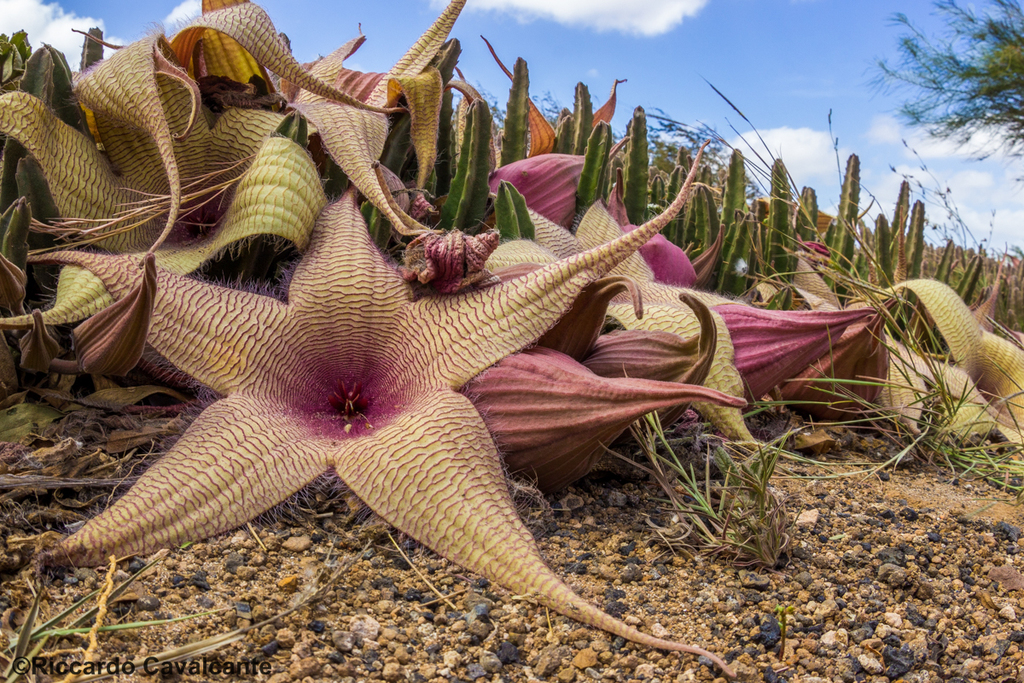
Zulu Giant
Stapelia gigantea
Stapelia gigantea is a species of flowering plant in the family Apocynaceae, native to south eastern Africa. Growing up to 20 cm (8 in) tall, it is a clump-forming succulent with erect green stems 3 cm (1 in) thick. In summer, it bears large star-shaped five-petalled flowers up to 25 cm (10 in) in diameter. The flowers are red and yellow, wrinkled, with a silky texture and fringed with hairs, that can be as long as 8 mm (0.3 in). They have the smell...
From the article Stapelia gigantea on Wikipedia (CC BY-SA), quoted section by section
Description
Growing up to 25 cm (10 in) tall, it is a clump-forming succulent plant with erect green four-angled stems 3 cm (1.2 in) thick. The flowers are large, up to 40 cm (16 in) wide, star-shaped, with five petals. The flowers are red and yellow, wrinkled, with a silky texture and fringed with hairs, that can be as long as 8 mm (0.3 in). They flower throughout the year, but most prolifically in late summer, between December and April in South Africa. The flowers have the smell of rotting flesh, in order to attract the flies which pollinate them. Scent compounds of carrion flowers responsible for their odour include diamines (putrescine and cadaverine), sulfur compounds and various phenolic molecules. Because of the foul odour of its flower, S. gigantea can act as an appetite suppressant in humans. There have been several proposed reasons for the size of the flowers of S. gigantea. First, it is possible that they are large to attract the flies that pollinate them. The large size and colour of the flowers combined with the carrion smell may cause the flies to behave as if it is a dead carcass and be more likely to visit it.
What it does
Stapelia gigantea grows in arid areas, often on sandy soil or rocky outcrops, and often with little other vegetation, though also sometimes in or even under open shubs. In South Africa, it occurs at altitudes from 325–1,100 m. S. gigantea can become an invasive plant when introduced in arid and semi-arid environments, although it has been found to facilitate the recruitment of nurse-dependent native taxa, those that require a suitable microhabitat created by another plant for successful germination, growth, and/or survival from impacts such as herbivory.
Wikipedia: “Ecology”
How it is grown
Since it does not tolerate temperatures below 10 °C (50 °F) for extended periods, this plant must be grown under glass in temperate zones. It has gained the Royal Horticultural Society's Award of Garden Merit. The cultivar 'Zulu Giant' is often grown.
Wikipedia: “Cultivation”
Where it lives
Recorded sightings
—
geo-referenced records in GBIF, from museums, herbaria and field observers.
Drag the globe to turn it. Dots are where records exist, not a range map; darker means more records.
In the stacks
Searching the stacks…
Every page naming Stapelia gigantea in the Biodiversity Heritage Library →
This page is assembled live from iNaturalist, GBIF, Wikipedia, the Source Library and the Internet Archive. It is not yet part of the hand-edited codex. iNaturalist taxon 54990.