- Plants
- ›Vascular Plants
- ›flowering plants
- ›Dicots
- ›begonias, gourds, and allies
- ›gourd family
- ›Sicyoeae
- ›Hodgsonia
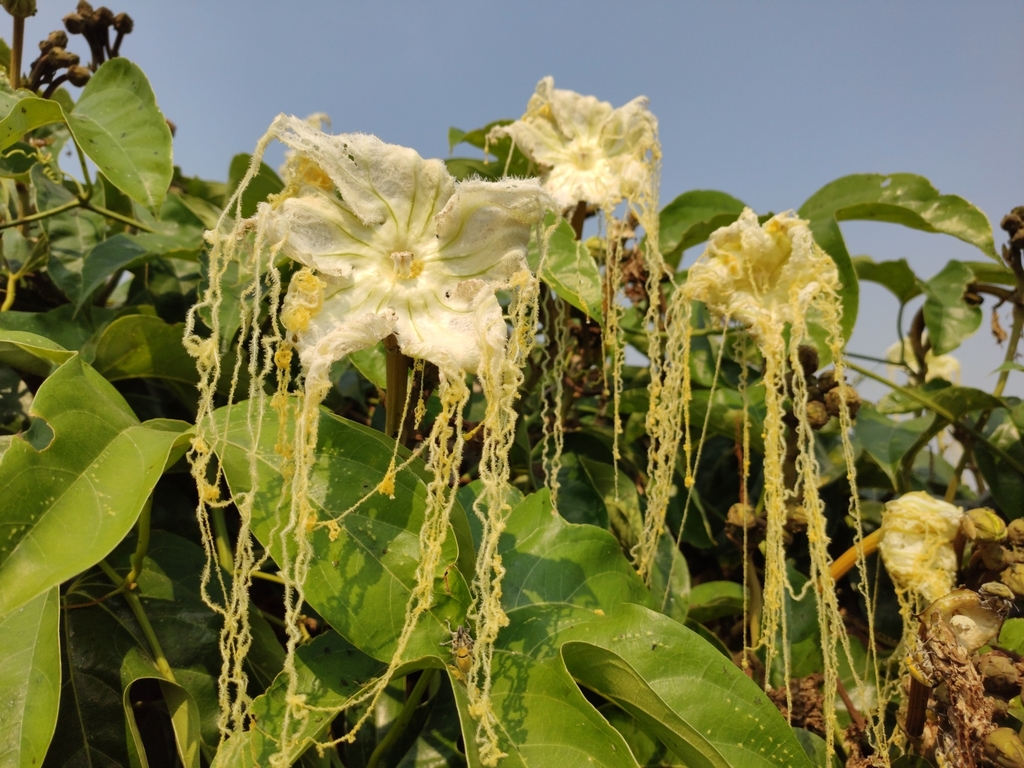
Lard Seed
Hodgsonia macrocarpa
Hodgsonia is a small genus of fruit-bearing vines in the family Cucurbitaceae.
Hodgsonia was named after Brian Houghton Hodgson in 1853 by the British botanists Joseph Dalton Hooker and Thomas Thomson, who examined the plant under Hodgson's hospitality in the Himalaya.
From the article Hodgsonia on Wikipedia (CC BY-SA), quoted section by section
At the table
Although the flesh of Hodgsonia fruit is inedible and considered worthless, the large, oil-rich seeds are an important source of food. The kernels are occasionally eaten raw; they are slightly bitter, possibly due to an unidentified alkaloid or glucoside, but "perfectly safe" to eat. More commonly, the seeds are roasted, after which they taste like pork scraps or lard; many mountain peoples consider these roasted seeds a delicacy. In addition to eating the seeds alone, the Naga incorporate them into various types of curry. The Karbi Community of North East India cultivate it in their backyard gardens and consume it as a side dish during a meal. They call it Hanthar Athe.
Wikipedia: “Food”
In medicine
The medicinal importance of Hodgsonia is mostly in its leaves. In Malaya and java, native physicians report several uses for the nose. The leaves may be dried and burnt, and the smoke inhaled, or the juice of young stems and leaves is squeezed into the nostrils to allay irritation from small insects. The leaves are also boiled and the resulting liquid taken internally, both for nose complaints and to reduce fevers. The ashes from burnt leaves of H. macrocarpa are also used to heal wounds. In Nagaland, the fruit bulb is applied to bacterial infections in the feet. In Sarawak, Hodgsonia oil is used to anoint the bodies of mothers after childbirth; it also forms the base of embrocations carrying ashes from the leaves of coconut palm and Kaempferia. The oil is also used as a base for medicines in Eastern India.
Wikipedia: “Medicine”
Where it lives
Recorded sightings
—
geo-referenced records in GBIF, from museums, herbaria and field observers.
Drag the globe to turn it. Dots are where records exist, not a range map; darker means more records.
In the stacks
Searching the stacks…
Every page naming Hodgsonia macrocarpa in the Biodiversity Heritage Library →
This page is assembled live from iNaturalist, GBIF, Wikipedia, the Source Library and the Internet Archive. It is not yet part of the hand-edited codex. iNaturalist taxon 549364.