- Plants
- ›Vascular Plants
- ›flowering plants
- ›Dicots
- ›Legumes, Milkworts, and Allies
- ›Legumes
- ›Faboideae
- ›brooms, lupines, and allies
- ›Lupinus
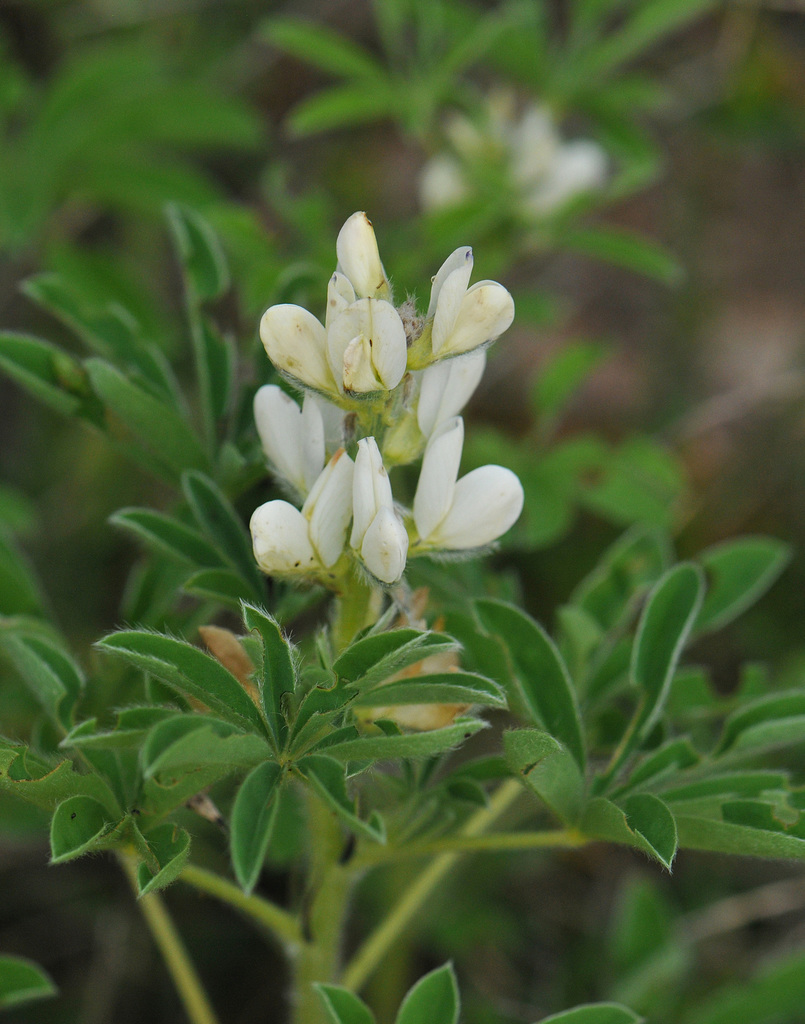
white lupine
Lupinus albus
Lupinus albus, commonly known as the white lupin, is a species of the genus Lupinus in the family Fabaceae native to the northeastern Mediterranean region. It is also a traditional pulse cultivated across the Mediterranean region and elsewhere.
From the article Lupinus albus on Wikipedia (CC BY-SA), quoted section by section
Description
The white lupin is an annual, more or less pubescent plant that typically reaches 30 to 120 cm in height. It grows naturally throughout the Balkans, the island of Sicily, and Turkey, and is also widely naturalised across the Mediterranean region including North Africa, in Europe north to Great Britain, Germany, the Baltic States and western Russia, and also in the Indian subcontinent. Naturalised populations are also known in Australia and Chile. It is found in meadows, pastures, and grassy slopes on both sandy and acidic soil. The white lupin is cultivated throughout the Mediterranean region and in Egypt, Sudan, Ethiopia, Syria, Europe, South America, and tropical and southern Africa. The ancient cultivation of white lupin under the local name hanchcoly was practiced until recently in western Georgia. It is also sometimes known in cultivation as "field lupin", though this name is imprecise, having been applied to several species in the genus. White lupin is distinct within the large and polymorphous genus Lupinus for a small variation of morphological characteristics. However, the species has wide, intraspecific variability in physiological plant properties; the duration of vernalisation time and growth rate, photoperiodic sensitivity, shape tolerance, drought resistance, and cold- and winter-hardiness. There are winter and spring forms of white lupin. …
At the table
The beginning of lupin cultivation in the Old World is sometimes associated with Ancient Egypt. It is more likely, however, that white lupin was originally introduced into cultivation in ancient Greece, where its greatest biodiversity was concentrated and where wild-growing forms have been preserved until today (ssp. graecus). On the Balkan Peninsula, representatives of another subspecies of white lupin (ssp. termis and ssp. albus) turned wild and now grow in natural environments. Also, the Grecian genesis of cultivated lupin may be testified by lupin's Greek name thermos, which translates roughly to "hot". White lupin dispersed from Greece to adjacent regions and states over time, particularly Egypt and Ancient Rome. The forms of lupin with white seeds and pink-and-blue or light-pink flowers (L. termis) spread mainly towards the south (Egypt, Libya, and Palestine), while the forms with white seeds and grayish-blue or white flowers (L. albus) moved to the west (Apennine Peninsula and beyond). According to Zohary and Hopf, "even today the white lupin is an appreciated food crop and it is still cultivated in some Mediterranean countries—particularly Egypt." In Greece, especially on the island of Crete and in the Peloponnese area, lupin seeds are a very common snack during Lent. They are normally soaked in seawater for 2–3 hours to mellow the flavour and are then consumed raw. …
Wikipedia: “History and modern uses”
How it is grown
Since ancient times, white lupin has been widespread in the Mediterranean region and in the Middle East due to its high tolerance for acidic soils and its soil-restoration abilities. It tolerates a soil acidity up to pH = 6.5, while alkaline or organic soils are not suitable for growth. The soil must be well drained and loose because lupin is subject to root asphyxia. White lupin flourishes in the same climate zones as maize, although lupin, except at the beginning of the growing season, requires little water thanks to its long tap root.
Sowing. In hotter climate zones, such as in Italy, sowing occurs following plowing in October–November in order to bury the stubble of the previous crop (often a cereal.) Due to its branched structure, lupin can adapt to different sowing densities, compensating for a lower density with a higher branch growth. In colder zones where lupin cannot survive the winter, white lupin is sowed in the spring, typically between March and April. The soil must be prepared as soon as possible after the last frost of the winter. The seedbed must be sufficiently fine, particularly in organic farming where mechanical weeding is done (so that harrowing the displacement of clods does not harm the plants). …
Wikipedia: “Cultivation”
Where it lives
Recorded sightings
—
geo-referenced records in GBIF, from museums, herbaria and field observers.
Drag the globe to turn it. Dots are where records exist, not a range map; darker means more records.
In the old herbals & bestiaries

In the stacks
Searching the stacks…
Every page naming Lupinus albus in the Biodiversity Heritage Library →
This page is assembled live from iNaturalist, GBIF, Wikipedia, the Source Library and the Internet Archive. It is not yet part of the hand-edited codex. iNaturalist taxon 54906.