- Animals
- ›Chordates
- ›Vertebrates
- ›Mammals
- ›Therians
- ›Placental Mammals
- ›Primates, Rodents, and Allies
- ›Primates
- ›Monkeys, Apes, and Tarsiers
- ›Monkeys and Apes
- ›Apes and Old World Monkeys
- ›Old World Monkeys
- ›Cercopithecines
- ›Baboons, Macaques, and Mangabeys
- ›Macaca
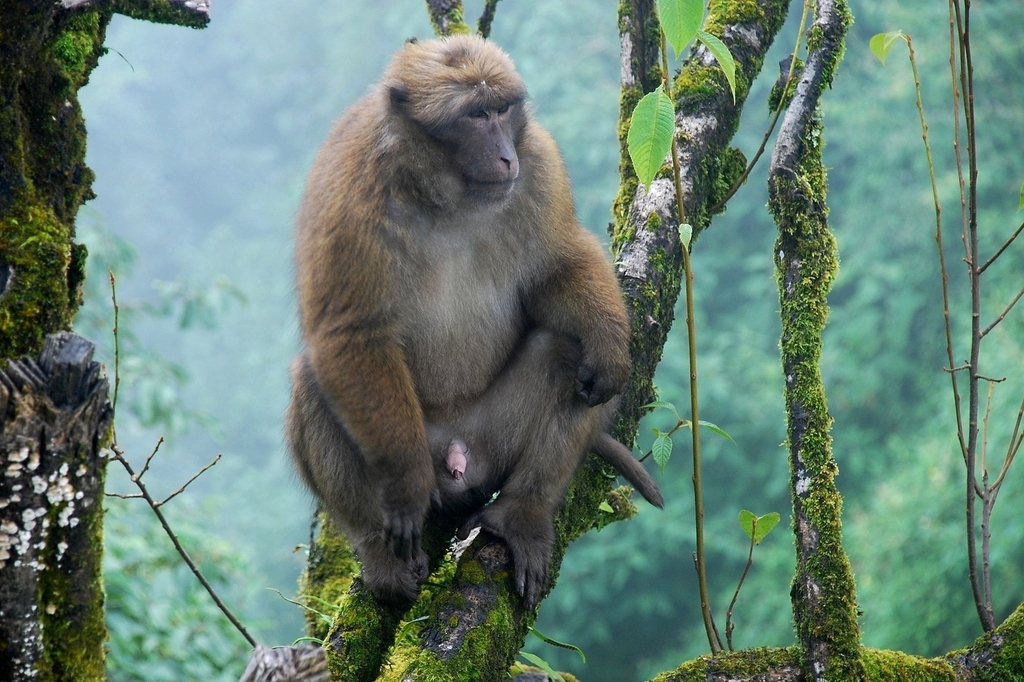
Arunachal Macaque
Macaca munzala
The Arunachal macaque (Macaca munzala), a relatively large brown primate with a comparatively short tail, is a macaque native to Arunachal Pradesh in northeastern India. Its species name comes from munzala ("monkey of the deep forest") as it was called by the Dirang Monpa tribe. It was discovered as a new taxon in 1997 by the noted Indian primatologist Anwaruddin Choudhury, but he thought it to be a new subspecies of Tibetan (or Père David's) macaque....
From the article Arunachal macaque on Wikipedia (CC BY-SA), quoted section by section
Description
The Arunachal macaque is compactly built and has a very dark face. It lives at high altitudes, between 2000 m and 3500 m above sea level, making it one of the highest-dwelling primates. It belongs to the M. sinica species-group of macaques, along with the Assamese macaque (M. assamensis), the Tibetan macaque, the bonnet macaque (M. radiata) and the toque macaque (M. sinica). The Arunachal macaque is apparently physically similar to the Assam and Tibetan macaques, while genetically closely related to the bonnet macaque of southern India. This is probably the result of convergent evolution, where organisms evolve similar physical features due to similar environmental selection pressure, while genetically they may have different origins. Kumar et al. (2008) and Sinha et al. (2006) report at least 569 individuals in thirty-five troops; thirty-two troops in Tawang and three troops in West Kameng. The monkey is severely persecuted in some parts of its known distribution by locals retaliating against crop raiding.
Listen
Looking for field recordings…
Where it lives
Recorded sightings
—
geo-referenced records in GBIF, from museums, herbaria and field observers.
Drag the globe to turn it. Dots are where records exist, not a range map; darker means more records.
In the stacks
Searching the stacks…
Every page naming Macaca munzala in the Biodiversity Heritage Library →
This page is assembled live from iNaturalist, GBIF, Wikipedia, the Source Library and the Internet Archive. It is not yet part of the hand-edited codex. iNaturalist taxon 54866.