- Plants
- ›Vascular Plants
- ›flowering plants
- ›Dicots
- ›Roses, Elms, Figs, and Allies
- ›elm family
- ›Ulmus
- ›Ulmus
- ›Ulmus
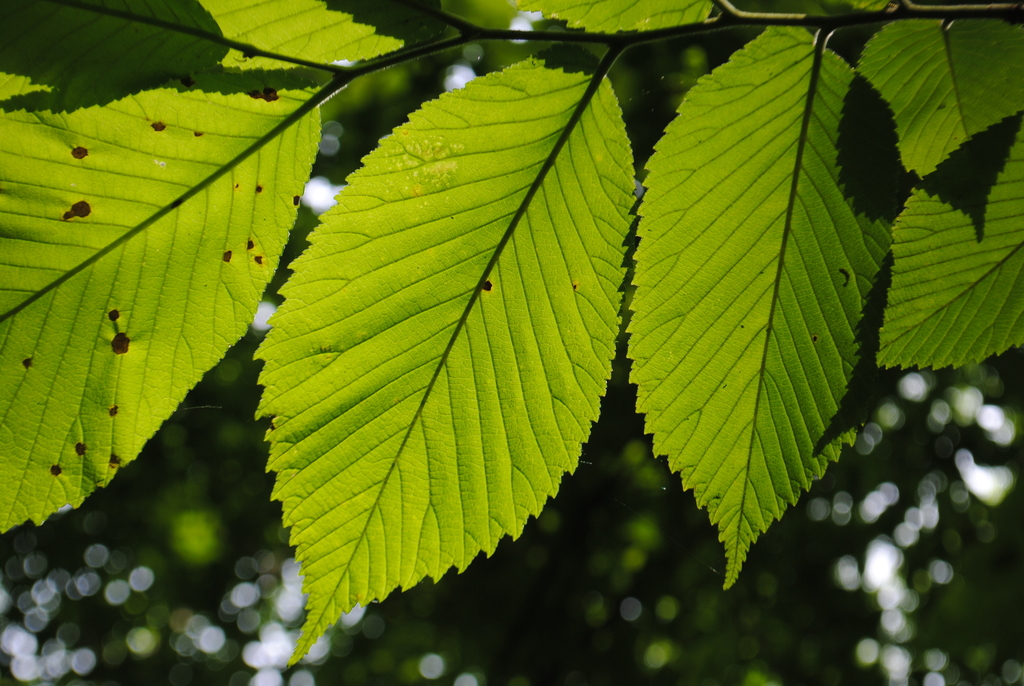
slippery elm
Ulmus rubra
Ulmus rubra, the slippery elm, is a species of elm native to eastern North America, ranging from southeast North Dakota, east to Maine and southern Quebec, south to northernmost Florida, and west to eastern Texas, where it thrives in moist uplands, although it will also grow in dry, intermediate soils. Other common names include red elm, gray elm, soft elm, moose elm, and Indian elm. The tree was first named as part of Ulmus americana in
From the article Ulmus rubra on Wikipedia (CC BY-SA), quoted section by section
Description
Ulmus rubra is a medium-sized deciduous tree with a spreading head of branches, commonly growing to 12–19 metres (39–62 feet), very occasionally over 30 m (98 ft) in height. Its heartwood is reddish-brown. The broad oblong to obovate leaves are 10–20 centimetres (4–8 inches) long, rough above but velvety below, with coarse double-serrate margins, acuminate apices and oblique bases; the petioles are 6–12 millimetres (1⁄4–15⁄32 in) long. The leaves are often tinged red on emergence, turning dark green by summer and a dull yellow in autumn. The perfect, apetalous, wind-pollinated flowers are produced before the leaves in early spring, usually in tight, short-stalked, clusters of 10–20. The reddish-brown fruit is an oval winged samara, orbicular to obovate, slightly notched at the top, 12–18 mm (15⁄32–23⁄32 in) long, the single, central seed coated with red-brown hairs, naked elsewhere.
The species superficially resembles American elm (Ulmus americana), but is chiefly distinguished from American elm by its downy twigs, chestnut brown or reddish hairy buds, and slimy red inner bark.
Range & habitat
The species is native to eastern North America, ranging from southeast North Dakota, east to Maine and southern Quebec, south to northernmost Florida, and west to eastern Texas, where it thrives in moist uplands, although it will also grow in dry, intermediate soils.
Wikipedia: “Distribution and habitat”
At the table
The mucilaginous inner bark of the tree is edible raw or boiled, and was eaten by Native Americans. The bark can also be used to make tea.
Wikipedia: “Food”
In medicine
The inner bark is used orally in folk medicine to treat sore throat and gastrointestinal upset, and topically for skin rash and irritation. The inner bark has long been used as a demulcent, and is still marketed commercially for this purpose in the United States as an over-the-counter demulcent. The leaves may be dried and ground into a powder, then made into a tea.
Wikipedia: “Folk medicine”
How it is grown
The species has seldom been planted for ornament in its native country, though it occasionally appeared in early 20th-century US nursery catalogues. Introduced to Europe in 1830, and later to Australasia, it has never thrived in the UK; Elwes & Henry knew of not one good specimen, and the last tree planted at Kew attained a height of only 12 m (39 ft) in 60 years. Specimens supplied by the Späth nursery of Berlin to the Royal Botanic Garden Edinburgh in 1902 as U. fulva may survive in Edinburgh as it was the practice of the Garden to distribute trees about the city (vide Wentworth Elm). A specimen at RBGE was felled c.1990. The current list of Living Accessions held in the Garden per se does not list the plant. The tree was propagated and marketed in the UK by the Hillier & Sons nursery, Winchester, Hampshire, from 1945, with 20 sold in the period 1970 to 1976, when production ceased. Several mature trees survive in Brighton (see Accessions).
Wikipedia: “Cultivation”
In human culture
The specific epithet rubra (red), and the common name 'red elm', allude to the tree's reddish-brown heartwood, whilst the common name 'slippery elm' alludes to the mucilaginous inner bark.
Wikipedia: “Etymology”
Where it lives
Recorded sightings
—
geo-referenced records in GBIF, from museums, herbaria and field observers.
Drag the globe to turn it. Dots are where records exist, not a range map; darker means more records.
In the stacks
Searching the stacks…
Every page naming Ulmus rubra in the Biodiversity Heritage Library →
This page is assembled live from iNaturalist, GBIF, Wikipedia, the Source Library and the Internet Archive. It is not yet part of the hand-edited codex. iNaturalist taxon 54860.