- Plants
- ›Vascular Plants
- ›flowering plants
- ›Dicots
- ›Nances, Willows, and Allies
- ›willow family
- ›Salix
- ›Vetrix
- ›Helix
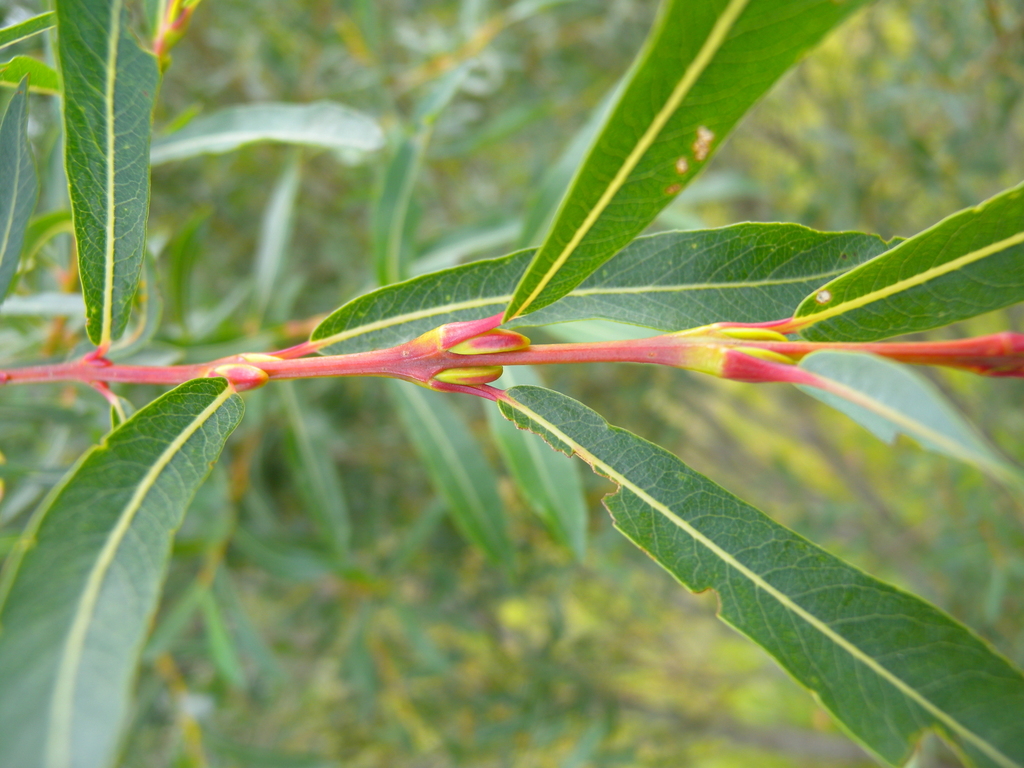
Purple Willow
Salix purpurea
Salix purpurea, known in Britain as purple willow, is a shrub or small tree native to Europe, western Asia and northwest Africa. It has been introduced to many other parts of the world as an ornamental garden plant, and it is widely used in basket making. Within its native range and some places where it is naturalised it is found in wetlands such as lake margins and the floodplains of rivers.
From the article Salix purpurea on Wikipedia (CC BY-SA), quoted section by section
Description
Purple willow is a dioecious shrub or small tree up to about 5 m tall, usually with numerous stems. The bark is greyish and smooth, with a bitter taste. The vegetative parts of the plant are all glabrous. The twigs and young branches are terete and flexible, often yellowish or tinged with purple. The leaves are - unusually, for a willow - opposite or almost opposite and narrowly oblong in shape, with a pointed tip, ranging from 2 cm to about 10 cm long. In bud, each leaf is covered by a single scale. They are a characteristically dull, pale green when fresh, turning black if the stems are harvested. The margins are entire or slightly serrated towards the tip. The petioles are very short and the stipules usually fall early.
Catkins appear before the leaves in the spring, and have either male or female flowers (on separate plants). They are narrowly cylindrical and usually held upright, about 3 cm long by 0.5 cm wide. Each catkin is typically subtended by 2 or 3 small bracts. The rhachis is densely hairy, as are the black catkin scales, which are bracteoles subtending each flower. The perianth (sepals and petals) is reduced to 1-2 tiny nectaries. The male catkins have flowers with 2 long stamens, exceeding the scales, and red anthers which open at maturity to reveal bright yellow pollen; the female ones have 2 bifid stigmas on a very short style. …
Range & habitat
The native range is southern Europe and north Africa, extending as far north as Denmark and eastwards to Turkey and the Baltic states. It is only just in western Russia: plants further east are a different species in the Salix purpurea group. Britain may be at the northern edge of its range, or it might be introduced there, as it is thought to be in Scandinavia. It has also been introduced into many other parts of the world, mostly as an ornamental plant. It is naturalised in wetlands in North America. Its altitudinal range is from sea level to 1,400 m in Britain, to 2,000 m in the Alps and the Pyrenees, and as high as 2,500 m at the southern edge of its range, in the Atlas mountains. Its status globally and in Britain is LC (least concern). In most counties in Britain it is considered an axiophyte because it is restricted to wetlands with a high conservation value, whether it is native there or not.
Wikipedia: “Distribution and status”
What it does
Within its native range of southern Europe and north Africa, purple willow is most characteristic of the EUNIS habitat F9.122 Western Mediterranean purple willow scrub, which comprises stands of purple, olive- and almond willow lining watercourses. It is also found in riverside scrub in Britain and northern France. In Britain this is classified as W6 Salix fragilis woodland. Here it could possibly be native or is more likely to have been planted, as osier beds were often cultivated within floodplains. Another native habitat for it is beside lakes such as the ancient glacial lakes of the Meres and Mosses region of the Shropshire-Cheshire plain. Here it grows in grey willow carr, sometimes in standing water, and is considered an indicator of ancient woodland. In France its habitat is very similar.
Its Ellenberg-type indicator values are L=8, F=8, R=8, N=5 and S=0, which show that it has a preference for bright sunlight, very wet conditions, base-rich water, low fertility and no salinity. There are many organisms associated with purple willow. The Plant Parasites of Europe website lists 247 species, of which 209 are insects, 25 fungi, 12 mites and one a single-celled organism. …
Wikipedia: “Habitat and ecology”
At the table
Purple willow has long been used for basket making and is still harvested for that purpose, when it is often known as "Brittany Green" willow, valued for its purple colour and evenly-sized stems (i.e. remaining the same thickness along its length). Willow beds were often planted with a variety of plants: the British botanist Charles Sinker documented a withy bed at Crew Green in Wales which contained five species and three hybrids. The weeping cultivar 'Pendula' has gained the Royal Horticultural Society's Award of Garden Merit. As with several other willows, the shoots, called withies, are often used in basketry. The wood of this and other willow species is used in making cricket bats. The Roman herbalist Dioscorides had many uses for iter (willow): taken with pepper and wine it would help people with intestinal obstruction, or effect birth control, and the juice of the leaves (with other ingredients) would help sores in the ears. The bark, when burned and mixed with vinegar, would take away calluses and corns. Culpeper suggested that the boughs of willow, stuck about a chamber, would refresh those who had fevers. More recent herbalists have had less use for willow. Mrs Grieve did not mention purple willow at all. This could be because the effects of consumption can include gastrointestinal bleeding and kidney damage, and just eating the leaves can cause severe abdominal pain.
Wikipedia: “Uses”
Where it lives
Recorded sightings
—
geo-referenced records in GBIF, from museums, herbaria and field observers.
Drag the globe to turn it. Dots are where records exist, not a range map; darker means more records.
In the stacks
Searching the stacks…
Every page naming Salix purpurea in the Biodiversity Heritage Library →
This page is assembled live from iNaturalist, GBIF, Wikipedia, the Source Library and the Internet Archive. It is not yet part of the hand-edited codex. iNaturalist taxon 54849.