- Plants
- ›Vascular Plants
- ›flowering plants
- ›Dicots
- ›Nances, Willows, and Allies
- ›willow family
- ›Salix
- ›Vetrix
- ›Cinerella
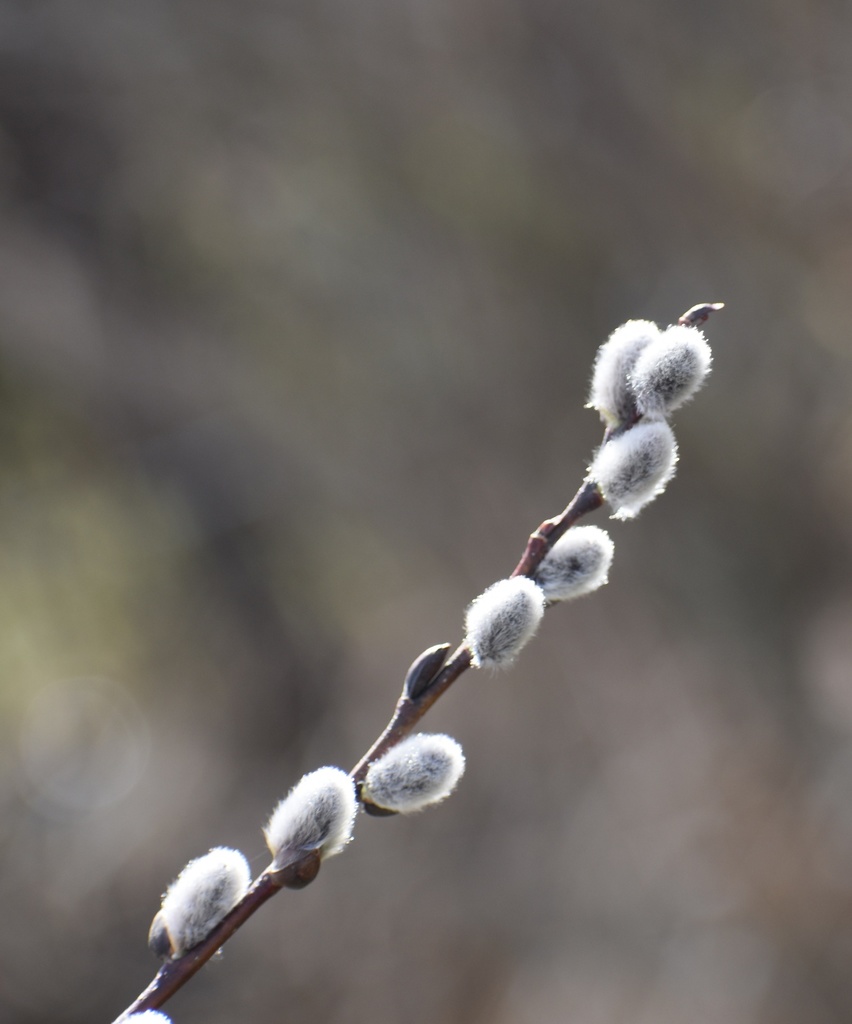
pussy willow
Salix discolor
Salix discolor, the American pussy willow or glaucous willow, is a species of willow native to North America, one of two species commonly called pussy willow.
It is native to the vast reaches of Alaska as well as the northern forests and wetlands of Canada (British Columbia east to Newfoundland), and is also found in the northern portions of the contiguous United States (Washington east to Maine, and south to Maryland).
From the article Salix discolor on Wikipedia (CC BY-SA), quoted section by section
What it does
Male flowers provide pollen for bees, and it is a popular larval host, supporting the Acadian hairstreak, black-waved flannel moth, cecropia moth, Compton's tortoiseshell, cynthia moth, dreamy duskywing, eastern tiger swallowtail, elm sphinx, imperial moth, Io moth, modest sphinx, mourning cloak, polyphemus moth, promethea moth, red-spotted purple, small-eyed sphinx, twin-spotted sphinx, and viceroy.
== References ==
Wikipedia: “Ecology”
At the table
Like other willows, it contains salicin, and was used by Native Americans as a painkiller. As with the closely related Salix caprea (European pussy willow), it is also often grown for cut flowers. The flowering shoots are used for spring religious decoration on Palm Sunday, as a replacement for palm branches, which do not grow in much of North America. Various Eastern European peoples carry pussy willows on Palm Sunday instead of palm branches. This custom was brought to North America by Ukrainian Orthodox Church, Romanian Orthodox, Russian Orthodox, Ruthenian Catholic, Ukrainian Catholic, Kashubian Catholic and Polish Catholic émigrés. Sometimes, on Palm Sunday, they will bless both palms and pussy willows in church. The branches will often be preserved throughout the year in the family's icon corner. Pussy willow also plays a prominent role in Polish Dyngus Day (Easter Monday) observances, continued also among Polish-Americans.
Wikipedia: “Cultivation and uses”
Where it lives
Recorded sightings
—
geo-referenced records in GBIF, from museums, herbaria and field observers.
Drag the globe to turn it. Dots are where records exist, not a range map; darker means more records.
In the stacks
Searching the stacks…
Every page naming Salix discolor in the Biodiversity Heritage Library →
This page is assembled live from iNaturalist, GBIF, Wikipedia, the Source Library and the Internet Archive. It is not yet part of the hand-edited codex. iNaturalist taxon 54844.