- Plants
- ›Vascular Plants
- ›flowering plants
- ›Dicots
- ›Mints, Plantains, Olives, and Allies
- ›olive family
- ›Fraxinus
- ›Fraxinus
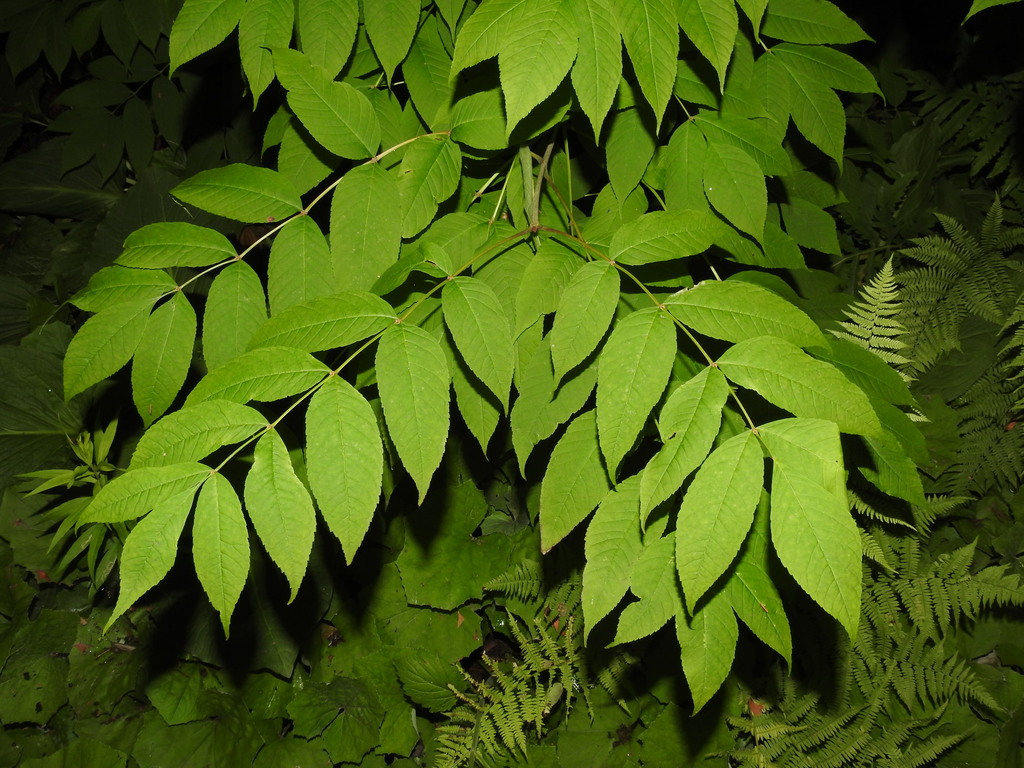
black ash
Fraxinus nigra
Fraxinus nigra, or the black ash, is a species of ash native to much of eastern Canada and the northeastern United States, from western Newfoundland west to southeastern Manitoba, and south to Illinois and northern Virginia. Formerly abundant, as of 2017 the species is threatened with near total extirpation throughout its range within the next century as a result of infestation by an invasive parasitic insect known as the emerald ash borer (Agrilus planipennis).
From the article Fraxinus nigra on Wikipedia (CC BY-SA), quoted section by section
Description
Black ash is a medium-sized deciduous tree reaching 15–20 metres (49–66 ft) (exceptionally 26 metres (85 ft)) tall with a trunk up to 60 cm (24 inches) diameter, or exceptionally to 160 cm (63 inches). The bark is grey, thick and corky even on young trees, becoming scaly and fissured with age. The winter buds are dark brown to blackish, with a velvety texture. The leaves are opposite, pinnately compound, with 7–13 (most often 9) leaflets; each leaf is 20–45 cm (8–18 in) long, the leaflets 7–16 cm (2+3⁄4–6+1⁄4 in) long and 2.5–5 cm (1–2 in) broad, with a finely toothed margin. The leaflets are sessile, directly attached to the rachis without a petiolule. The flowers are produced in spring shortly before the new leaves, in loose panicles; they are inconspicuous with no petals, and are wind-pollinated. The fruit is a samara 2.5–4.5 cm (1–1+3⁄4 in) long comprising a single seed 2 cm (3⁄4 in) long with an elongated apical wing 1.5–2 cm (5⁄8–3⁄4 in) long and 6–8 mm (1⁄4–5⁄16 in) broad.
What it does
Black ash commonly occurs in swamps, often with the closely related green ash. Its fall foliage is yellow. Black ash is one of the first trees to lose its leaves in the fall. It is very closely related to Manchurian ash, and will easily hybridize with it. Some consider the two to be geographic isolates of each other. The species was considered abundant and its survival of little concern prior to the invasion of the emerald ash borer, first detected in North America in 2002. However, since that time this invasive insect has spread throughout most of the tree's range, and within a few years black ash is expected to be all but extirpated; a similar fate awaits green ash. In 2014, a U.S. Forest Service agent estimated that "ninety-nine percent of the ashes in North America are probably going to die." Blue ash and white ash are only slightly less affected. Some populations in the northern part of its range may persist, where they see winter temperatures low enough to kill or significantly reduce the population of the emerald ash borer. Due to the ongoing decline of black ash in eastern Canada due to emerald ash borer, among other threats, the species was assessed by COSEWIC as threatened in 2018. Likewise, black ash was previously listed as threatened under the Nova Scotia Endangered Species Act in 2013.
Wikipedia: “Ecology and conservation status”
Where it lives
Recorded sightings
—
geo-referenced records in GBIF, from museums, herbaria and field observers.
Drag the globe to turn it. Dots are where records exist, not a range map; darker means more records.
In the stacks
Searching the stacks…
Every page naming Fraxinus nigra in the Biodiversity Heritage Library →
This page is assembled live from iNaturalist, GBIF, Wikipedia, the Source Library and the Internet Archive. It is not yet part of the hand-edited codex. iNaturalist taxon 54807.