- Plants
- ›Vascular Plants
- ›flowering plants
- ›Dicots
- ›beeches, oaks, walnuts, and allies
- ›beech family
- ›Quercus
- ›Quercus
- ›Quercus
- ›Prinoideae
- ›Quercus prinoides
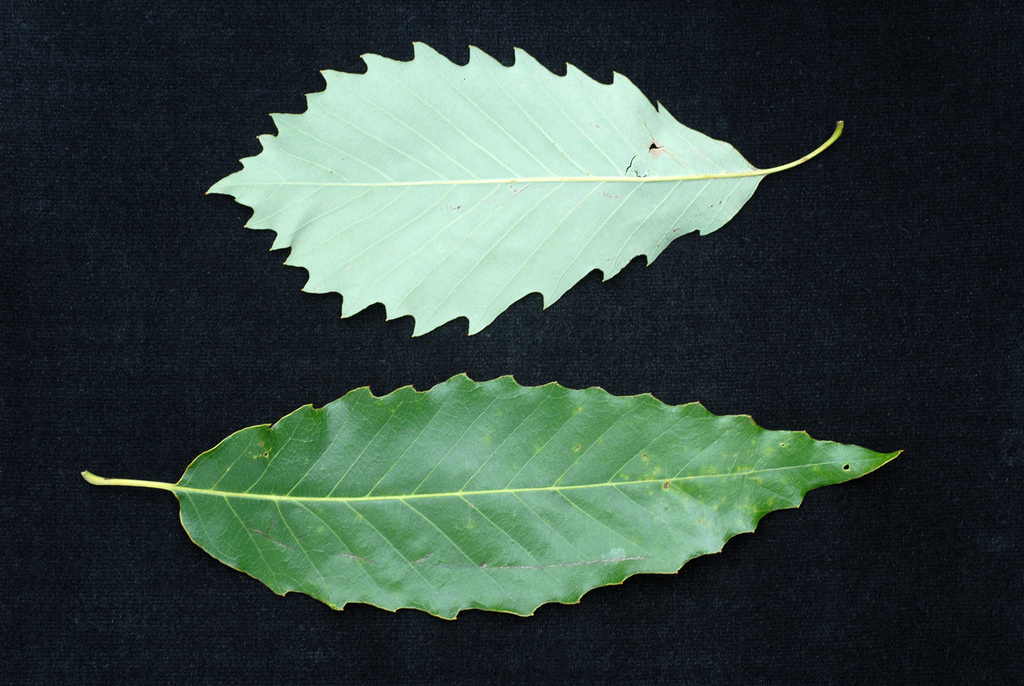
chinkapin oak
Quercus muehlenbergii
Quercus muehlenbergii, the chinquapin (or chinkapin) oak, is a deciduous species of tree in the white oak group (Quercus sect. Quercus). The species was often called Quercus acuminata in older literature. Quercus muehlenbergii (often misspelled as muhlenbergii) is native to eastern and central North America. It ranges from Vermont to Minnesota, south to the Florida panhandle, and west to New Mexico in the United States. In Canada it is only found in southern Ontario, and in Mexico it ranges from Coahuila south to Hidalgo.
From the article Quercus muehlenbergii on Wikipedia (CC BY-SA), quoted section by section
Description
Chinquapin oak is monoecious in flowering habit; flowers emerge in April to late May or early June. The staminate flowers are borne in catkins that develop from the leaf axils of the previous year, and the pistillate flowers develop from the axils of the current year's leaves. The fruit, an acorn or nut, is borne singly or in pairs, matures in one year, and ripens in September or October. About half of the acorn is enclosed in a thin cup and is chestnut brown to nearly black.
Chinquapin oak is closely related to the smaller but generally similar dwarf chinquapin oak (Quercus prinoides). Chinquapin oak is usually a tree, but occasionally shrubby, while dwarf chinquapin oak is a low-growing, clone-forming shrub. The two species generally occur in different habitats: chinquapin oak is typically found on calcareous soils and rocky slopes, while dwarf chinquapin oak is usually found on acidic substrates, primarily sand or sandy soils, and also dry shales. Chinquapin oak is also sometimes confused with the related chestnut oak (Quercus montana), which it closely resembles. However, unlike the pointed teeth on the leaves of the chinquapin oak, chestnut oak leaves generally have rounded teeth. The two species have contrasting kinds of bark: chinquapin oak has a gray, flaky bark very similar to that of white oak (Q. …
At the table
Like that of other white oak species, the wood of the chinquapin oak is a durable hardwood prized for many types of construction. The chinquapin oak is especially known for its sweet and palatable acorns. The nuts contained inside of the thin shell are among the sweetest of any oak, with an excellent taste even when eaten raw, providing an excellent source of food for both wildlife and people. The acorns are eaten by squirrels, mice, voles, chipmunks, deer, turkey, and other birds.
== References ==
Wikipedia: “Uses”
Where it lives
Recorded sightings
—
geo-referenced records in GBIF, from museums, herbaria and field observers.
Drag the globe to turn it. Dots are where records exist, not a range map; darker means more records.
In the stacks
Searching the stacks…
Every page naming Quercus muehlenbergii in the Biodiversity Heritage Library →
This page is assembled live from iNaturalist, GBIF, Wikipedia, the Source Library and the Internet Archive. It is not yet part of the hand-edited codex. iNaturalist taxon 54783.