- Plants
- ›Vascular Plants
- ›flowering plants
- ›Dicots
- ›dogwoods, hydrangeas, and allies
- ›Dogwood family
- ›Cornus
- ›Cynoxylon
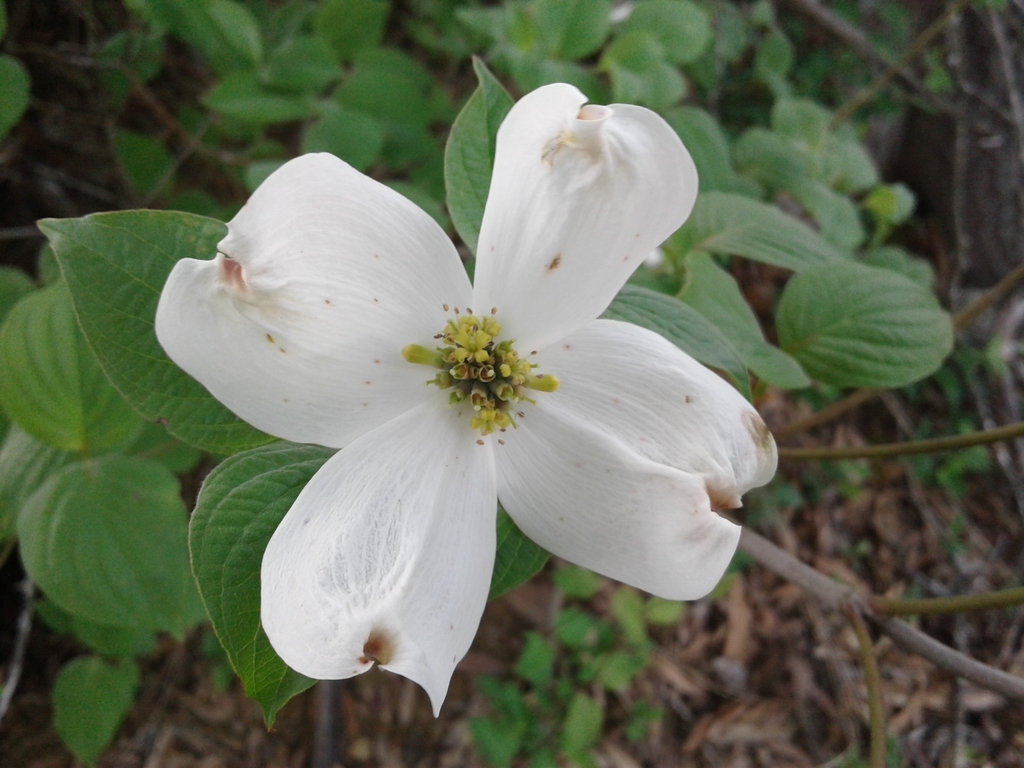
flowering dogwood
Cornus florida
Cornus florida, the flowering dogwood or American dogwood, is a species of flowering tree in the family Cornaceae native to eastern North America and northern Mexico. An endemic population once spanned from southernmost coastal Maine south to northern Florida and west to the Mississippi River. The tree is commonly planted as an ornamental in residential and public areas because of its showy bracts and interesting bark structure.
From the article Cornus florida on Wikipedia (CC BY-SA), quoted section by section
Description
Flowering dogwood is a small deciduous tree growing to 10 m (33 ft) high, often wider than it is tall when mature, with a trunk diameter of up to 30 cm (1 ft). A 10-year-old tree will stand about 5 m (16 ft) tall. The leaves are opposite, simple, ovate, 6–13 cm (2.4–5.1 in) long and 4–6 cm (1.6–2.4 in) broad, with an apparently entire margin (actually very finely toothed, under a lens); they turn a rich red-brown in fall. Flowering dogwood attains its greatest size and growth potential in the Upper South, sometimes up to 40 feet in height. At the northern end of its range, heights of 30–33 feet are more typical. Hot, humid summer weather is necessary for new growth to harden off in the fall. The maximum lifespan of C. florida is about 80 years. The flowers are individually small, inconspicuous, and hermaphroditic, with four, greenish-yellow petals (not bracts) 4 mm (0.16 in) long. Around 20 flowers are produced in a dense, rounded, umbel-shaped inflorescence, 1–2 cm (0.39–0.79 in) in diameter. This central flower head is surrounded by four conspicuous large white, pink or red bracts (not petals), each bract 3 cm (1.2 in) long and 2.5 cm (0.98 in) broad, rounded, and often with a distinct notch at the apex. When in the wild they can typically be found at the forest edge and frequently on dry ridges. …
Range & habitat
The flowering dogwood can grow in a range of habitats from moist to dry forests to wetlands, often found in the understories of these communities. They are tolerant of seasonal dry periods, but not tolerant of severe drought or saturated soils. Additionally, they are sensitive to rapid changes in soil temperatures and prefer the moderated temperatures of woodland soils.
Wikipedia: “Habitat”
At the table
For humans, the fruit is poisonous. The Houma people of modern Louisiana and Mississippi used scrapings from the bark or roots in a remedy for malaria. Compounds isolated from the bark have shown moderate antiplasmodial and antileishmanial activity in lab experiments, partly supporting its use as a quinine substitute. Many Native American groups also used the root bark as a fever reducer, a pain reliver, an antidiarrheal, and a skin astringent. The bark itself was used for headaches and backaches, a throat aid, and as an infusion for diseases such as measles. The flowers were used for colic pain relief and as a fever reducer. The species has been used in the production of inks and scarlet dyes. The hard, dense wood has been used for products such as golf club heads, mallets, wooden rake teeth, tool handles, jeweler's boxes and butcher's blocks. It was used to treat dogs with mange, which may be how it got its name. The red berries are not edible, despite some rumors otherwise. Cornus florida can be used in restoration projects for urban areas and abandoned strip mines. It is a soil improver, as the leaf litter decomposes faster than most of the species with which it is associated.
Wikipedia: “Uses”
How it is grown
Flowering dogwood does best horticulturally in moist, acidic soil in a site with some afternoon shade, but good morning sun. It does not do well when exposed to intense heat sources such as adjacent parking lots or air conditioning compressors. It also has a low salinity tolerance. The hardiness zone is 5–9 and the preferred pH is between 6.0 and 7.0. In urban and suburban settings, care should be taken not to inflict mower damage on the trunk or roots, as this increases the tree's susceptibility to disease and pest pressure. The common flowering dogwood has been placed on the endangered species list in Ontario. Sites should be selected for reasonably well-drained, fertile soils; full sun is recommended in high-hazard areas (such as stream or pond banks). New plantings should be mulched to a depth of 5 to 10 cm (2 to 4 in), avoiding the stem. Dead wood and leaves should be pruned and completely removed and destroyed yearly. Plants should be watered weekly during droughts, with watering done in the morning, avoiding wetting the foliage. Registered fungicides can be applied when necessary, according to manufacturers instructions and advice of local Extension Service.
Flowering dogwood is grown widely throughout the temperate world. …
Wikipedia: “Cultivation”
In human culture
Cornus florida is the state tree and flower of Virginia, the state tree of Missouri, and state flower of North Carolina. It gained recognition as the state tree and flower of Virginia in the movie The American President. In 1915, 40 dogwood saplings were donated by the U.S. to Japan in the 1912–1915 exchange of flowers between Tokyo and Washington, D.C. While the cherry blossom trees survived the ensuing sour relations of these two countries and are the main feature of the National Cherry Blossom Festival, all dogwood trees in Tokyo died except the one that had been planted in an agriculture high school. In 2012, the U.S. sent 3,000 dogwood saplings to Japan to commemorate the 100th anniversary of the Washington, D.C., cherry trees given as a gift to the U.S. by Japan in 1912.
Wikipedia: “In culture”
Where it lives
Recorded sightings
—
geo-referenced records in GBIF, from museums, herbaria and field observers.
Drag the globe to turn it. Dots are where records exist, not a range map; darker means more records.
In the old herbals & bestiaries

The natural history of Carolina, Florida, and the Bahama Islands : containing two hundred a...
Catesby, Mark, bioloog, kunstenaar · 1743 · p.234

The Natural History of Carolina Florida and Bahama Islands Vol. 2
Mark Catesby · 1743 · p.232

The Natural History of Carolina, Florida and the Bahama Islands, Vol. 1
Mark Catesby · 1777 · p.98
In the stacks
Searching the stacks…
Every page naming Cornus florida in the Biodiversity Heritage Library →
This page is assembled live from iNaturalist, GBIF, Wikipedia, the Source Library and the Internet Archive. It is not yet part of the hand-edited codex. iNaturalist taxon 54777.