- Plants
- ›Vascular Plants
- ›flowering plants
- ›Dicots
- ›beeches, oaks, walnuts, and allies
- ›birch family
- ›Carpinus
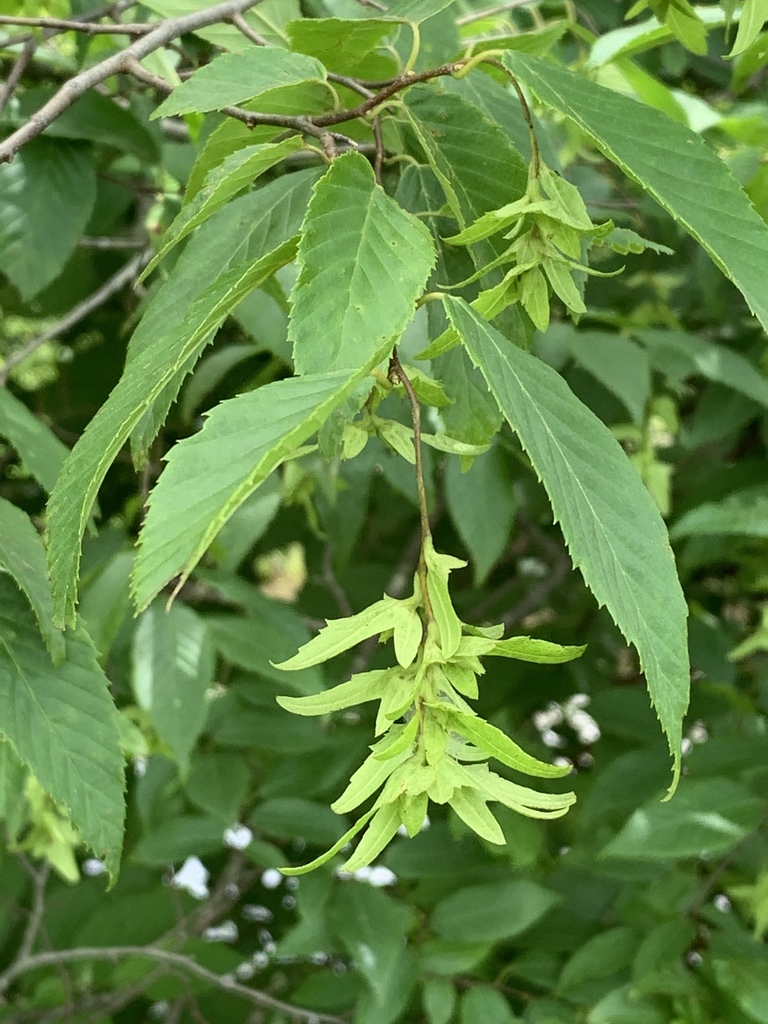
American hornbeam
Carpinus caroliniana
Carpinus caroliniana, the American hornbeam, is a small hardwood understory tree in the genus Carpinus. American hornbeam is also known as blue-beech, ironwood, musclewood and muscle beech for the distinctive sinewy, muscle-like appearance of its trunk. It is native to eastern North America, from Minnesota to southern Quebec, east to Maine, and south to eastern Texas and northern Florida. It occurs in shaded areas with moist soil, particularly near the banks of streams or rivers, and is often a natural understory species of the riverine and maritime forests of eastern temperate North America.
From the article Carpinus caroliniana on Wikipedia (CC BY-SA), quoted section by section
Description
Carpinus caroliniana (American hornbeam) is a small tree reaching heights of 6–10 meters (20–35 ft), and often has a fluted and crooked trunk. The bark is smooth and greenish-grey, becoming shallowly fissured in all old trees. The leaves are alternate, 3–12 centimeters (1+1⁄4–4+3⁄4 in) long, with prominent veins giving a distinctive corrugated texture, and a serrated margin. The male and female catkins appear in spring at the same time as the leaves. The fruit is a small 7–8-millimeter (9⁄32–5⁄16-inch) long nut, partially surrounded by a three- to seven-pointed leafy involucre 2–3 centimeters (3⁄4–1+1⁄4 in) long; it matures in autumn. The seeds often do not germinate till the spring of the second year after maturating.
Bark: On old trees near the base, furrowed. Young trees and branches smooth, dark bluish gray, sometimes furrowed, light and dark gray. Branchlets at first pale green, changing to reddish brown, ultimately dull gray. Wood: Light brown, sapwood nearly white; heavy, hard, close-grained, very strong. Specific gravity, 0.7286; density 45.41 pounds per cubic foot (0.7274 g/cm3). Winter buds: Ovate, acute, chestnut brown, 1⁄8 inch (3 mm) long. Inner scales enlarge when spring growth begins. …
What it does
They are shade-loving trees, preferring moderate soil fertility and moisture. It has a shallow, wide-spreading root system. The leaves are eaten by the caterpillars of some Lepidoptera, for example the Io moth (Automeris io). Common along the borders of streams and swamps, loves a deep moist soil. Varies from shrub to small tree, and ranges throughout the United States east of the Rocky Mountains. Deer browse the foliage and twigs, while game birds eat the nutlets.
Wikipedia: “Ecology”
At the table
The wood is heavy and hard (Specific gravity, 0.7286; density 45.41 pounds per cubic foot (0.7274 g/cm3)), and is used for tool handles, longbows, levers, walking sticks, walking canes and golf clubs.
== References ==
Wikipedia: “Uses”
Where it lives
Recorded sightings
—
geo-referenced records in GBIF, from museums, herbaria and field observers.
Drag the globe to turn it. Dots are where records exist, not a range map; darker means more records.
In the stacks
Searching the stacks…
Every page naming Carpinus caroliniana in the Biodiversity Heritage Library →
This page is assembled live from iNaturalist, GBIF, Wikipedia, the Source Library and the Internet Archive. It is not yet part of the hand-edited codex. iNaturalist taxon 54768.