- Plants
- ›Vascular Plants
- ›flowering plants
- ›Dicots
- ›Roses, Elms, Figs, and Allies
- ›rose family
- ›Amygdaloideae
- ›Amygdaleae
- ›Prunus
- ›Cerasus
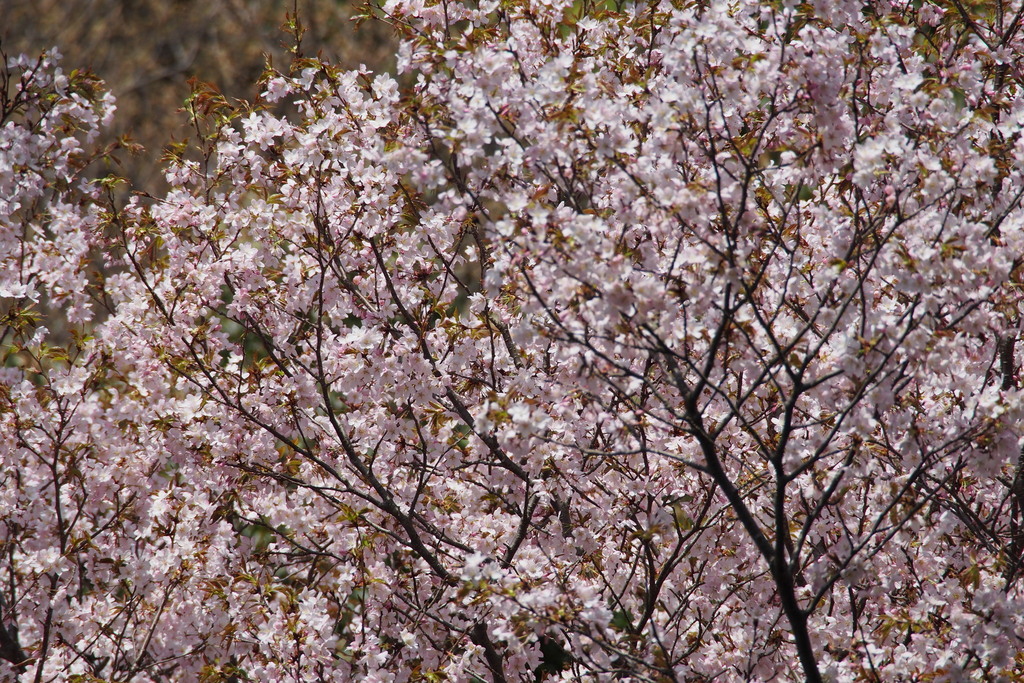
yamazakura
Prunus jamasakura
Prunus serrulata or Japanese cherry, also called hill cherry, oriental cherry or East Asian cherry, is a species of cherry native to Japan, Korea and China, and is used for its spring cherry blossom displays and festivals.
From the article Prunus jamasakura on Wikipedia (CC BY-SA), quoted section by section
Description
Prunus jamasakura is a deciduous tree that grows to a height of 20–25 metres (66–82 ft). Koidzumi's description is as follows: "a glabrous tree, more rarely pubescent. Elliptic leaves suddenly acuminate, sharply setaceo-serrated. Petioles arranged mostly towards the apex, with two glands. Coetaneous flowers very rarely subprecocious, corymbose or fascicled. Glabrous style." His description of the Tsukushi variety notes: "umbels with shorter peduncles, smaller bracts, and leaves' saw-teeth less aristate". A study of the impact of feeding upon the fruit by black bears noted their preference for ripe cherries (some 50–66 days after blossoming) and found no significant difference in the percentage of seeds that germinated compared with the control, suggesting their potential in dispersal.
Range & habitat
The endemic species occurs in the low mountains and secondary forests of Japan, from the Kantō region of Honshū to Shikoku and Kyūshū. The Tsukushi variety is found on the islands surrounding Kyūshū, including Tsushima, Tanegashima, and the Tokara Islands.
Wikipedia: “Distribution”
At the table
In South Korea this cherry is used an ornamental, and the wood is used for building materials, furniture, musical instruments, and carving. The fruit is edible and the bark is used medicinally.
Wikipedia: “Uses”
In human culture
The mountain cherry, even if its historic circumscription hasn't always conformed with current taxonomic understanding and molecular phylogenetics, has inspired Japanese poets since the days of the Man'yōshū and long been the object of the practices of appreciation known as hanami. Records of its full blossoming and of viewing parties in Edo period diaries and chronicles are such that they have been drawn on more recently for the reconstruction of historic temperatures.
Wikipedia: “Cultural significance”
Where it lives
Recorded sightings
—
geo-referenced records in GBIF, from museums, herbaria and field observers.
Drag the globe to turn it. Dots are where records exist, not a range map; darker means more records.
In the stacks
Searching the stacks…
Every page naming Prunus jamasakura in the Biodiversity Heritage Library →
This page is assembled live from iNaturalist, GBIF, Wikipedia, the Source Library and the Internet Archive. It is not yet part of the hand-edited codex. iNaturalist taxon 547458.