- Plants
- ›Vascular Plants
- ›flowering plants
- ›Dicots
- ›Mallows, Rock Roses, and Allies
- ›Mallow and Hibiscus Family
- ›Byttnerioideae
- ›Guichenotia
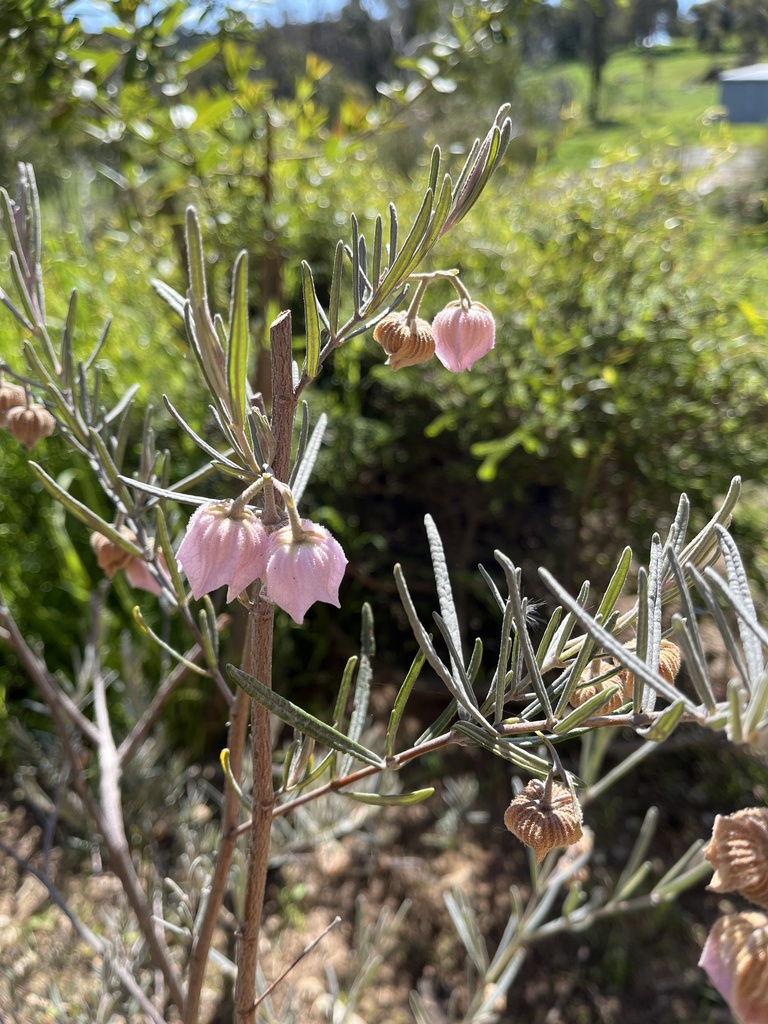
large-flowered guichenotia
Guichenotia macrantha
Guichenotia macrantha, commonly known as large-flowered guichenotia, is a species of flowering plant in the family Malvaceae. It is a shrub with grey-green leaves, mauve flowers and is endemic to Western Australia.
From the article Guichenotia macrantha on Wikipedia (CC BY-SA), quoted section by section
Description
Guichenotia macrantha is an open, upright, or sometimes a straggling small or tall shrub to 1–2 m (3 ft 3 in – 6 ft 7 in) high, 1.5–2 m (4 ft 11 in – 6 ft 7 in) wide with new growth covered in star-shaped hairs. The leaves are linear to oblong shaped, upper surface grey-green, 20–95 mm (0.79–3.74 in) long, 1.5–2 mm (0.059–0.079 in) wide, margins rolled under, lower surface yellowish-green, wrinkled, thickly hairy, rounded apex on a petiole 2–3 mm (0.079–0.118 in) long. The calyx lobes are mauve, pink-purple, sometimes white, each lobe with three distinct ribs, 1.5–2.5 cm (0.59–0.98 in) in diameter, divided to halfway, petals deep red, small, pedicel 8–15 mm (0.31–0.59 in) long and peduncles 18–50 mm (0.71–1.97 in) long. The bracts are leaf-like, oval-shaped, 8–12 mm (0.31–0.47 in) long, 1–2 mm (0.039–0.079 in) wide and borne at the base of each pedicel. Flowering occurs from May to September and the fruit is a woody, elliptic-shaped capsule.
Range & habitat
Large-flowered guichenotia grows on a variety of soils including clay sands, sands, gravel and granite from the Murchison River to Merredin.
== References ==
Wikipedia: “Distribution and habitat”
Where it lives
Recorded sightings
—
geo-referenced records in GBIF, from museums, herbaria and field observers.
Drag the globe to turn it. Dots are where records exist, not a range map; darker means more records.
In the stacks
Searching the stacks…
Every page naming Guichenotia macrantha in the Biodiversity Heritage Library →
This page is assembled live from iNaturalist, GBIF, Wikipedia, the Source Library and the Internet Archive. It is not yet part of the hand-edited codex. iNaturalist taxon 545383.