- Plants
- ›Vascular Plants
- ›flowering plants
- ›Dicots
- ›Mustards, Capers, and Allies
- ›mustard family
- ›Brassicoideae
- ›Brassicodae
- ›Brassiceae
- ›Brassica
- ›Brassica
- ›Brassica oleracea
cabbage, broccoli, and allies
Brassica oleracea
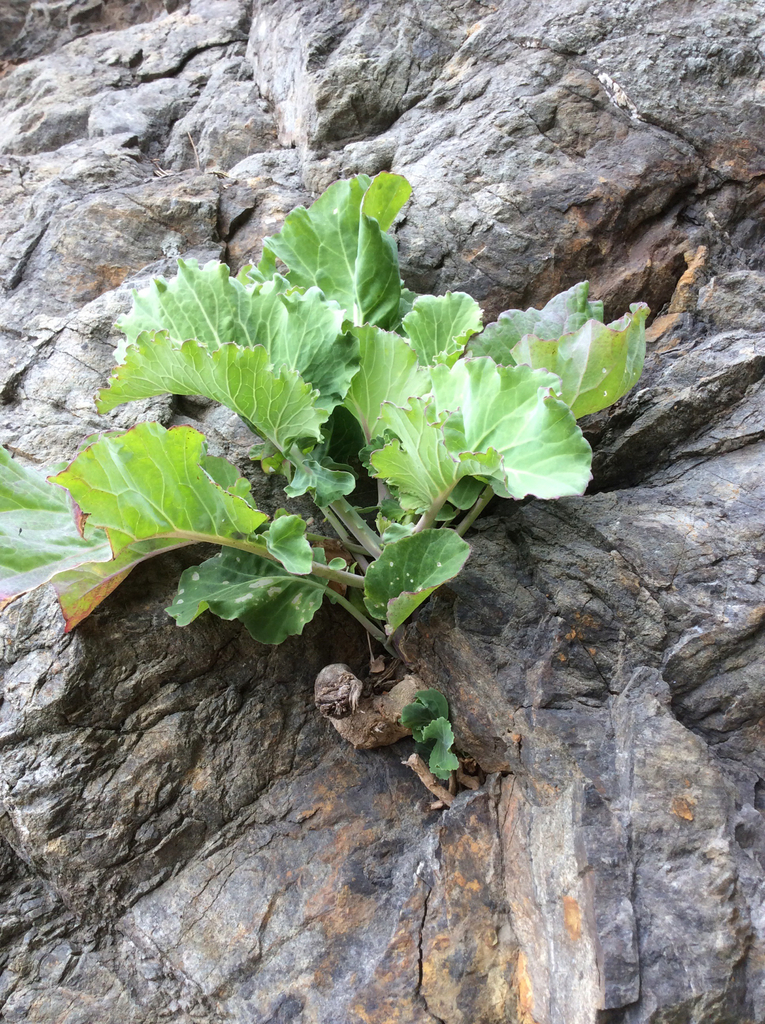
Brassica oleracea, also known as wild cabbage in its uncultivated form, is a plant of the family Brassicaceae.
The species originated from feral populations of related plants in the Eastern Mediterranean, where it was most likely first cultivated. It has many common cultivars that are used as culinary vegetables, including cabbage, broccoli, cauliflower, romanesco, kale, Brussels sprout, collard, Savoy cabbage, kohlrabi, and gai lan.
From the article Brassica oleracea on Wikipedia (CC BY-SA), quoted section by section
Description
Wild Brassica oleracea is a tall biennial or perennial plant that forms a stout rosette of large leaves in its first year. The grayish-green leaves are fleshy and thick, helping the plant store water and nutrients in difficult environments. In its second year, a woody spike grows up to 1.5 metres (5 ft) tall, from which branch off stems with long clusters of four-petaled yellow flowers.
Range & habitat
Wild cabbage is considered to be native only to the coasts of France, Great Britain, and Spain, although widely naturalized elsewhere. Although rarely abundant, wild cabbage is also found on the coasts of Ireland, Italy, and the German island of Heligoland. Wild cabbage is a hardy plant with high tolerance for salt and lime. Its intolerance of competition from other plants typically restricts its natural occurrence to limestone sea cliffs, like the chalk cliffs on both sides of the English Channel.
Wikipedia: “Distribution and habitat”
How it is grown
The species has become established as an important human food crop, used because of its large food reserves, which are stored over the winter in its leaves. It has been bred into a wide range of cultivars, including cabbage, broccoli, cauliflower, brussels sprouts, collards, and kale, some of which are hardly recognizable as being members of the same genus, let alone species. The historical genus of Crucifera, meaning "cross-bearing" in reference to the four-petaled flowers, may be the only unifying feature beyond taste. The plant is tolerant of a variety of soil conditions between pH 6.0 and 7.5, but grows particularly well in alkaline soils in full sunlight, with good drainage and high amounts of nitrogen. The plant can grow in partial shade, but care must be taken to provide sufficient ventilation, as this reduces the prevalence of downy mildew.
History. Researchers believe that B. oleracea has been cultivated for several thousand years, but its history as a domesticated plant is not clear before Greek and Roman times, when it was a well-established garden vegetable. Theophrastus mentions three kinds of rhaphanos (ῥάφανος): a curly-leaved, a smooth-leaved, and a wild-type. …
Wikipedia: “Cultivation”
In human culture
"Brassica" was Pliny the Elder's name for several cabbage-like plants. Its specific epithet oleracea means 'vegetable/herbal' in Latin and is a form of holeraceus (oleraceus).
Wikipedia: “Etymology”
Where it lives
Recorded sightings
—
geo-referenced records in GBIF, from museums, herbaria and field observers.
Drag the globe to turn it. Dots are where records exist, not a range map; darker means more records.
In the stacks
Searching the stacks…
Every page naming Brassica oleracea in the Biodiversity Heritage Library →
This page is assembled live from iNaturalist, GBIF, Wikipedia, the Source Library and the Internet Archive. It is not yet part of the hand-edited codex. iNaturalist taxon 54516.