 NL·0528
Herbarium of the Nature Library
- Name
- Mantis religiosa
- Family
- Mantidae
- Native to
- Southern and central Europe, Africa and Asia; introduced to North America in the 1890s
- Habitat
- Temperate grassland, Mediterranean scrub, Meadows, Gardens
European mantis
Mantis religiosa
Also calledGottesanbeterin (German) · Mante religieuse (French) · Santateresa (Spanish) · Faras an-nabi (Arabic) · Tángláng (Chinese)
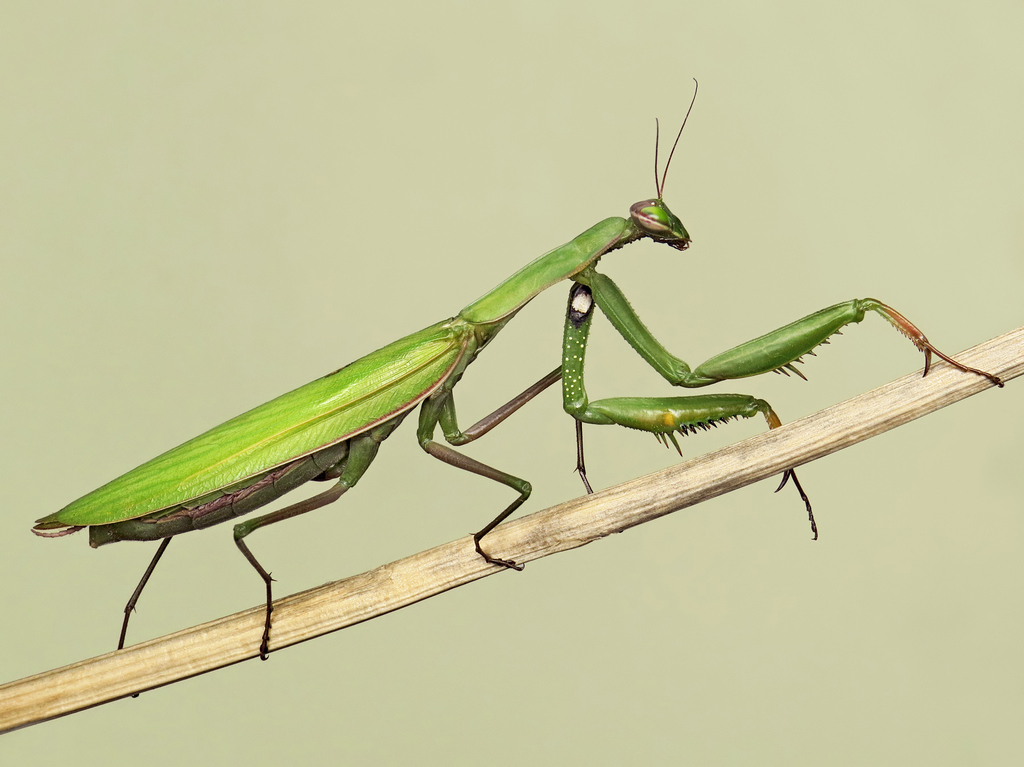
The original 'praying mantis', an ambush predator that waits with spiked forelegs folded as if in prayer. It hears with a single ear in the middle of its chest, tuned to the ultrasound of hunting bats.
The European mantis is a large hemimetabolic insect in the family Mantidae, which is the largest family of the order Mantodea (mantises). Their common name praying mantis is derived from the distinctive posture of the first pair of legs, which can be observed when the mantis is in repose, resembling a praying position. Both males and females have elongated bodies with two pairs of wings. The most striking features that the species have are a very mobile, triangular head with large compound eyes and their first pair of legs, which is highly modified for the efficient capture and restraint of fast-moving or flying prey. Wikipedia
What it can do
- iStrikes prey with spiked raptorial forelegs in a fraction of a second
- iiSingle midline ear detects bat ultrasound, triggering evasive dives in flight
- iiiTurns its head almost 180° to watch prey
- ivFemales sometimes eat males during or after mating
In the field
Field marks
- aGreen or brown, slender body with long neck-like thorax
- bRaptorial forelegs held folded in front
- cBlack spot ringed with white (a dark 'eye') on the inner base of each foreleg
- dWings reach the tip of the abdomen in both sexes
- Not to be confused with
- Chinese mantis (Tenodera sinensis), also introduced in North America, is larger (to about 10 cm), lacks the black foreleg spot and has a green-edged wing. Carolina mantis (Stagmomantis carolina) is smaller and the female's wings stop short of the abdomen tip.
- Where to see it
- Rough grassland and vineyards in southern Europe; meadows and old fields in north-eastern North America.
- When
- Adults Aug–Oct
Listen
Looking for field recordings…
Life & habits
- Diet
- Grasshoppers, flies, butterflies, crickets and other insects
- Habitat
- Sunny, tall grassland, scrub, vineyards and gardens
- Size
- About 4–8 cm; females larger
- Lifespan
- About one year: nymphs hatch in spring and adults die in autumn
Females lay eggs in a frothy case (ootheca) on stems or stones that hardens and protects up to a few hundred eggs through winter.
Where it lives
Recorded sightings
—
geo-referenced records in GBIF, from museums, herbaria and field observers.
Native range
Southern and central Europe, Africa and Asia; introduced to North America in the 1890s
Drag the globe to turn it. Dots are where records exist, not a range map; darker means more records.
In the old herbals & bestiaries
Woodcuts and engravings matched from the Source Library’s scanned books by name. Plates marked “relative” show a close kin rather than this exact species. Click a plate to read the page it came from, with translation.

Georg Wolfgang Knorr — Deliciae naturae selectae (1771)
Georg Wolfgang Knorr · 1771 · p.134

Books on Marine Fishes
Guillaume Rondelet · 1554 · p.572

Commentaries on the Six Books of Dioscorides on Medical Matter
Pietro Andrea Mattioli · 1563 · p.280

History of Animals, Book II: On Oviparous Quadrupeds
Conrad Gessner · 1586 · p.588

Theater of Insects
Conrad Gessner; Thomas Moffet; Edward Wotton · 1634 · p.350

Historia naturalis Brasiliae
Willem Piso / Georg Marcgraf · 1648 · p.332

Georg Wolfgang Knorr; Johann Ernst Immanuel Walch — Schnecken und Muscheln (1770)
Georg Wolfgang Knorr; Johann Ernst Immanuel Walch · 1770 · p.117
In the stacks
Searching the stacks…
Every page naming Mantis religiosa in the Biodiversity Heritage Library →
Marginalia
The Greek mantis means 'prophet' or 'seer', and in Provence it is called prega-Diéu, 'pray to God'. The entomologist Jean-Henri Fabre made it famous in his Souvenirs entomologiques (1879–1907).
Curiosity
Its 'cyclopean ear' was discovered in 1986: a single slit between the legs on the underside of the thorax, which makes the mantis deaf to the direction of sound but very sensitive to bat calls.
Kinship






Photographs: iNaturalist contributors under the licences shown. Records: GBIF.org. Historical plates: Source Library (CC BY-SA 4.0; originals public domain). Summary text: Nature Library editors and Wikipedia (CC BY-SA). Medicinal and edibility notes are historical and educational, not advice. iNaturalist taxon 53905.