- Plants
- ›Vascular Plants
- ›flowering plants
- ›Dicots
- ›Roses, Elms, Figs, and Allies
- ›elm family
- ›Ulmus
- ›Oreoptelea
- ›Blepharocarpus
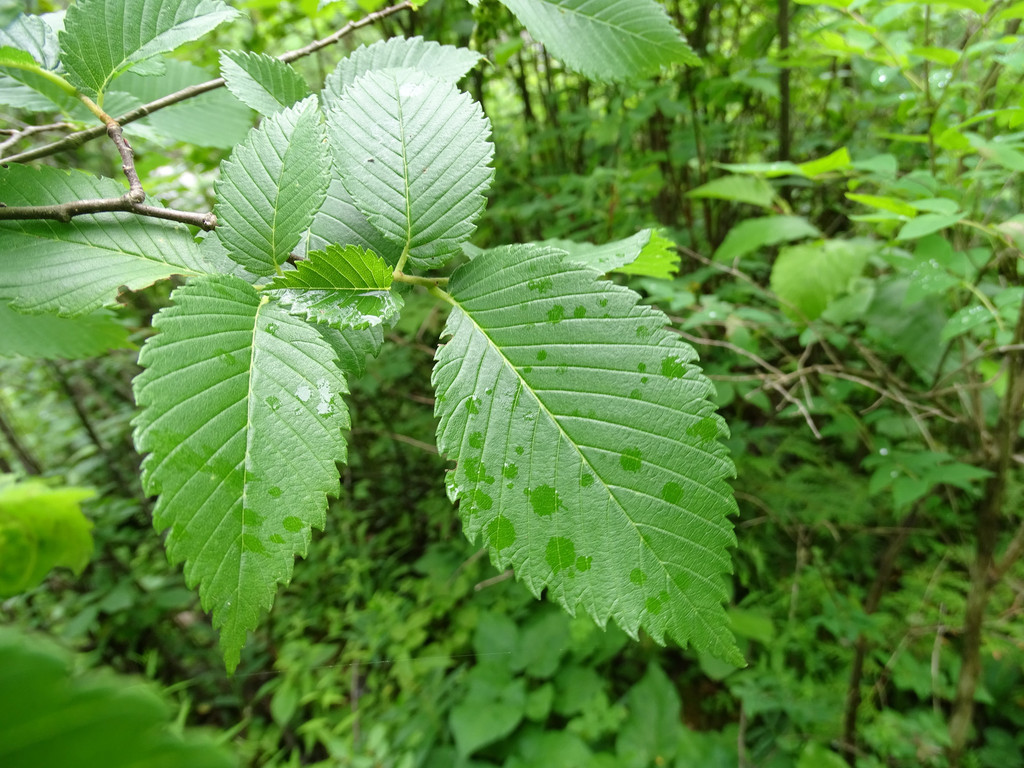
American elm
Ulmus americana
Ulmus americana, generally known as the American elm or, less commonly, as the white elm or water elm, is a species of elm native to eastern North America. The trees can live for several hundred years. It is a very hardy species that can withstand low winter temperatures. The American elm was once exceptionally common as a street tree, its tolerance of urban conditions making it a popular choice to line American streets in the 19th and early 20th centuries. The coming of beetles bearing Dutch elm disease devastated the American elm population, starting in the 1920s. The species still holds out in some locations, but is also no longer nearly as common as during its height.
The wood was seldom utilized until the advent of mechanical sawing, for its interlocking grain is difficult to split and tends to bind on saws. It is the state tree of Massachusetts and North Dakota.
From the article Ulmus americana on Wikipedia (CC BY-SA), quoted section by section
Description
The American elm is a deciduous tree which, under ideal conditions, can grow to heights of 21 to 35 meters (69 to 115 feet). The trunk may have a diameter at breast height (dbh) of more than 1.2 m (4 ft), supporting a high, spreading umbrella-like canopy. The leaves are alternate, 7–20 centimeters (3–8 inches) long, with double-serrate margins and an oblique base. The leaves turn yellow in the fall. The perfect flowers are small, purple-brown and, being wind-pollinated, apetalous. The flowers are also protogynous, the female parts maturing before the male, thus reducing, but not eliminating, self-fertilization, and emerge in early spring before the leaves. The fruit is a flat samara 2 cm (3⁄4 in) long by 1.5 cm (1⁄2 in) broad, with a circular papery wing surrounding the single 4.5 millimeters (1⁄8 inch) seed. As in the closely related Ulmus laevis (European white elm), the flowers and seeds are borne on 1–3 cm (0.39–1.18 in) long stems. American elm is wholly insensitive to daylight length (photoperiod), and will continue to grow well into autumn until injured by frost. Ploidy is 2n = 56, or more rarely, 2n = 28. For over 80 years, U. americana had been identified as a tetraploid, i.e. having double the usual number of chromosomes, making it unique within the genus. …
Range & habitat
The American elm is native to eastern North America, occurring from Nova Scotia west to Alberta and Montana, and south to Florida and central Texas. It is an extremely hardy tree that can withstand winter temperatures as low as −40 °C (−40 °F). The species occurs naturally in an assortment of habitats, most notably rich bottomlands, floodplains, stream banks, and swampy ground, although it also often thrives on hillsides, uplands and other well-drained soils. On more elevated terrain, as in the Appalachian Mountains, it is most often found along rivers. The species' wind-dispersed seeds enable it to spread rapidly as suitable areas of habitat become available. American elm fruits in late spring (which can be as early as February and as late as June depending on the climate), the seeds usually germinating immediately, with no cold stratification needed (occasionally some might remain dormant until the following year). …
Wikipedia: “Distribution and habitat”
What it does
The leaves of the American elm serve as food for the larvae of a number of species of Lepidoptera. These include such butterflies as the Eastern Comma (Polygonia comma), Question Mark (Polygonia interrogationis), Mourning Cloak (Nymphalis antiopa), Painted Lady (Vanessa cardui) and Red-spotted Purple (Limenitis arthemis astyanax), as well as such moths as the Columbian Silkmoth (Hyalophora columbia) and the Banded Tussock Moth (Pale Tiger Moth) (Halysidota tessellaris).
Pests and diseases. The American elm is susceptible to Dutch elm disease and to elm yellows. In North America, there are three species of elm bark beetles: one native, Hylurgopinus rufipes ("native elm bark beetle"); and two invasive, Scolytus multistriatus ("smaller European elm bark beetle") and Scolytus schevyrewi ("banded elm bark beetle"). Although intensive feeding by elm bark beetles can kill weakened trees, their main impact is as vectors of DED. American elm is also moderately preferred for feeding and reproduction by the adult elm leaf beetle Xanthogaleruca luteola and highly preferred for feeding by the Japanese beetle Popillia japonica in the United States. U. americana is also the most susceptible of all the elms to verticillium wilt, whose external symptoms closely mimic those of DED. …
Wikipedia: “Ecology”
At the table
Young twigs and branchlets of the American elm have tough, fibrous bark that has been used as a tying and binding material, even for rope swings for children, and also for making whips.
Wikipedia: “Pioneer and traditional uses”
How it is grown
In the 19th and early 20th century, American elm was a common street and park tree owing to its tolerance of urban conditions, rapid growth, and graceful form. This however led to extreme overplanting of the species, especially to form living archways over streets, which ultimately produced an unhealthy monoculture of elms that had no resistance to disease and pests. Elms do not naturally form pure stands and trees used in landscaping were grown from a handful of cultivars, causing extremely low genetic diversity. These trees' rapid growth and longevity, leading to great size within decades, made them popular before the advent of DED. Ohio botanist William B. Werthner, discussing the contrast between open-grown and forest-grown American elms, noted that: "In the open, with an abundance of air and light, the main trunk divides into several leading branches which leave the trunk at a sharp angle and continue to grow upward, gradually diverging, dividing and subdividing into long, flexible branchlets whose ends, at last, float lightly in the air, giving the tree a round, somewhat flattened top of beautifully regular proportions and characteristically fine twiggery." It is this distinctive growth form that is so valued in the open-grown American elms of street plantings, lawns, and parks; along most narrower streets, elms planted on opposite sides arch and blend together into a lea …
Wikipedia: “Cultivation”
In human culture
Mary Eleanor Wilkins Freeman, in her 1903 book of short stories, Six Trees, wrote of the American elm:
There was not in the whole countryside another tree which could compare with him. He was matchless. Never a stranger passed the elm but stopped, and stared, and said or thought something about it. Even dull rustics looked, and had a momentary lapse from vacuity. On 21 March 1941 the American elm was made the state tree of Massachusetts. The designation was in commemoration of the fact that George Washington reputedly took command of the Continental Army under an elm.
Notable trees. A number of mostly small to medium-sized American elms now survive in woodlands, suburban areas, and occasionally cities, where the survivors have often been relatively isolated from other elms and thus spared a severe exposure to the fungus. For example, in Central Park and Tompkins Square Park in New York City, stands of several large elms originally planted by Frederick Law Olmsted survive because of their isolation from neighboring areas in New York where there had been heavy mortality. The Olmsted-designed park system in Buffalo, New York, did not fare as well. A row of mature American elms lines Central Park along the entire length of Fifth Avenue from 59th to 110th Streets. In Akron, Ohio, there is a very old elm tree that has not been infected. …
Wikipedia: “In culture”
Where it lives
Recorded sightings
—
geo-referenced records in GBIF, from museums, herbaria and field observers.
Drag the globe to turn it. Dots are where records exist, not a range map; darker means more records.
In the stacks
Searching the stacks…
Every page naming Ulmus americana in the Biodiversity Heritage Library →
This page is assembled live from iNaturalist, GBIF, Wikipedia, the Source Library and the Internet Archive. It is not yet part of the hand-edited codex. iNaturalist taxon 53547.