- Plants
- ›Vascular Plants
- ›flowering plants
- ›Dicots
- ›honeysuckles, moschatels, and allies
- ›honeysuckle family
- ›honeysuckle subfamily
- ›Symphoricarpos
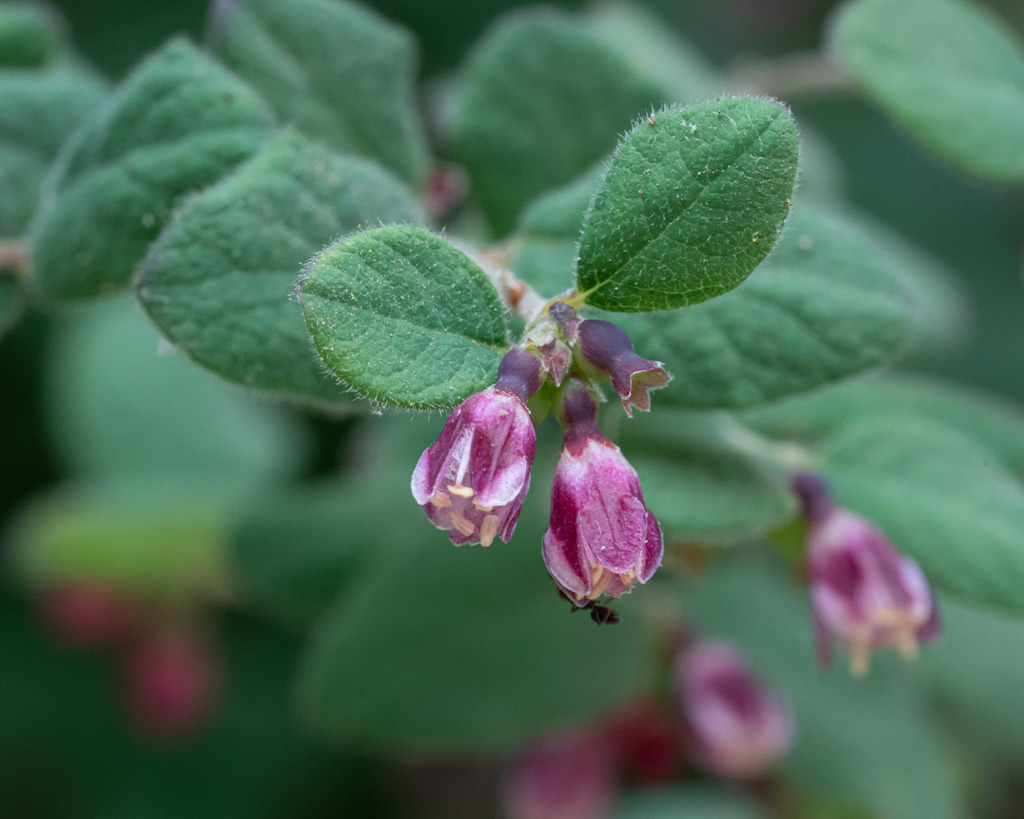
creeping snowberry
Symphoricarpos mollis
Symphoricarpos mollis, with the common names creeping snowberry, Southern California snowberry, and trip vine, is a shrub in the Honeysuckle Family (Caprifoliaceae). It is found in western North America from British Columbia to California inland to Nevada and Idaho.
From the article Symphoricarpos mollis on Wikipedia (CC BY-SA), quoted section by section
Description
The plant is a creeping shrub, low growing and straggling, with stems that can reach several feet while the height limited to about 0.5 metres (1+1⁄2 ft). It reproduces both from via rhizome and seed. Leaves are opposite. Stems are flexible. It bears bunches of red or pink rounded, bell-shaped flowers and spherical or bulbous white or pink-tinted fruits measuring about 1 centimetre (1⁄2 in).
Range & habitat
The shrub is found in western North America from British Columbia to California inland to Nevada and Idaho. It does well in warm climates and can tolerate both intense sun and constant shade. It is a plant of chaparral ecosystems, especially along coastlines.
Wikipedia: “Distribution and habitat”
At the table
The fruits are inedible. While not generally considered toxic, they are distasteful, having a soapy texture due to the presence of saponins.
Wikipedia: “Edibility”
Where it lives
Recorded sightings
—
geo-referenced records in GBIF, from museums, herbaria and field observers.
Drag the globe to turn it. Dots are where records exist, not a range map; darker means more records.
In the stacks
Searching the stacks…
Every page naming Symphoricarpos mollis in the Biodiversity Heritage Library →
This page is assembled live from iNaturalist, GBIF, Wikipedia, the Source Library and the Internet Archive. It is not yet part of the hand-edited codex. iNaturalist taxon 53456.