- Plants
- ›Vascular Plants
- ›flowering plants
- ›Dicots
- ›Roses, Elms, Figs, and Allies
- ›rose family
- ›Amygdaloideae
- ›Maleae
- ›Heteromeles
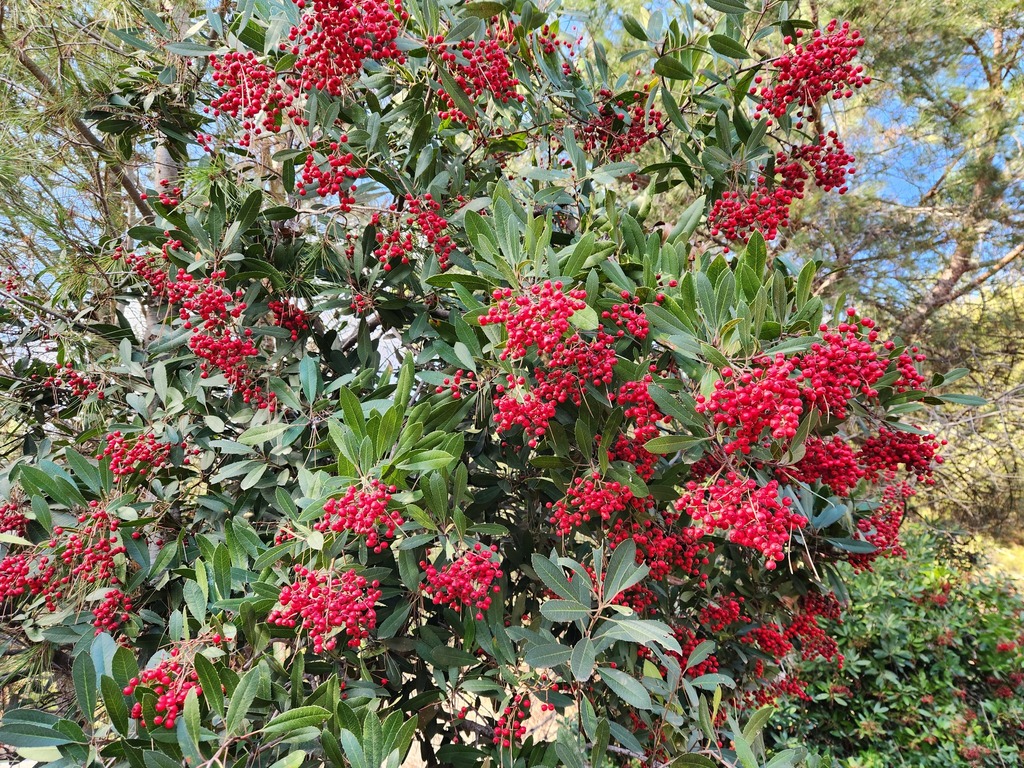
Toyon
Heteromeles arbutifolia
Heteromeles arbutifolia (/ˌhɛtɪroʊˈmiːliːz ɑːrˌbjuːtɪˈfoʊliə/; more commonly /ˌhɛtəˈrɒməliːz/ by Californian botanists), commonly known as toyon, is a common perennial shrub native to extreme southwest Oregon, California, Baja California, and British Columbia. It is the sole species in the genus Heteromeles.
From the article Heteromeles on Wikipedia (CC BY-SA), quoted section by section
Description
Toyon typically grows from 2–5 meters (7–16 ft), rarely up to 10 m in shaded conditions, and has a rounded to irregular top. Its leaves are evergreen, alternate, sharply toothed, have short petioles, and are 5–10 centimeters (2–4 in) in length and 2–4 cm (0.8–1.6 in) wide. In the early summer it produces small white flowers 6–10 millimeters (1⁄4–3⁄8 in) diameter in dense terminal corymbs. Flowering peaks in June. The five petals are rounded. The fruit is a small pome, 5–10 mm across, bright red and berry-like, produced in large quantities, developing in August or September and maturing in December.
Range & habitat
It is native to extreme southwest Oregon, California, and the Baja California Peninsula. Toyon is a prominent component of the coastal sage scrub plant community, and is a part of drought-adapted chaparral and mixed oak woodland habitats. It is also known by the common names Christmas berry and California holly.
Wikipedia: “Distribution and habitat”
What it does
Mature toyon fruit is eaten by many wildlife species, especially birds. The fruit are consumed by California quail, mockingbirds, band-tailed pigeons, American robins, cedar waxwings, hermit thrushes and raccoons. The tall shrub communities in which toyons grow also provide nesting and hiding cover for birds and small mammals. The plants are visited frequently by butterflies.
Toyon persists in the fire-prone chaparral environment with vigorous resprouting: seeds are destroyed in fire and the plant requires fire free periods for successful seedling establishment and population expansion.
Wikipedia: “Ecology”
At the table
Toyon is known by several names to different Indigenous tribes and linguistic groups (Tongva and ʔívil̃uqaletem: ashuwet; Barbareño, Cruzeño, and Inseño Chumashan languages: qwe'). The pomes provided food for local Native American tribes, such as the Chumash, Tongva, and Tataviam. The pomes also can be made into a jelly. Native Americans also made a tea from the leaves as a stomach remedy. Most were dried and stored, then later cooked into porridge or pancakes. Later settlers added sugar to make custard and wine. The plants were also often cooked over a fire to remove the slightly bitter taste by Californian tribes. The Tongva ate the berries fresh, boiled and left them in an earthen oven for 2 to 3 days, roasted them, or made them into a cider. Pulverized flowers were steeped into hot water to make tea which could be used to ease gynecological ailments. For stomach pains, bark and leaves are steeped in hot water to make tea. The same tea can serve as a seasonal tonic and ease other body pains. Also, applying mashed ashuwet to sores eases pain. Infected wounds are washed using an infusion of bark and leaves. The ʔívil̃uqaletem often consumed the fruit both raw and cooked.
Wikipedia: “Indigenous Uses”
In medicine
The plant has been used as a treatment for Alzheimer's disease by indigenous people of California and recent research has found a number of active compounds that are potentially beneficial to Alzheimer's treatment. These include icariside compounds, which protect the blood-brain barrier and prevent infiltration of inflammatory cells into the brain.
Wikipedia: “Phytochemistry”
Toxicity
Toyon pomes are acidic and astringent, and contain a small amount of cyanogenic glycosides, which break down into hydrocyanic acid on digestion. This is removed by mild cooking. Most fruit from plants in the family Rosaceae, including apples, apricots, peaches, cherries, and plums, contain cyanide. A 2016 study found 5 g of the dried berries (used as a treatment for Alzheimer's) to be safe. The study also found no cyanogenic compounds in the plant.
How it is grown
Toyon is cultivated as an ornamental shrub, but can be trained into a multi-stemmed small tree: a shape that must be maintained by constant pruning. It grows in sun or partial shade and prefers well drained soil. Established plants are drought tolerant, making it suitable for xeriscape gardening. Toyon can be grown in domestic gardens and has been cultivated as an ornamental plant in southern England at the Ventnor Botanic Garden. Like many other genera in the Rosaceae tribe Maleae, toyon includes some cultivars that are susceptible to fireblight. Toyon is less of a fire hazard than some chaparral plants.
Wikipedia: “Cultivation”
In human culture
In 1921, collecting toyon branches for Christmas became so popular in Los Angeles that the State of California passed a law forbidding collecting on public land or on any land not owned by the person picking any plant without the landowner's written permission (CA Penal Code § 384a). Toyon was adopted as the official native plant of the city of Los Angeles by the LA City Council on April 17, 2012.
Wikipedia: “In culture”
Where it lives
Recorded sightings
—
geo-referenced records in GBIF, from museums, herbaria and field observers.
Drag the globe to turn it. Dots are where records exist, not a range map; darker means more records.
In the stacks
Searching the stacks…
Every page naming Heteromeles arbutifolia in the Biodiversity Heritage Library →
This page is assembled live from iNaturalist, GBIF, Wikipedia, the Source Library and the Internet Archive. It is not yet part of the hand-edited codex. iNaturalist taxon 53405.