- Plants
- ›Vascular Plants
- ›flowering plants
- ›Dicots
- ›beeches, oaks, walnuts, and allies
- ›beech family
- ›Chrysolepis
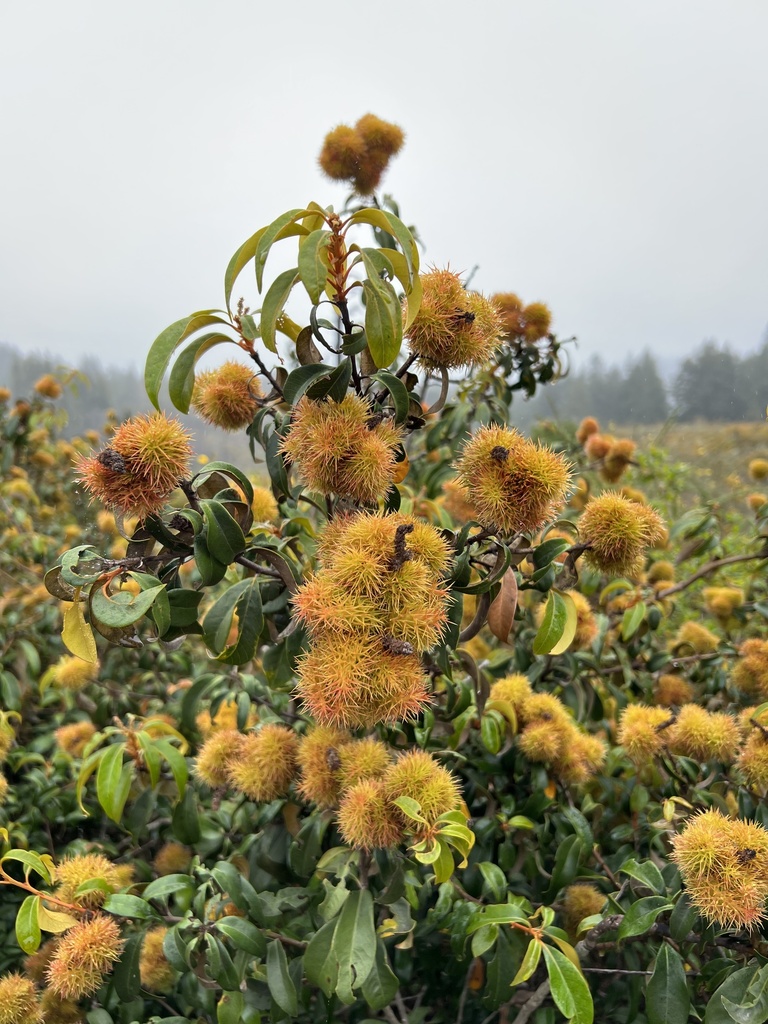
Golden chinquapin
Chrysolepis chrysophylla
Chrysolepis chrysophylla, commonly known as golden chinquapin or giant chinquapin (also spelled chinkapin), is a species of evergreen shrub or tree in the beech family. It is native to California, Oregon and Washington. The species has dark green leathery leaves, with distinct golden-yellow fuzzy undersides and produces small nuts which are protected by conspicuous spiny burs. It may become a large tree on favorable sites, but often remains small and shrubby on exposed, rocky, dry or high elevation places.
From the article Chrysolepis chrysophylla on Wikipedia (CC BY-SA), quoted section by section
Description
The giant chinquapin is an evergreen tree or erect shrub. Trees are generally 5 to 30 m (16 to 98 ft) tall, although exceptionally large specimens may reach 45 m (148 ft) and 1.5 m (4.9 ft) in trunk diameter. Shrubby forms are more common on exposed, dry or high elevation sites, while tree forms occur more often in sheltered, moist locations. Mature trees generally have straight trunks and cone shaped crowns, though trees growing in more open areas may develop broader spreading crowns. Giant chinquapins may live up to 500 years, with trees on drier sites more likely to avoid disease and live longer. The reddish bark is thin and smooth when young, becoming thick, rough and deeply furrowed with age. The dark green leathery leaves are evergreen, lanceolate to oblong, 5 to 15 cm (2.0 to 5.9 in) long, with mostly smooth margins. The lower leaf surface is covered in distinctly golden yellow or brownish fuzz. The leaf blade may be flat or folded upward along the midrib. Individual leaves remain on the plant for about three years. The species is monoecious, with individuals bearing both male and female flowers. White male flowers are catkins, while groups of up to three female flowers occur at the base of a male catkin or on separate short catkins and emit a strong, musty odor. A spiny 4-valved bur contains one to three nuts, each about 1 cm in diameter. …
Range & habitat
Chrysolepis chrysophylla is endemic to the Pacific coast of the United States, growing from extreme southern Washington through western Oregon, south to west-central California, with a disjunct population documented in El Dorado county. It grows in climax forests dominated by redwood, white fir, western hemlock, and Shasta red fir, or mixes of tree types. It may be an understory shrub, or it may codominate the canopy as a tree. Habitat types where the tree may be found include coastal forests, woodlands, and chaparral. In the western Cascade Mountains it grows in western hemlock forests. In the southern Cascades it grows at higher elevations but takes on a smaller, shrubbier form. It can be found growing up to 1,800 m (5,900 ft) above sea level.
Wikipedia: “Distribution and habitat”
What it does
The giant chinquapin occurs in forests of all successional stages, from recently burned stands to undisturbed forests over 500 years old. It has been called a " persistent subclimax species": it has wide ecological adaptability: it comes in tree and shrub form, is tolerant of shade, yet needs disturbance such as fire for sprouts from the root crown to become established, while rarely fully dominating the canopy. Assessments of its shade tolerance vary: different studies classify the species as tolerant, intermediate tolerance or intolerant of shade. Tree forms of this plant have been classified as shade intolerant, while shrub forms have been classified as shade-tolerant. Although tolerant to a degree of shade, it has been observed that on some open sites, the species has better growth, more individual specimens and increased sexual reproduction.
This species is generally wind-pollinated, but bees visit the flowers and may pollinate them. The giant chinquapin reproduces both by seed and vegetatively. Mast production is generally low, occurring in 2-5 year cycles, and it takes two years for fruit to mature on the tree. The germination rate of the seed is low, but may be immediately germinable once fallen from the tree. The seeds are dispersed by gravity, birds and squirrels. The seeds are sometimes cached by squirrels. …
Wikipedia: “Ecology”
At the table
The tree has a heavy, strong wood which is light brown with a pinkish tinge. It rarely grows in large enough quantities to serve commercial purposes. The nut is edible, having a flavor similar to the hazelnut/filbert. They were consumed by Native Americans.
Wikipedia: “Uses”
Where it lives
Recorded sightings
—
geo-referenced records in GBIF, from museums, herbaria and field observers.
Drag the globe to turn it. Dots are where records exist, not a range map; darker means more records.
In the stacks
Searching the stacks…
Every page naming Chrysolepis chrysophylla in the Biodiversity Heritage Library →
This page is assembled live from iNaturalist, GBIF, Wikipedia, the Source Library and the Internet Archive. It is not yet part of the hand-edited codex. iNaturalist taxon 53363.