- Plants
- ›Vascular Plants
- ›flowering plants
- ›Dicots
- ›pinks, cactuses, and allies
- ›Stone plants
- ›Icefigs
- ›Mesembryanthemum
- ›Phyllobolus
- ›Planifolia
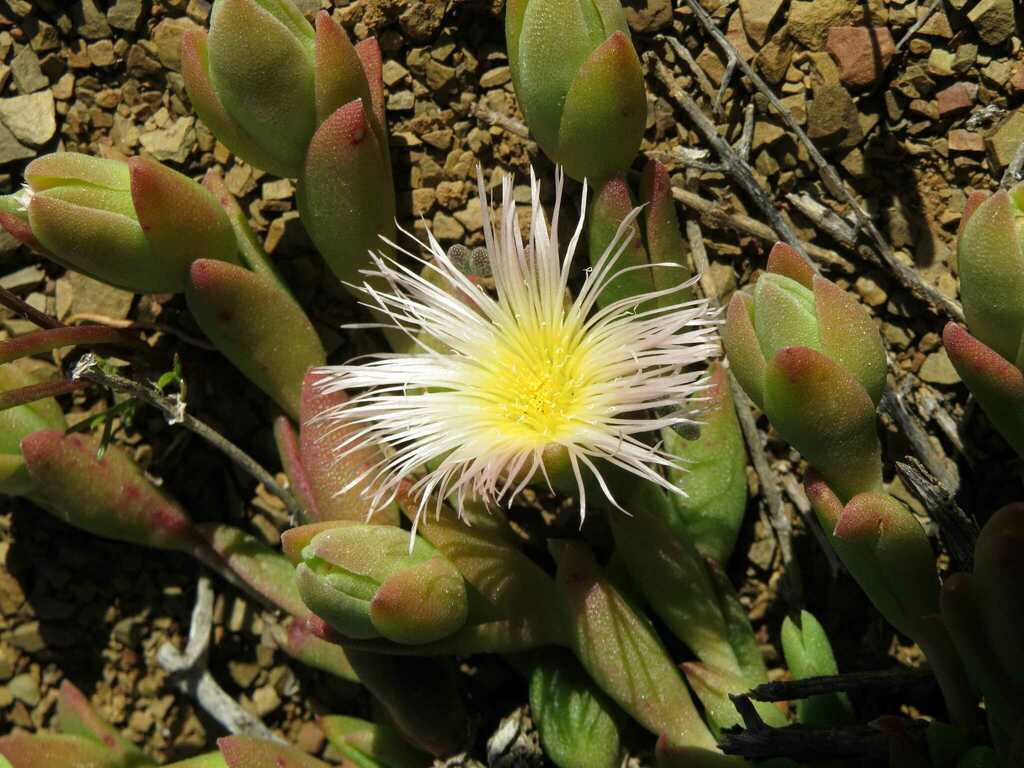
Namaqua Skeletonfig
Mesembryanthemum tortuosum
Mesembryanthemum tortuosum, often referred to by its synonym Sceletium tortuosum, is a succulent plant in the family Aizoaceae, native to the Cape Provinces of South Africa. In English, it is commonly known as kanna (a name derived from the plant's local Khoekhoe name), or alternatively kougoed, an Afrikaans term meaning 'chewable thing', originally referring to a fermented preparation of the plant that was chewed by the Indigenous Khoisan peoples for its medical and psychoactive effects. The plant contains more than 25 alkaloids, with mesembrine-type alkaloids predominating.
It has likely been used by South African pastoralists and hunter-gatherers for thousands of years. The first written account of its use dates to 1662, recorded by Jan van Riebeeck. The dried plant was traditionally chewed with the saliva swallowed. It has also been prepared in various forms, including gel caps, teas, tinctures, snuff, and smoked. It is used in traditional medicine. It is currently classified as a species of least concern, though wild populations face pressure from overharvesting.
From the article Mesembryanthemum tortuosum on Wikipedia (CC BY-SA), quoted section by section
Range & habitat
M. tortuosum is found in 50 subpopulations in the Cape provinces from Namaqualand to Montagu and Aberdeen; in karroid habitat.
Wikipedia: “Distribution and habitat”
At the table
Kanna has been consumed for its mood-altering and medicinal properties by pastoralists and hunter-gatherers since historic times. The earliest recorded use dates back to 1662. It is consumed in various forms—chewed, fermented, made into tinctures, teas, tablets, snuff, or smoked. Traditionally, it serves as a narcotic, sedative, analgesic (relieving mouth pain), and suppresses hunger and thirst during hunting. It has been used to treat toothache, abdominal pain, and digestive issues, especially in pregnant women for constipation, nausea, uterine contractions, and post-birth recovery. An oil made from the plant mixed with sheep's tail is used to relieve colic in babies. It is used as a party drug for its euphoric effects. It has been described as producing MDMA-like effects. It has been studied to alleviate excessive nocturnal barking in dogs or meowing in cats.
Wikipedia: “Uses”
In medicine
Hans Zwicky (1914) was the first to report the presence of alkaloids in Sceletium tortuosum, identifying mesembrine and mesembrenine, though their chemical structures were later corrected. Subsequent research confirmed the structure of mesembrine and noted additional unidentified alkaloids. Studies of fermentation processes revealed that mesembrine transforms into mesembrenone when exposed to sunlight and aqueous conditions, while remaining stable in methanol or darkness. To date, more than 25 alkaloids from four main structural classes—mesembrine, Sceletium A4, joubertiamine, and tortuosamine—have been identified in Sceletium species, with mesembrine-types predominating. Recent advances include the structural characterization of new alkaloids such as channaine and sceletorines A and B, with evidence indicating sceletorine B may be a biosynthetic precursor to channaine. These discoveries deepen understanding of the chemical diversity and transformation of alkaloids in Sceletium tortuosum, which are key to its pharmacological properties. M. tortuosum contains about 1–1.5% total alkaloids. A standardised ethanolic extract of dried M. …
Wikipedia: “Pharmacology”
Toxicity
Toxicology data for Sceletium tortuosum in humans is limited. However, animal studies suggest a favorable safety profile. In dogs and cats, daily oral doses of 10 mg/kg and 100 mg/kg respectively showed no toxic effects, with all body systems functioning normally. In Wistar rats, a 90-day oral study using a proprietary extract at doses of 17.85, 35.7, and 71.4 mg/kg revealed no toxic effects, establishing a no-observed-adverse-effect level at 71.4 mg/kg. Additional studies administering higher doses—up to 5,000 mg/kg daily for 14 days and up to 600 mg/kg daily for 90 days—also reported no mortality or signs of toxicity. These findings indicate a high margin of safety in animal models. Traditional and contemporary methods of preparation serve to reduce levels of potentially harmful oxalates found in M. tortuosum. An analysis indicated levels of 3.6–5.1% oxalate, which falls within the median range for crop plants, just like spinach or kale.
Wikipedia: “Toxicology”
How it is grown
M. tortuosum can be grown from seeds and be propagated from cuttings. Its cultivation and care are similar to cactaceae like Echinopsis. The optimal temperature is at least 16 °C and it does not tolerate frost.
Wikipedia: “Cultivation”
In human culture
Plants of the genus Sceletium have likely been used for millennia by San and Khoi peoples as masticatories and traditional medicines for thirst, hunger, fatigue, and social and spiritual purposes; this knowledge from oral tradition of how it was used has declined over the past three centuries due to colonization, conflict, and cultural disruption. Along with dagga, kanna constituted an important element in southern Africa's precolonial exchange economy. The first known written account of the plant's use was in 1662 by Jan van Riebeeck, although the English East India Company official in Hirado Richard Cocks explained kanna's properties by likening it to those of ginseng as early as 1616. In the seventeenth and eighteenth centuries, European writers like Peter Kolb and Guy Tachard incorrectly hypothesized that kanna may be the same plant as East Asian ginseng, on account of its stimulant properties. The traditionally prepared dried plant was often chewed and the saliva swallowed, but it has also been made into gel caps, teas and tinctures. It has also been used as a snuff and smoked. Its name relates to the skeletal appearance of its dried leaves. It was highly valued and traded, sometimes combined with cannabis to enhance effects. Today, it is sold commercially, especially to boost sexual performance.
Wikipedia: “History”
Where it lives
Recorded sightings
—
geo-referenced records in GBIF, from museums, herbaria and field observers.
Drag the globe to turn it. Dots are where records exist, not a range map; darker means more records.
In the stacks
Searching the stacks…
Every page naming Mesembryanthemum tortuosum in the Biodiversity Heritage Library →
This page is assembled live from iNaturalist, GBIF, Wikipedia, the Source Library and the Internet Archive. It is not yet part of the hand-edited codex. iNaturalist taxon 533332.