- Animals
- ›Arthropods
- ›Hexapods
- ›Insects
- ›Winged and Once-winged Insects
- ›Stick Insects
- ›Verophasmatodea
- ›Areolatae
- ›Bacilloidea
- ›Heteropterygidae
- ›Dataminae
- ›Datamini
- ›Epidares
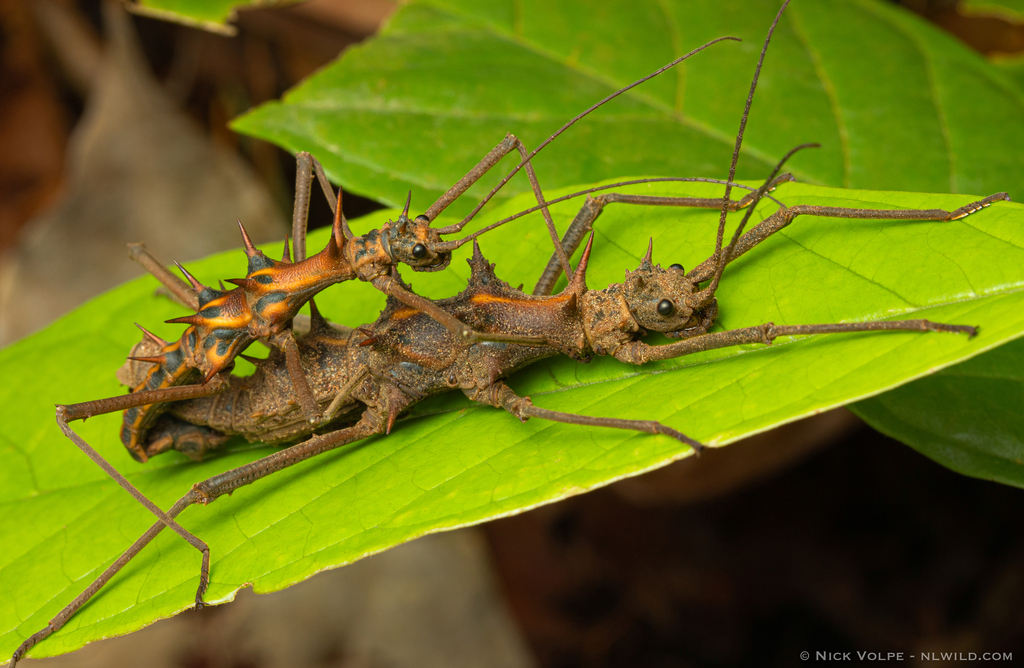
Touch-Me-Not Stick Insect
Epidares nolimetangere
Epidares nolimetangere, the touch-me-not stick insect, is an insect species from the order of the Phasmatodea and the only representative of the genus Epidares. The species name nolimetangere (originally: noli-me-tangere) comes from Latin and means "don't touch me". It refers to the prickly appearance of the animals.
From the article Epidares on Wikipedia (CC BY-SA), quoted section by section
Description
Epidares nolimetangere is one of the smaller representatives of the Phasmatodea. The males are about 35 to 43 mm long, the females reach a length of about 45 to 48 mm and have shorter spines than the males. The insects, wingless in both sexes, have a pair of spines on the head and on the anterior margin of the mesonotum and a ring of four spines on the posterior margin of the meso- and metathorax. On the entire abdomen of the males there is only one pair of spines, which can be found on the second abdominal segment. In addition to this, the females also have a pair of spines on the third abdominal segment, which is supplemented by smaller, mostly lateral spines. The females are monochrome dark brown except for a light central stripe. The abdomen of egg-laying females is thickened in the middle. The males show dark areas on the back from the posterior mesothorax, especially in the areas around the spines and on the abdomen. There are other spots on the pronotum and between the lateral and dorsal spines of the meso- and metathorax, the spines themselves being light-colored. On the abdomen, the dark areas flow together to form two parallel longitudinal stripes. These spots can be small or significantly larger or flow together. Their color can be brown to dark green or metallic green. …
Wikipedia: “Characteristics”
Range & habitat
Epidares nolimetangere comes from Borneo. There it can be found very frequently in the northwest, more precisely in the Malay state Sarawak and here it reaches the highest observed population density of phasmatodea living on Borneo. The insects live on low shrub vegetation of the tropical rainforest. As food plants are known, Rosaceae like the Molucca bramble (Rubus moluccanus), Melastomataceae like Clidemia hirta, Vitaceae like Leea indica, Acanthaceae as Strobilanthes alternata and Bonnetiaceae as Ploiarium alternifolium. The females lay one to three eggs about 3.5 to 3.9 mm long, 2.9 to 3.1 mm wide and an average of 6.8 mg each week for a period of up to twenty months. These are covered with barbed hairs. They are placed individually in a hollow dug with the legs. The abdomen is bent forward over the back and the then released egg is rolled over the parallel held antennae into the hollow. This is covered again after the eggs have been laid. After three to six months, the seven to twelve millimeter long nymphs hatch from the eggs. Males are after about eight months, females after about ten months adult. After another three to four weeks, the females begin to lay eggs.
Wikipedia: “Distribution area, way of life and reproduction”
Listen
Looking for field recordings…
Where it lives
Recorded sightings
—
geo-referenced records in GBIF, from museums, herbaria and field observers.
Drag the globe to turn it. Dots are where records exist, not a range map; darker means more records.
In the stacks
Searching the stacks…
Every page naming Epidares nolimetangere in the Biodiversity Heritage Library →
This page is assembled live from iNaturalist, GBIF, Wikipedia, the Source Library and the Internet Archive. It is not yet part of the hand-edited codex. iNaturalist taxon 532719.