- Plants
- ›Vascular Plants
- ›flowering plants
- ›Dicots
- ›Woodsorrels, Quandongs, and Allies
- ›Woodsorrel Family
- ›Oxalis
- ›Oxalis
- ›Cernuae
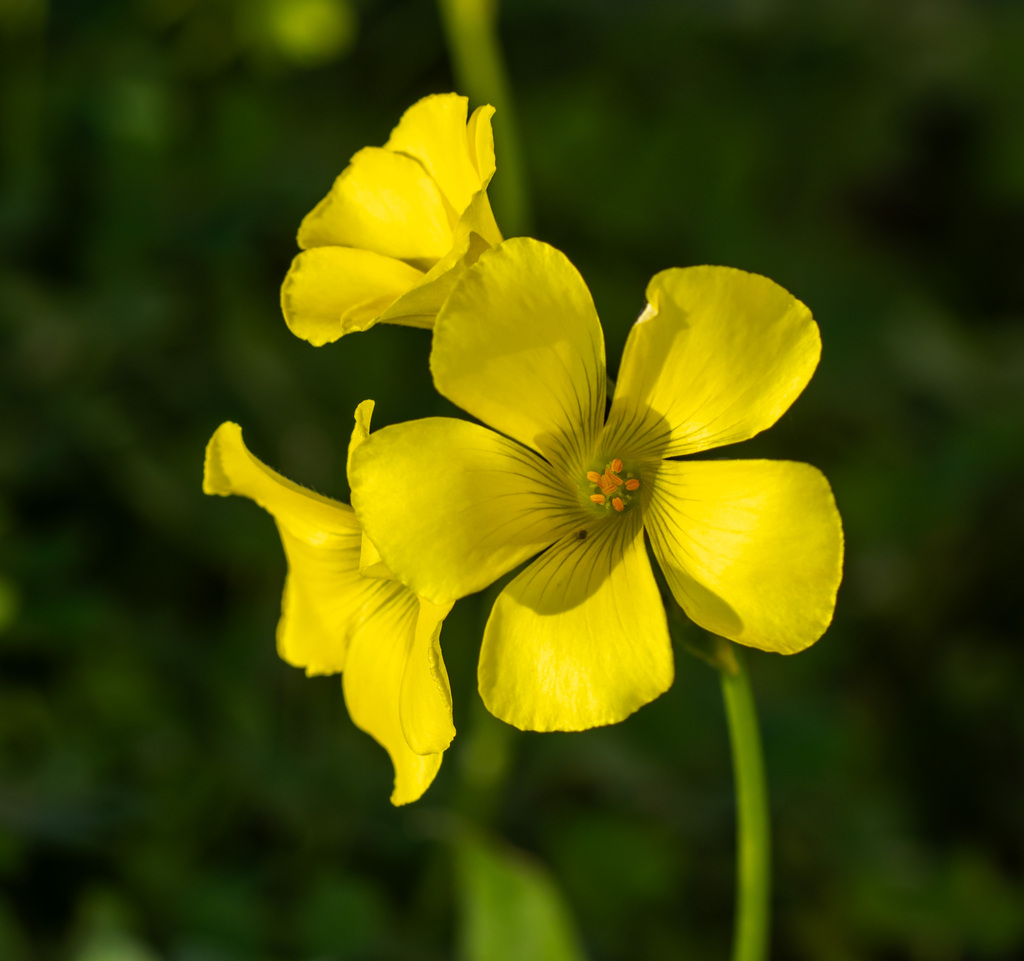
Bermuda buttercup
Oxalis pes-caprae
Oxalis pes-caprae is a species of tristylous yellow-flowering plant in the wood sorrel family Oxalidaceae. Oxalis cernua is a less common synonym for this species. It is commonly known as African wood-sorrel, Bermuda buttercup, Bermuda sorrel, buttercup oxalis, Cape sorrel, English weed, goat's-foot, sourgrass, soursob, or soursop; Afrikaans: suring; Arabic: hommayda (حميضة).
Some of the most common names for the plant reference its sour taste owing to oxalic acid present in its tissues. Indigenous to South Africa, the plant has become a pest plant in different parts of the world that is difficult to eradicate because of how it propagates through underground bulbs.
From the article Oxalis pes-caprae on Wikipedia (CC BY-SA), quoted section by section
Description
The Oxalis pes-caprae flower is actinomorphic, with a calyx composed of five free or slightly fused sepals, a sympetalous corolla composed of five fused petals, an androecium composed of ten free stamens in two ranks, and a compound pistil. Native populations in South Africa are heterostylous, flowers of long-styled plants have a stigma held above the two ranks of stamens, mid-styled plants have the stigma in between the two ranks of stamens and short-styled plants have a stigma below both ranks of stamen. In the non-native range the plants largely reproduce vegetatively and many populations have only one style length and the plants never produce seed. Like most African Oxalis species, it produces adventitious subterranean propagules. These take the form of true bulbs in botanical terms, which is unusual among dicotyledons. O. pes-caprae produces small bulbs copiously, whereas most other African species produce fewer, larger bulbs.
At the table
The plant is palatable and in modest quantities is reasonably harmless to humans and livestock. In South Africa it is a traditional ingredient in dishes such as waterblommetjiebredie ('water flower stew'). The plant has been used in various ways as a source of oxalic acid, as food, and in folk medicine. The raw bulbs have been used to deal with tapeworm and possibly other worms. The plant has been used as a diuretic, possibly hazardously. The lateral underground runners, which tend to be fleshy, have been eaten raw or boiled and served with milk. The golden petals can be used to produce a yellow dye.
Wikipedia: “Uses”
Where it lives
Recorded sightings
—
geo-referenced records in GBIF, from museums, herbaria and field observers.
Drag the globe to turn it. Dots are where records exist, not a range map; darker means more records.
In the stacks
Searching the stacks…
Every page naming Oxalis pes-caprae in the Biodiversity Heritage Library →
This page is assembled live from iNaturalist, GBIF, Wikipedia, the Source Library and the Internet Archive. It is not yet part of the hand-edited codex. iNaturalist taxon 53169.