- Plants
- ›Vascular Plants
- ›flowering plants
- ›Dicots
- ›proteas, lotuses, planes, and allies
- ›Protea family
- ›Singlet Proteas
- ›Nutseed Proteoid Clade
- ›Cape Nutseed Proteoids
- ›Serruria
- ›Elongatae
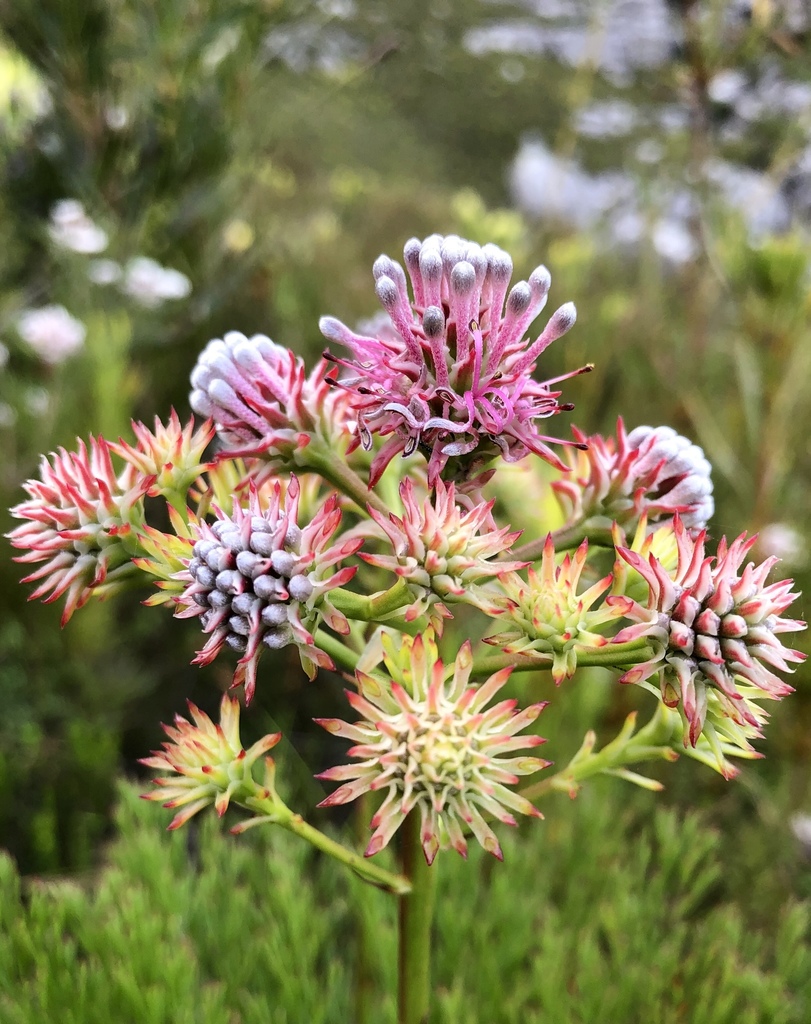
Longstalk Spiderhead
Serruria elongata
Serruria elongata or long-stalk spiderhead is a plant belonging to the protea family. It is an erect, hairless shrublet of 1–1½ m (3½–5 ft) high with densely set, alternate, finely divided leaves lower down the plant, with needle-like segments. On top of an up to 30 cm (12 in) long inflorescence stalk are several, loosely arranged heads of pin-like, densely silvery-haired flower buds, each of which opens with four curled, magenta pink corolla lobes. The species is endemic to the southern Western Cape province of South Africa. It flowers during the southern hemisphere winter and early spring, between June and September.
From the article Serruria elongata on Wikipedia (CC BY-SA), quoted section by section
Description
Serruria elongata is a small, hairless shrub of 1–1½ m (3½–5 ft) high with upright or rising stems. Its leaves are arranged in what appears to be a whorl at the base of the inflorescence stalk, are 5–12+1⁄2 cm (2.0–4.9 in) long twice or more feather-shaped divided in the upper half to third, with about sixty segments, hairless or young leaves sometimes felty. The highest order segments are about 1 mm (0.039 in) thick, cylinder-shaped with a blunt tip that carries a pointy extension of the midrib. Each stalk carries five to twenty five flower heads, arranged like a panicle or corymb on the long common inflorescence stalk, extending far above the leaves. The inflorescence stalk is hairless and 15–30 cm (6–12 in) long. The primary branches of the inflorescence stalk are up to about 6 cm (2+1⁄4 in) in length and mostly carry several heads, each of which is subtended by a lance-shaped bract of 4–8 mm (0.16–0.31 in) long, with a pointy or pointed tip (or acute or acuminate). The stalks that carry the individual flower heads are 4–6 mm (0.16–0.24 in) long, hairless, and lack or have a very small bract. Flower heads are about 1½ cm (0.6 in) across. The hairless bract that subtends the individual flower is purplish in colour, about 6 mm (0.24 in) long and 3 mm (0.12 in) wide, and consists of a roundish body from which a thick midrib extends in a long, stretched tip. …
Range & habitat
The long-stalk spiderhead can be found in Du Toitskloof, between Paarl and Worcester in the northwest to the neighbourhood of Cape Agulhas in the southeast. It grows at 100–650 metres (330–2,130 ft) elevation in fynbos vegetation on sandy soils that have been formed by the weathering of acid sandstones. The flowers were observed to produce a strong sweet scent, reminiscent of jasmine, late in the afternoon. No smell has been noted earlier during daylight hours. The sweet scent near dusk suggests the species may be pollinated by moths. The fruits are collected by ants and the seeds remain dormant until a spring that follows a summer bushfire.
Wikipedia: “Distribution, habitat and ecology”
Where it lives
Recorded sightings
—
geo-referenced records in GBIF, from museums, herbaria and field observers.
Drag the globe to turn it. Dots are where records exist, not a range map; darker means more records.
In the stacks
Searching the stacks…
Every page naming Serruria elongata in the Biodiversity Heritage Library →
This page is assembled live from iNaturalist, GBIF, Wikipedia, the Source Library and the Internet Archive. It is not yet part of the hand-edited codex. iNaturalist taxon 531638.