- Plants
- ›Vascular Plants
- ›flowering plants
- ›Dicots
- ›nightshades, bindweeds, gooseweeds, and allies
- ›nightshade family
- ›nightshades and allies
- ›boxthorns and allies
- ›Lycium
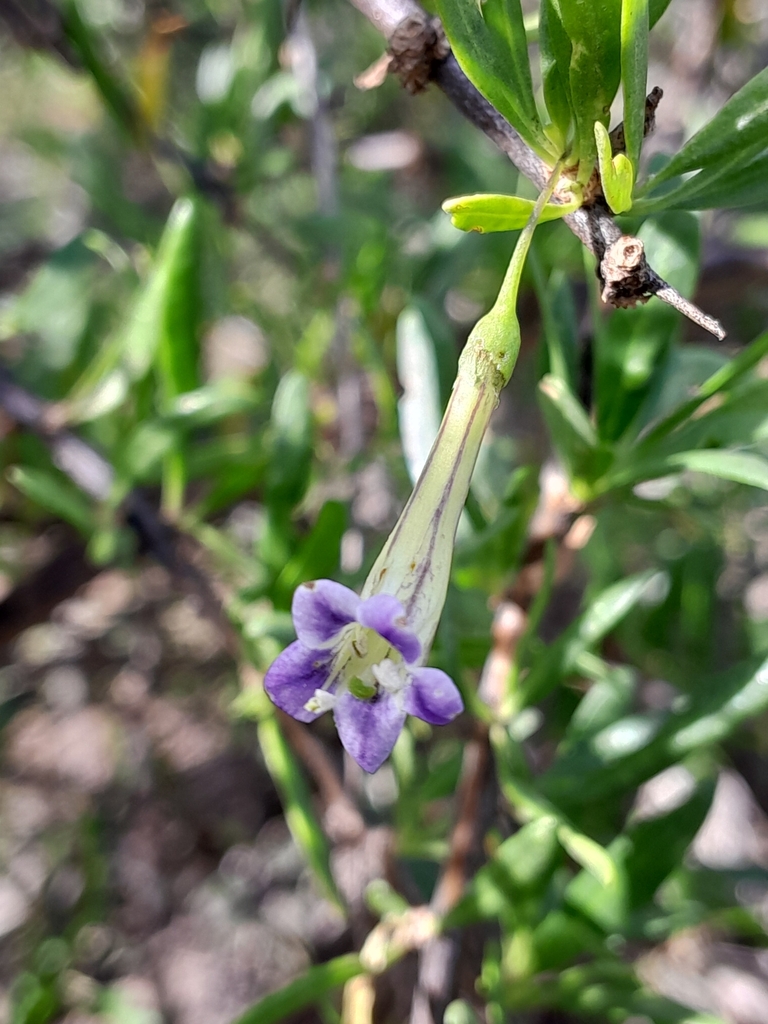
Cape honey-thorn
Lycium oxycarpum
Lycium oxycarpum is a shrub in the nightshade family (Solanaceae) indigenous to the Karoo regions of South Africa.
From the article Lycium oxycarpum on Wikipedia (CC BY-SA), quoted section by section
Description
Lycium oxycarpum is a large shrub which, unlike many of its Lycium relatives, can eventually grow into a small tree (max. 5 m. in height). The branches are curving and the younger branches quite sturdy, giving the species a distinctive appearance. The branches are covered in short thorns that are of approximately equal length along the length of each branch. It shares these characters with its close relative, Lycium bosciifolium, but they nonetheless help to distinguish L. oxycarpum from most of its other relatives. Like many other Lycium species, the leaves are oblong, to narrowly-elliptic or obovate in shape. They are bright green, and a slightly lighter colour on their undersides. The mostly solitary flowers emerge from the leaf axils. The corolla has a long, funnel-shaped tube, cream-coloured with longitudinal lines, tipped with small, mauve lobes (petals). The calyx is small and covers only a small portion at the base of the flower tube. The flowers are the most distinctive characteristic of this species, and they serve to distinguish it from all other Lycium species in Africa.
== References ==
Range & habitat
The species is native to the Western Cape, Northern Cape, Eastern Cape, and Free State provinces in South Africa, where it tends to occur in dry karrooid areas inland (the Great Karoo and Little Karoo regions). It is also found in southwestern Angola.
Wikipedia: “Distribution”
Where it lives
Recorded sightings
—
geo-referenced records in GBIF, from museums, herbaria and field observers.
Drag the globe to turn it. Dots are where records exist, not a range map; darker means more records.
In the stacks
Searching the stacks…
Every page naming Lycium oxycarpum in the Biodiversity Heritage Library →
This page is assembled live from iNaturalist, GBIF, Wikipedia, the Source Library and the Internet Archive. It is not yet part of the hand-edited codex. iNaturalist taxon 531574.