- Plants
- ›Vascular Plants
- ›flowering plants
- ›Dicots
- ›Sunflowers, Bellflowers, Fanflowers, and Allies
- ›Sunflowers, Daisies, Asters, and Allies
- ›chicories, dandelions, and allies
- ›Lettuce, Chicory, Dandelion and Salsify Tribe
- ›Oxtongues, Hawkbits and Allies
- ›Hypochaeris
- ›Hypochaeris
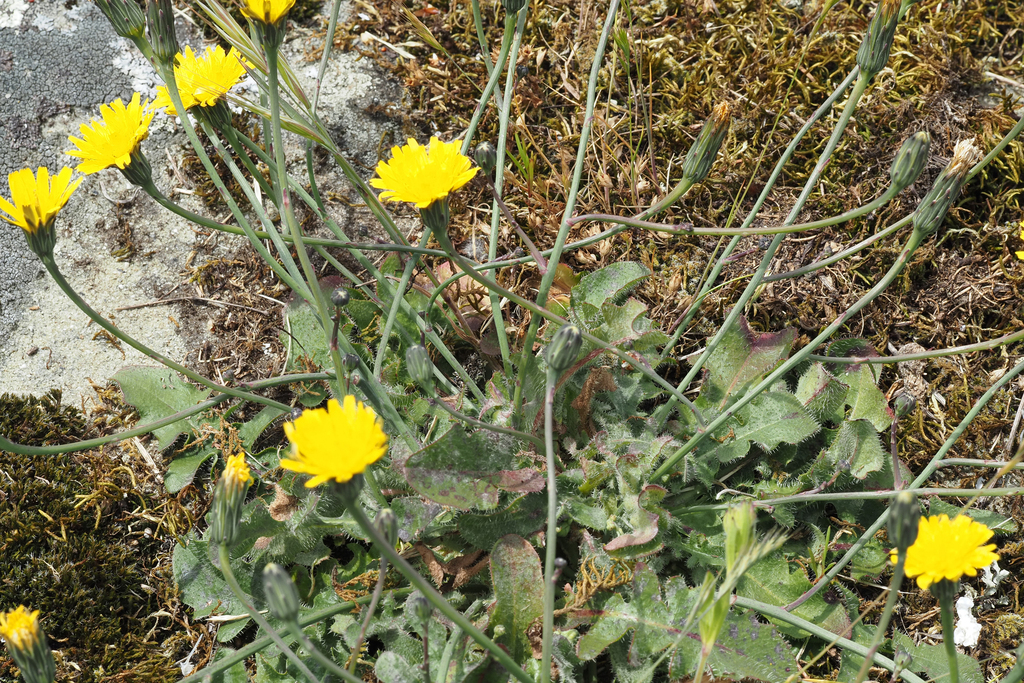
Common Cat's-ear
Hypochaeris radicata
Hypochaeris radicata, phonetically hy-poh-KAIR-iss rad-ee-KAY-tuh, is sometimes spelled Hypochoeris radicata and known as catsear, flatweed, cat's-ear, hairy cat's ear, or false dandelion. It is a perennial, low-lying edible herb often found in lawns. H. radicata has been used for both food and medinicinal purposes.
The plant is native to Europe, but has also been introduced to the Americas, Japan, Australia, and New Zealand, where it can be an invasive weed. It is listed as a harmful, noxious weed by the Korean Ministry of Environment and in the northwestern U.S. state of Washington.
From the article Hypochaeris radicata on Wikipedia (CC BY-SA), quoted section by section
Range & habitat
H. radicata is native from Europe to Caucasus, and in North Africa. It has been introduced in S and SE Asia, Australia, New Zealand, Japan, Pacific islands, S and SE Africa, and North and South America. Its range has been reported from Tasmania, 42°S Lat., to Scandinavia, near 63°N; at elevations from sea-level to 1,676 meters (5,499 ft) in Colorado and 4,500 meters (14,800 ft) in Columbia's Andean Mountain Range.
Wikipedia: “Distribution and habitat”
What it does
Hypochaeris radicata is considered a "nonhydrophyte" in the 2013 (US) National Wetland Plant List due to its preference for dryer upland soils. Dependent upon region, it may be found in wetlands, but not typically common. Catsear can become a problematic weed, but does provide beneficial wildlife forage.
Pests and diseases. Parasites: Broomrape (Orobanche minor), a holoparasite plant, has invaded H. radicata in Canada and the dense foliage of H. radicata's basal rosette is known to harbor slugs, detrimental to other flora. Insects and nematodes: H. radicata's asteraceae family is used as a food source by larvae of some lepidoptera species including the shark moth, feeding on its flowers and leaves. H. radicata is known to be afflicted by soil-born stem nematodes (ditylenchus dipsaci); gall midges (contarinia hypochoeridis); cynipid wasps; and several weevils, e.g. the cribrate weevil (otiorhynchus cribricollis) and trachyphloeus scabriculus. Fungi: Parasitic fungi include Hawkweed rust (puccinia hieracii), causing microscopic spore-producing pustules on leaf surfaces, leading to their curling, withering; and Phymatotrichum omnivorum, a soil-born fungus causing root rot. Viruses: H. radicata is commonly affected by Hypochaeris Mosaic virus (HYMV00) in western Canada.
Ecological impact. H. …
Wikipedia: “Ecology”
At the table
All parts of the catsear plant are edible; however, the leaves and roots are those most often harvested. The leaves are bland in taste but can be eaten raw in salads, steamed, or used in stir-fries. Some recommend mixing them with other vegetables. Older leaves can become tough and fibrous, but younger leaves are suitable for consumption. In contrast to the edible leaves of dandelion, catsear leaves only rarely have some bitterness. In Crete, Greece, the leaves of a variety called παχιές (pachiés) or αγριοράδικα (agriorádika) are eaten boiled or steamed. The root can be roasted and ground to form a coffee substitute.
Wikipedia: “Culinary uses”
Toxicity
This species is associated with stringhalt in horses and donkeys if consumed in excess, the exact etiology unknown; otherwise non-poisonous and no contact dermatitis association.
In human culture
Hypochaeris radicata's genus, Hypochaeris or Hypochoeris, is derived from Greek ὑπό 'under' and χοῖρος for 'a young pig', being its preferred food source. Its species, radicata, means "with large, conspicuous roots" in Latin (derived from radix 'root'). Catsear is also known as false dandelion, commonly mistaken for true dandelions (Taraxacum). Both carry similar flowers which form windborne seeds. However, catsear flowering stems are forked and solid, whereas dandelions possess unforked, hollow stems (peduncles). Both plants have a rosette of leaves and a central taproot. The leaves of dandelions are jagged in appearance, whereas those of catsear are more lobe-shaped and hairy. The plants have similar uses. H. radicata is also misidentified as autumn hawkbit (Scorzoneroides autumnalis) and smooth cat's ear (Hypochaeris glabra) due to similarity of their bright yellow flowers, the higher density of short, stiff hairs on its leaves being a distinguishing characteristic.
Wikipedia: “Etymology and differences from dandelions”
Where it lives
Recorded sightings
—
geo-referenced records in GBIF, from museums, herbaria and field observers.
Drag the globe to turn it. Dots are where records exist, not a range map; darker means more records.
In the stacks
Searching the stacks…
Every page naming Hypochaeris radicata in the Biodiversity Heritage Library →
This page is assembled live from iNaturalist, GBIF, Wikipedia, the Source Library and the Internet Archive. It is not yet part of the hand-edited codex. iNaturalist taxon 53104.