- Plants
- ›Vascular Plants
- ›flowering plants
- ›Dicots
- ›Sunflowers, Bellflowers, Fanflowers, and Allies
- ›Sunflowers, Daisies, Asters, and Allies
- ›Asteroideae
- ›paper daisies
- ›cudweeds, everlastings, and pussytoes
- ›Antennaria
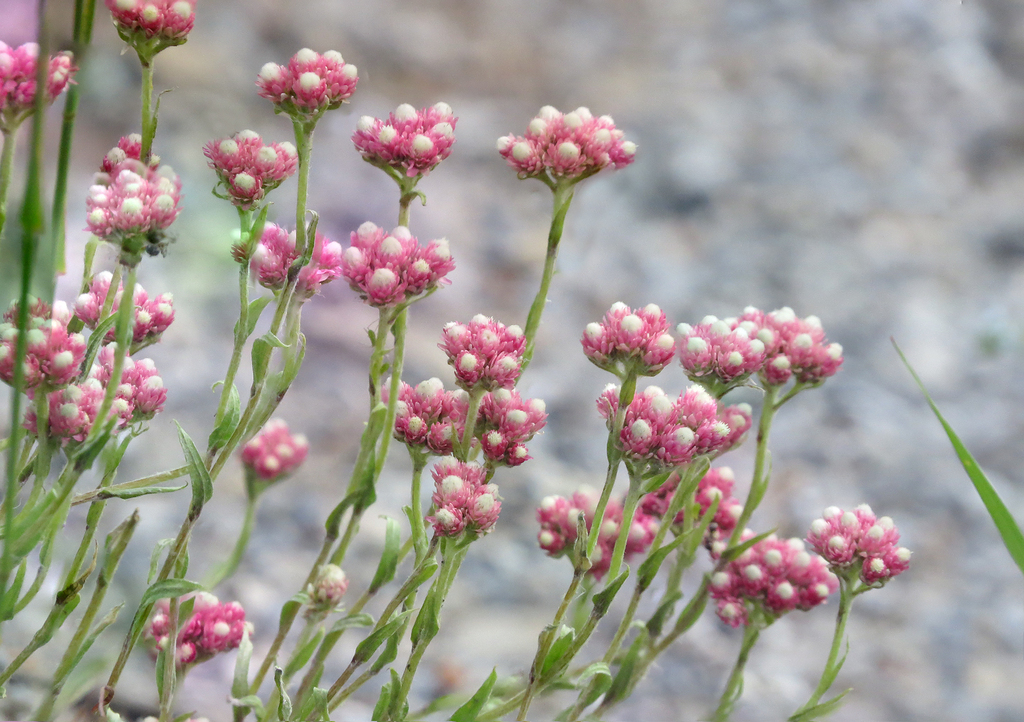
Rosy Pussytoes
Antennaria rosea
Antennaria rosea is a North American species of flowering plant in the daisy family known by the common name rosy pussytoes. It is widespread across much of Canada including all three Arctic territories, as well as Greenland, the western and north-central United States, and the Mexican State of Baja California.
From the article Antennaria rosea on Wikipedia (CC BY-SA), quoted section by section
Description
This herbaceous perennial grows to a height of 10 to 40 centimeters (4 to 15+1⁄2 in). It has a network of short stolons by which it spreads, its method of vegetative reproduction. It forms a basal patch of woolly grayish leaves 1 to 4 cm (1⁄2 to 1+1⁄2 in) long. Blooming early in summer, the inflorescence contains several flower heads in a cluster. Each head is lined with wide, pointed phyllaries which are often rose in color, the trait that gives the species its name, but they may also be white, yellowish, or brownish. The species is dioecious, but since most of the individuals are female, most bear flower heads containing pistillate flowers. The fruit is an achene with a body less than 2 millimeters long and a pappus which may be 6 or 7 mm long. The plant often produces fertile seeds, but most individuals in most populations are clones. Plants are sometimes fertilized with pollen from other Antennaria species, which may bring new genes into an A. rosea population, increasing the genetic diversity amongst the clones. The species is polyploid and exhibits apomixis; most all the plants are female and they reproduce asexually.
Range & habitat
Antennaria rosea is widespread across much of Canada including all three Arctic territories, as well as Greenland, the western and north-central United States, and the Mexican state of Baja California. The plant occupies many habitats, from dry to wet climates and low elevation to very high. It is a very morphologically diverse species; individuals can look very different.
Wikipedia: “Distribution and habitat”
How it is grown
In the UK, A. rosea has gained the Royal Horticultural Society's Award of Garden Merit.
Subspecies Antennaria rosea subsp. arida (E.E.Nelson) R.J.Bayer Antennaria rosea subsp. confinis (Greene) R.J.Bayer Antennaria rosea subsp. pulvinata (Greene) R.J.Bayer Antennaria rosea subsp. rosea
Wikipedia: “Cultivation”
Where it lives
Recorded sightings
—
geo-referenced records in GBIF, from museums, herbaria and field observers.
Drag the globe to turn it. Dots are where records exist, not a range map; darker means more records.
In the stacks
Searching the stacks…
Every page naming Antennaria rosea in the Biodiversity Heritage Library →
This page is assembled live from iNaturalist, GBIF, Wikipedia, the Source Library and the Internet Archive. It is not yet part of the hand-edited codex. iNaturalist taxon 53096.