- Plants
- ›Vascular Plants
- ›flowering plants
- ›Dicots
- ›pinks, cactuses, and allies
- ›Old World pitcher plants
- ›Nepenthes
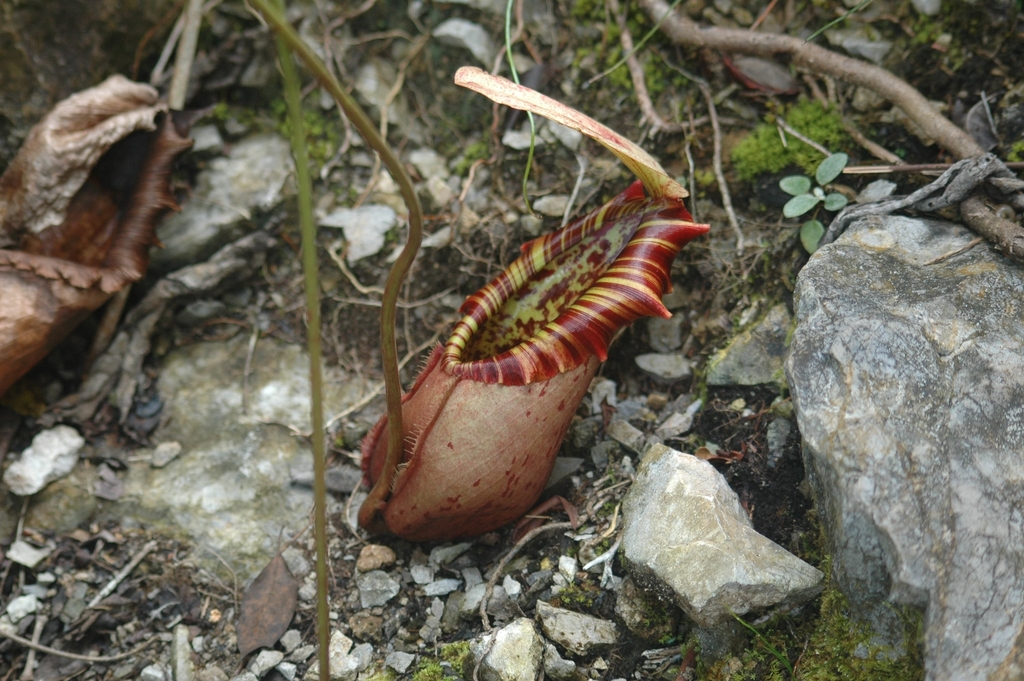
Nepenthes northiana
Nepenthes northiana , or Miss North's pitcher-plant, is a tropical pitcher plant endemic to Borneo, where it grows at elevations ranging from 0 to 500 m above sea level. The specific epithet northiana honours the English botanic illustrator Marianne North, who first depicted the species. Nepenthes northiana is one of the most famous Nepenthes, and its discovery in the latter half of the 19th century contributed to Sarawak's reputation as a land of spectacular exotic plants.
From the article Nepenthes northiana on Wikipedia (CC BY-SA), quoted section by section
Description
Nepenthes northiana is a climbing plant. The stem may attain a length of 10 m and is up to 15 mm in diameter. Internodes are up to 25 cm long and cylindrical to triangular in cross section.
The leaves of this species are chartaceous and sessile to sub-petiolate. The lamina is oblong-obovate in shape and up to 40 cm long by 10 cm wide. It has an acute apex and is gradually attenuate towards the base. The base is semi-amplexicaul and decurrent into a pair of wings. Up to 4 longitudinal veins are present on either side of the midrib. Pinnate veins are indistinct. Between 30 and 60 nectar glands are present on the lower surface of the lamina. Tendrils are up to 100 cm long. Rosette and lower pitchers are generally ovoid, sometimes being slightly cylindrical in the upper part. They are some of the largest in the genus, reaching 40 cm in height and 15 cm in width. Exceptionally large pitchers can hold more than a quart (946 ml) of fluid. A pair of fringed wings (≤15 mm) runs down the front of the pitcher. The waxy zone of the inner surface is reduced. The pitcher mouth is ovate, slightly raised towards the rear, and has an oblique insertion. The peristome of this species is greatly expanded at the sides (≤25 mm wide) and often has undulate margins. Its inner edge is lined with short but distinct teeth. …
What it does
Nepenthes northiana is endemic to the Kuching Division of Sarawak, particularly the hills around the village of Bau. The species has an elevational distribution of 0 to 500 m above sea level and is restricted to limestone substrates.
Nepenthes northiana generally grows in exposed sites on near-vertical limestone cliffs with permanent water seepage. Less commonly it occurs in secondary vegetation on small hills. It is sympatric with other limestone flora such as Alocasia longiloba var. lowii. The conservation status of N. northiana is listed as Vulnerable on the 2006 IUCN Red List of Threatened Species based on an assessment carried out in 2000. This agrees with the informal classification of the species made by botanist Charles Clarke in 1997. However, it differs from the assessment by the World Conservation Monitoring Centre, which classified N. northiana as "endangered". Quarrying activity has damaged several of the hills on which N. northiana grows, although this has apparently not affected the plants directly. In addition, natural populations of N. northiana have suffered from over-collection in recent years. Plants of this species have a high commercial value and are thus highly sought after by collectors. In their 1996 monograph Pitcher-Plants of Borneo, Anthea Phillipps and Anthony Lamb wrote that N. northiana "has been over-collected nearly to the point of extinction". …
Wikipedia: “Ecology”
How it is grown
Nepenthes northiana has a reputation amongst Nepenthes growers for being difficult to cultivate. For some time it was speculated that a potting medium involving limestone was necessary to successfully cultivate the species, but this is apparently not the case. It appears to grow well in low light conditions, with direct sunlight resulting in brown patches of dead tissue on the leaves and a decline or cessation in pitcher production. The species is also sensitive to fluctuations in relative humidity and grows best in moist environments. In The Savage Garden: Cultivating Carnivorous Plants, Peter D'Amato writes that peat and Sphagnum moss stunt the growth of N. northiana. He notes that a good alkaline medium for this species consists of two parts coarse vermiculite to one part each of perlite, pumice, and sand. Other growers have reported that the choice of growing medium is apparently of little consequence.
Wikipedia: “Cultivation”
In human culture
Nepenthes northiana was first brought to the attention of the scientific community by Marianne North, who painted plants brought to her from the Bau area of Sarawak, Borneo. Harry Veitch, owner of James Veitch & Sons, recognised these as belonging to an as yet undescribed species and sent Charles Curtis to locate a sample and send seeds to the United Kingdom. The species was subsequently named after Marianne North in 1881 by Joseph Dalton Hooker. The type specimen, M.North s.n., was collected near Jambusan in Sarawak in 1876. It is deposited at the Royal Botanic Gardens, Kew.
In her autobiography Recollections of a Happy Life, the first edition of which bears a gilt outline of N. northiana on its cover, North wrote the following account of the species's discovery:
"Mr E. [Everett] went up a mountain near and brought me down some grand trailing specimens of the largest of all pitcher-plants, which I festooned round the balcony by its yards of trailing stems. I painted a portrait of the largest, and my picture afterwards induced Mr Veitch to send a traveller to seek the seeds, from which he raised plants and Sir Joseph Hooker named the species Nepenthes northiana. …
Wikipedia: “Botanical history”
Where it lives
Recorded sightings
—
geo-referenced records in GBIF, from museums, herbaria and field observers.
Drag the globe to turn it. Dots are where records exist, not a range map; darker means more records.
In the stacks
Searching the stacks…
Every page naming Nepenthes northiana in the Biodiversity Heritage Library →
This page is assembled live from iNaturalist, GBIF, Wikipedia, the Source Library and the Internet Archive. It is not yet part of the hand-edited codex. iNaturalist taxon 52968.