- Animals
- ›Arthropods
- ›Hexapods
- ›Insects
- ›Winged and Once-winged Insects
- ›Ants, Bees, Wasps, and Sawflies
- ›Narrow-waisted Wasps, Ants, and Bees
- ›Ants, Bees, and Stinging Wasps
- ›Bees and Apoid Wasps
- ›Bees
- ›Mason, Leafcutter, Carder, and Resin Bees
- ›Megachilinae
- ›Megachilini
- ›Megachile
- ›Eutricharaea
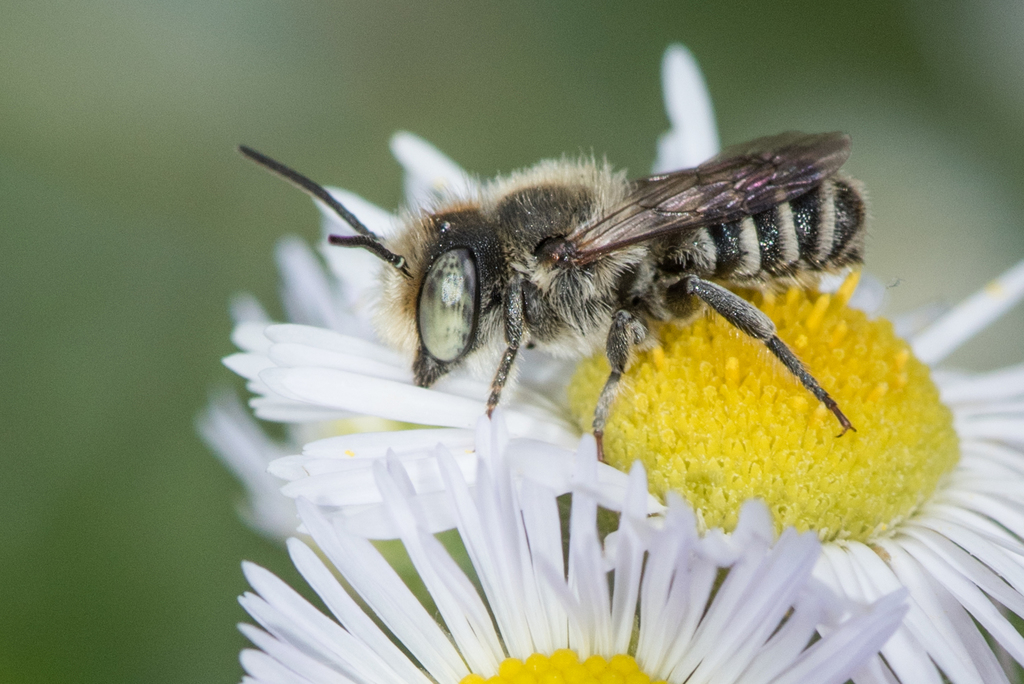
Alfalfa Leafcutter Bee
Megachile rotundata
Megachile rotundata, the alfalfa leafcutting bee, is a European bee that has been introduced to various regions around the world. As a solitary bee species, it does not build colonies or store honey, but is a very efficient pollinator of alfalfa, carrots, other vegetables, and some fruits. Because of this, farmers often use M. rotundata as a pollination aid by distributing M. rotundata prepupae around their crops. Each female constructs and provisions her own nest, which is built in old trees or log tunnels. Being a leafcutter bee, these nests are lined with cut leaves. These bees feed on pollen and nectar and display sexual dimorphism. This species has been known to bite and sting, but it poses no overall danger unless it is threatened or harmed, and its sting has been described as half as painful as a honey bee's.
From the article Megachile rotundata on Wikipedia (CC BY-SA), quoted section by section
Description
Megachile rotundata is a European leaf-cutting bee placed in the subgenus Eutricharaea, the "small leaf-cutting bees"; they are 6–9 mm (0.24–0.35 in) in length. They are partially bivoltine, meaning that under the right conditions they can produce two generations per year. These bees present a sexual dimorphism, in which the males are smaller than the females and differently marked. Megachile rotundata bees are a dark grey color. Females have white hairs all over their bodies, including on their scopae. In contrast, males have white and yellow spots on their abdomens.
Wikipedia: “Description and identification”
Range & habitat
Megachile rotundata is currently found on all continents except Antarctica. In North America, the species was deliberately imported to assist in the pollination of food crops, but has now become feral and widespread. M. rotundata was also introduced to New Zealand in 1971 and Australia in 1987 to assist in the pollination of alfalfa (known locally as lucerne).
Nest construction. Females construct tubular nests in a variety of sites, including rotting wood, flower stems, reeds, and soda straws. In the wild, females also create nests in small holes in the ground or in available cracks/crevices in trees or buildings. The nests are composed of a string of individual cells, as many as the space will allow. When managed for pollination, the females are induced to nest in paper cylinders similar to drinking straws or drilled blocks of wood. Each cell is made from circular disks cut from plant leaves using the bee's mandibles, hence the name "leafcutter". Females use about 15 leaves per cell, called a concave bottom, overlapping the leaves to produce the thimble-shaped cell. While the bees do not store honey, females do collect pollen and nectar which they store in the cells of their nests. Specifically, females first regurgitate the nectar they have provisioned into the cell and then transfer the pollen that is attached to their scopa on top of the nectar. …
Wikipedia: “Distribution and habitat”
What it does
As a member of the Hymenoptera order, the alfalfa leafcutter bee is haplodiploid. Adults emerge by the end of the summer through one of two developmental pathways: larvae will develop by the end of one summer and proceed through a prepupal diapause phase until the next summer; or larvae, known as "second-generation" bees, skip this phase and emerge as adults in the same summer. The larva transitions through four instar stages before emerging as an adult. During its development, which occurs rapidly, the larva consumes the pollen ball and enters diapause when the pollen is fully consumed. In its progression into the diapause phase, the larva defecates pellets in a ring formation and then spins its cocoon out of silk threads. The next spring, the mature larva pupates, a process that lasts 3–4 weeks, and completes its development. Once the bee is developed, it cuts its way out from the nest by chewing itself out of its cocoon. Upon emergence, females mate immediately and begin constructing their nests after a week. Progeny released via the two alternative pathways for emergence display different sex ratios and sizes. Among adults that emerge during the summer of the same year, the sex ratio is biased towards males. Among the "second-generation bees", however, the sex ratio is female biased. …
Wikipedia: “Life cycle”
Listen
Looking for field recordings…
Where it lives
Recorded sightings
—
geo-referenced records in GBIF, from museums, herbaria and field observers.
Drag the globe to turn it. Dots are where records exist, not a range map; darker means more records.
In the stacks
Searching the stacks…
Every page naming Megachile rotundata in the Biodiversity Heritage Library →
This page is assembled live from iNaturalist, GBIF, Wikipedia, the Source Library and the Internet Archive. It is not yet part of the hand-edited codex. iNaturalist taxon 52783.