- Plants
- ›Vascular Plants
- ›flowering plants
- ›monocots
- ›Agaves, Orchids, Irises, and Allies
- ›Aloe family
- ›Aloes and allies
- ›Aloidendron
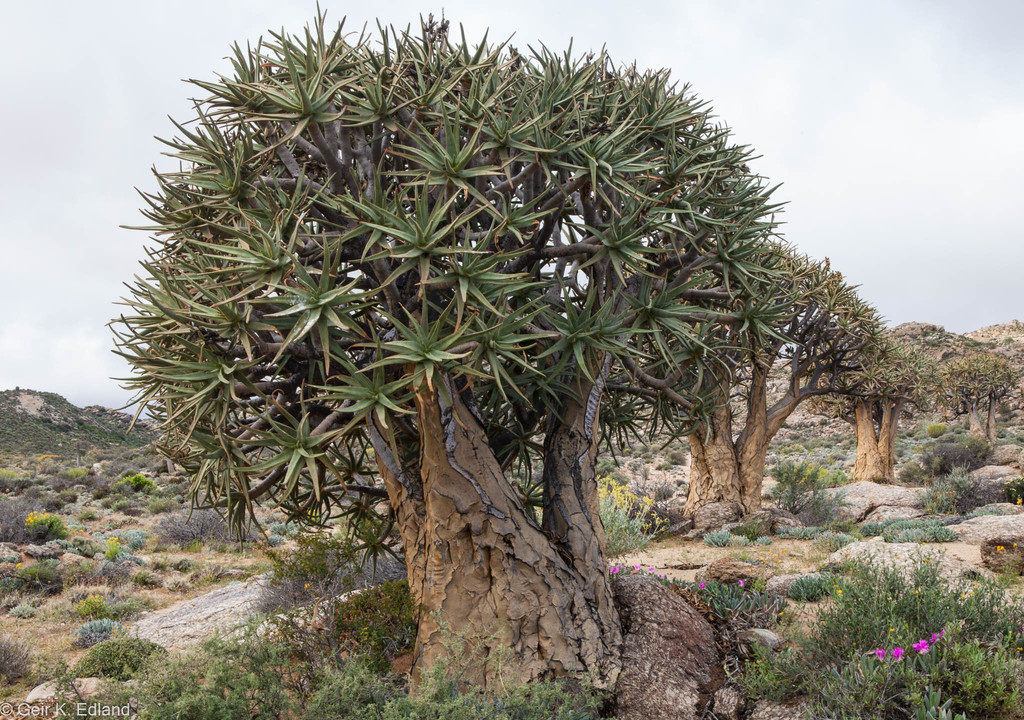
Quiver Tree
Aloidendron dichotomum
Aloidendron dichotomum, formerly Aloe dichotoma, the quiver tree or kokerboom, is a tall, branching species of succulent plant, indigenous to Southern Africa, specifically in the Northern Cape province of South Africa, and parts of Southern Namibia.
From the article Aloidendron dichotomum on Wikipedia (CC BY-SA), quoted section by section
Range & habitat
One of the few examples of spontaneous forests of A. dichotomum is the Quiver Tree Forest, about 14 km north of Keetmanshoop, in Namibia. Another is located in the Northern Cape of South Africa at Gannabos. Throughout much of its range this species is in decline. Modelling of Aloidendron dichotomum in South Africa and Namibia has contributed to understanding the needs of protected areas in response to climate change. Modelled range declines in this species due to climate change have recently been confirmed by field surveys.
Wikipedia: “Distribution and conservation”
How it is grown
Aloidendron dichotomum is cultivated in arid areas around the world, for use in landscaping. The slow growth rate and relative rarity of the plant make it a particularly expensive specimen. It is also relatively difficult to keep outside of its natural habitat. In cultivation it requires extremely well-drained coarse mineral sand (preferably with some loam and bone meal to keep it active and growing), full sun, good aeration and extremely little water - primarily in the winter (as it mainly occurs in winter rainfall desert areas). In the (rare) event that it is under-watered, the leaves will curl up and die off at the tips; this is not fatal, but indicates that it is relatively dry. It is unusually prone to aphids and insect infections in between its leaves, and this is exacerbated whenever there is not full sun and constant fresh air movement. Indoor plants require frequent treatment for these pests. Fungicide can be added occasionally, to protect the plant from rot. It can be propagated from seed and (with more difficulty) from cuttings or truncheons. Cuttings need to be thoroughly dried for several weeks in a shaded area before being planted.
Wikipedia: “Cultivation”
In human culture
Michael Benson's book Space Odyssey: Stanley Kubrick, Arthur C. Clarke, and the Making of a Masterpiece (2018) briefly discusses how the kokerboom piqued the interest of film director, Stanley Kubrick. The book claims that several protected kokerboom trees were cut down so they could be used to film 2001: A Space Odyssey.
Wikipedia: “In popular culture”
Where it lives
Recorded sightings
—
geo-referenced records in GBIF, from museums, herbaria and field observers.
Drag the globe to turn it. Dots are where records exist, not a range map; darker means more records.
In the stacks
Searching the stacks…
Every page naming Aloidendron dichotomum in the Biodiversity Heritage Library →
This page is assembled live from iNaturalist, GBIF, Wikipedia, the Source Library and the Internet Archive. It is not yet part of the hand-edited codex. iNaturalist taxon 527446.