- Plants
- ›Vascular Plants
- ›flowering plants
- ›Dicots
- ›proteas, lotuses, planes, and allies
- ›Protea family
- ›Paired Proteas
- ›Banksieae
- ›Banksiinae
- ›Banksia
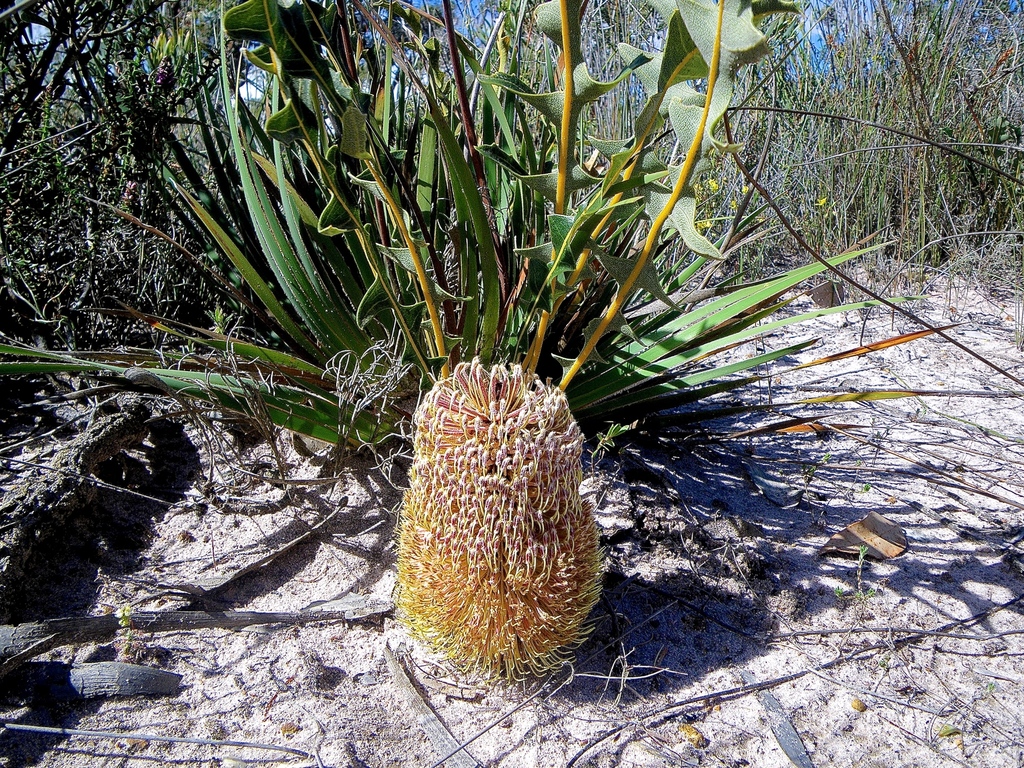
Creeping Banksia
Banksia repens
Banksia repens, the creeping banksia, is a species of shrub in the plant genus Banksia. It occurs on the south coast of Western Australia from D'Entrecasteaux National Park in the west to Mount Ragged in the east.
Seeds do not require any treatment, and take 29 to 56 days to germinate.
From the article Banksia repens on Wikipedia (CC BY-SA), quoted section by section
Description
Banksia repens is a prostrate shrub with horizontal stems covered in a fine velvety fur which spread underground. The large leathery upright leaves arise vertically on petioles 5–15 cm (2–6 in) high. They are 18 to 40 cm (7–16 in) in length and 18 cm (7 in) wide. They are intricately lobed with smaller lobes. Appearing from October to November, the cylindrical inflorescences arise well beyond the leaves and are variable shades of orange, tan and pinkish shades in overall colour and range from 6 to 10 cm (2.4–4 in) high. As the flower spikes age, they fade to a greyish colour, the old flowers persisting. It is lignotuberous, and resprouts after fire.
Range & habitat
It occurs in sandy soils from Cranbrook to Israelite Bay, on the Western Australian south coast.
Wikipedia: “Distribution and habitat”
Where it lives
Recorded sightings
—
geo-referenced records in GBIF, from museums, herbaria and field observers.
Drag the globe to turn it. Dots are where records exist, not a range map; darker means more records.
In the stacks
Searching the stacks…
Every page naming Banksia repens in the Biodiversity Heritage Library →
This page is assembled live from iNaturalist, GBIF, Wikipedia, the Source Library and the Internet Archive. It is not yet part of the hand-edited codex. iNaturalist taxon 525078.