- Animals
- ›Arthropods
- ›Hexapods
- ›Insects
- ›Winged and Once-winged Insects
- ›Grasshoppers, Crickets, and Katydids
- ›Grasshoppers, Locusts, and Allies
- ›Grasshoppers
- ›Short-horned Grasshoppers and Locusts
- ›Short-horned Grasshoppers
- ›Bird Grasshoppers
- ›Cyrtacanthacridini
- ›Schistocerca
- ›Schistocerca nitens
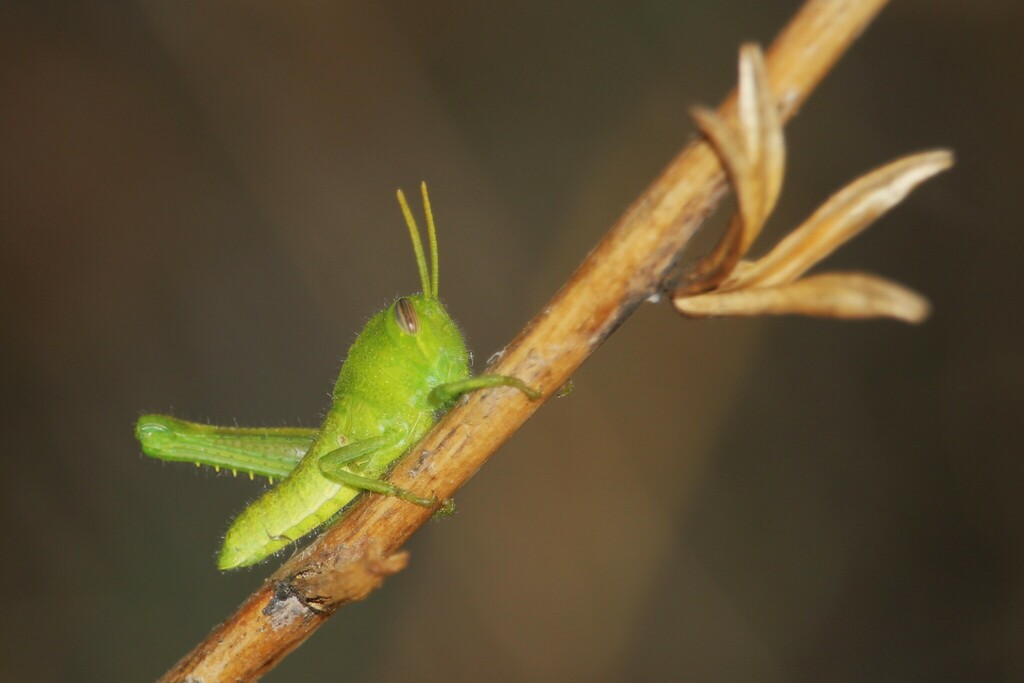
Gray Bird Grasshopper
Schistocerca nitens
Schistocerca nitens is a species of grasshopper known by several names, including vagrant grasshopper and gray bird grasshopper. It is a close relative of the desert locust, which is in the same genus. This grasshopper is native to southern North America including Mexico and the south-western United States from California to Texas. Vagrants are occasionally found in Colorado, Utah, and Oklahoma, where the winters are too cold for them to survive, otherwise. It is also present in parts of Central and South America. It lives in many habitats including desert, woodland, and lower elevation mountainous areas. This species is known as a pest on ornamental plants and many types of crop plants.
From the article Schistocerca nitens on Wikipedia (CC BY-SA), quoted section by section
Description
Adult females are 60–70 millimetres (2.4–2.8 in) while the smaller males are 40–50 millimetres (1.6–2.0 in). They are mottled in coloration, with colors including grays, browns, and yellows. A stripe runs from their head to their thorax. Juveniles, called nymphs, are usually a lighter brown or green, with a dark stripe extending down below the eye.
What it does
The grasshopper becomes sexually mature at 3 to 4 months of age. Any stage of its life cycle can be seen at any time of the year, but the adult is less active during the winter and fall. Mating usually occurs on warm nights in summer, and often around bright lights. Adult females lay their eggs in the late summer or early fall. They deposit their eggs in the soil by inserting their ovipositor at a depth of 1-2 inches. Eggs are encapsulated in pods that can contain as few as 20 or more than 100 eggs.
Wikipedia: “Life cycle”
Listen
Looking for field recordings…
Where it lives
Recorded sightings
—
geo-referenced records in GBIF, from museums, herbaria and field observers.
Drag the globe to turn it. Dots are where records exist, not a range map; darker means more records.
In the stacks
Searching the stacks…
Every page naming Schistocerca nitens in the Biodiversity Heritage Library →
This page is assembled live from iNaturalist, GBIF, Wikipedia, the Source Library and the Internet Archive. It is not yet part of the hand-edited codex. iNaturalist taxon 52158.