- Plants
- ›Vascular Plants
- ›flowering plants
- ›Dicots
- ›Nances, Willows, and Allies
- ›willow family
- ›Populus
- ›Aigeiros
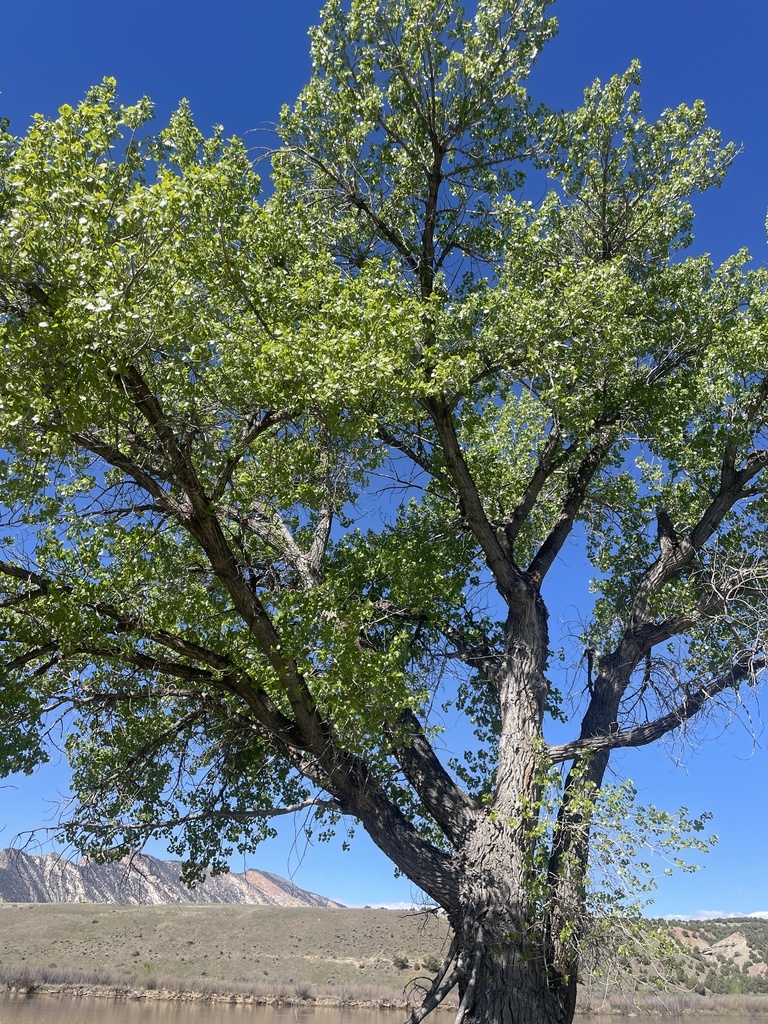
Frémont Cottonwood
Populus fremontii
Populus fremontii, commonly known as Fremont's cottonwood or the Alamo cottonwood, is a cottonwood (and thus a poplar) native to riparian zones of the Southwestern United States and northern through central Mexico. It is one of three species in Populus sect. Aigeiros. The tree was named after famous 19th Century American explorer and pathfinder John C. Frémont.
From the article Populus fremontii on Wikipedia (CC BY-SA), quoted section by section
Description
P. fremontii is a large tree growing from 12–35 m (39–115 ft) in height with a wide crown, with a trunk up to 1.5 m (4 ft 11 in) in diameter. The bark is smooth when young, becoming deeply fissured with whitish, cracked bark on old trees. The 3–7 cm (1.2–2.8 in) long leaves, are cordate (heart-shaped) with an elongated tip, with white veins and coarse crenate teeth along the sides, glabrous to hairy, and often stained with milky resin. Autumn colors occur from October–November, mainly a bright yellow, also orange, rarely red. The inflorescence consists of a long, drooping catkin, which blooms from March to April. The fruit is a wind-dispersed achene, that appears to look like patches of cotton hanging from limbs, thus the name cottonwood. The largest known P. fremontii tree in the United States grows in Skull Valley, Arizona. In 2012, it had a measured circumference of 557 in (14,100 mm), height of 102 ft (31 m), and a spread of 149.5 ft (45.6 m).
Subspecies or varieties. Two subspecies are currently recognized. Some confusion due to hybridization with a Rio Grande subspecies of Populus deltoides subsp. wislizeni had originally placed this eastern cottonwood subspecies as a P. fremontii subspecies, but it was removed in 1977.
P. f. subsp. fremontii, with synonyms P. f. var. arizonica - Sarg. and P. f. var. macdougalii - (Rose) Jeps. …
Range & habitat
The tree is native to the Southwestern United States and Mexico. In the northwestern US it is only found in the state of Idaho, but it is widespread in every state of the southwestern United States including California, Nevada, Utah, and Arizona. It is also native to a few locations in western Colorado as well as disjunct parts of New Mexico and far western Texas. In northwestern Mexico it is native to the states of Baja California, Baja California Sur, and Sonora. In the northeast it is found in Chihuahua, Coahuila, Durango, and Nuevo León and in just Mexico State and Puebla in central Mexico. A riparian tree, it grows near streams, rivers, springs, seeps, wetlands, and well-watered alluvial bottomlands at elevations below 2,000 metres (6,600 ft) elevation.
Wikipedia: “Distribution”
How it is grown
P. fremontii is cultivated as an ornamental tree and riparian zone restoration tree. It is used in planting for wildlife food and shelter habitats, and ecological restoration, larger native plant and wildlife gardens, and natural landscaping projects, windbreaks, erosion control, and shade for recreation facilities, parks, and livestock. Frémont's cottonwood was used in the past by settlers and ranchers for fuel and fence posts.
Wikipedia: “Cultivation”
Where it lives
Recorded sightings
—
geo-referenced records in GBIF, from museums, herbaria and field observers.
Drag the globe to turn it. Dots are where records exist, not a range map; darker means more records.
In the stacks
Searching the stacks…
Every page naming Populus fremontii in the Biodiversity Heritage Library →
This page is assembled live from iNaturalist, GBIF, Wikipedia, the Source Library and the Internet Archive. It is not yet part of the hand-edited codex. iNaturalist taxon 52120.