On eBird ↗
Grayish Baywing
Live sightings near you, the range map, bar charts of when it is seen, and Macaulay Library photos and recordings.
Grayish Baywing
Agelaioides badius
The grayish baywing (Agelaioides badius), formerly known as the bay-winged cowbird, is a species of bird in the family Icteridae. It is currently placed in the genus Agelaioides but has traditionally been placed in the genus Molothrus. It is found in the northern half of Argentina, Bolivia, Uruguay, Paraguay and southern and central Brazil, The isolated population in north-eastern Brazil is usually now considered a separate species, the pale cowbird or pale baywing (Agelaioides fringillarius). The...
From the article Grayish baywing on Wikipedia (CC BY-SA), quoted section by section
Description
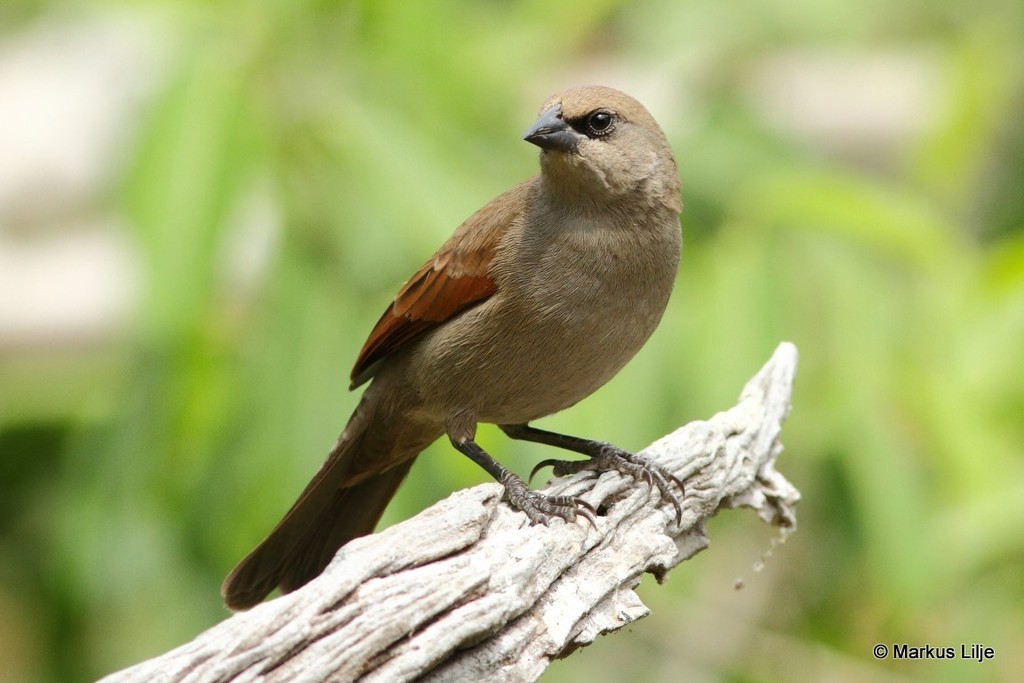
The greyish baywing is 19 cm (7 in) long. Males weigh an average of about 46 g (1.6 oz) and females average about 42 g (1.5 oz). Both sexes of both subspecies have the same plumage though A. b. bolivianus is larger than the nominate A. b. badius. Adults have a mostly grayish buffy brown head, neck, and upperparts. They have blackish lores and ear coverts and an otherwise grayish buffy brown face. Their uppertail coverts are olive-brown and their tail very dark olive-brown. Their lesser wing coverts are sandy buffy brown, their middle wing coverts are light grayish rufous, and their greater wing coverts are dark blackish brown with wide rufous edges. Their primaries and secondaries are dark blackish brown with light rufous chestnut outer edges. Their underparts are sandy olive buffy brown and their underwing coverts pale gray. They have a dark eye, a black bill, and black legs and feet.
Range & habitat
The nominate subspecies of the greyish baywing has a much larger range than A. b. bolivianus. It is found from eastern Bolivia's Beni Department and southwestern Brazil's Mato Grosso and southern Brazil's Paraná states south through eastern Bolivia, Paraguay, Uruguay, and northern and central Argentina to Chubut Province. Subspecies A. b. bolivianus has a much smaller range in central and southern Bolivia from La Paz Department to Chuquisaca Department. However, some authors state that A. b. bolivianus rather than the nominate occurs in far northwestern Argentina. The status of the nominate subspecies in Chile is in dispute. One source says it arrived as a vagrant and another that it was introduced to the country. However, the South American Classification Committee has no confirmed records of the species in Chile. The greyish baywing inhabits a variety of open landscapes both natural and human-modified. These include open woodlands, savanna, scrub- and brushlands, pastures, agricultural lands, and suburban areas. In elevation the nominate subspecies is found from sea level to at most 1,000 m (3,300 ft) while A. b. bolivianus is known up to 2,900 m (9,500 ft) and could occur as high as 3,350 m (11,000 ft).
Wikipedia: “Distribution and habitat”
What it does
The greyish baywing's diet has not been fully defined but it is known to include insects, seeds of wild plants, and seeds of crops like corn and rice. It forages in dense vegetation on the ground and also in shrubs and trees. In the early breeding season it typically forages singly or in pairs; later in that season and afterwards it is often in flocks of up to about 25 individuals.
Wikipedia: “Feeding”
Listen
Looking for field recordings…
Where it lives
Recorded sightings
—
geo-referenced records in GBIF, from museums, herbaria and field observers.
Drag the globe to turn it. Dots are where records exist, not a range map; darker means more records.
In the stacks
Searching the stacks…
Every page naming Agelaioides badius in the Biodiversity Heritage Library →
This page is assembled live from iNaturalist, GBIF, Wikipedia, the Source Library and the Internet Archive. It is not yet part of the hand-edited codex. iNaturalist taxon 516244.