- Animals
- ›Arthropods
- ›Hexapods
- ›Insects
- ›Winged and Once-winged Insects
- ›Butterflies and Moths
- ›Butterflies
- ›Whites, Yellows, and Sulphurs
- ›Yellows and Sulphurs
- ›Euremini
- ›Euremina
- ›Eurema
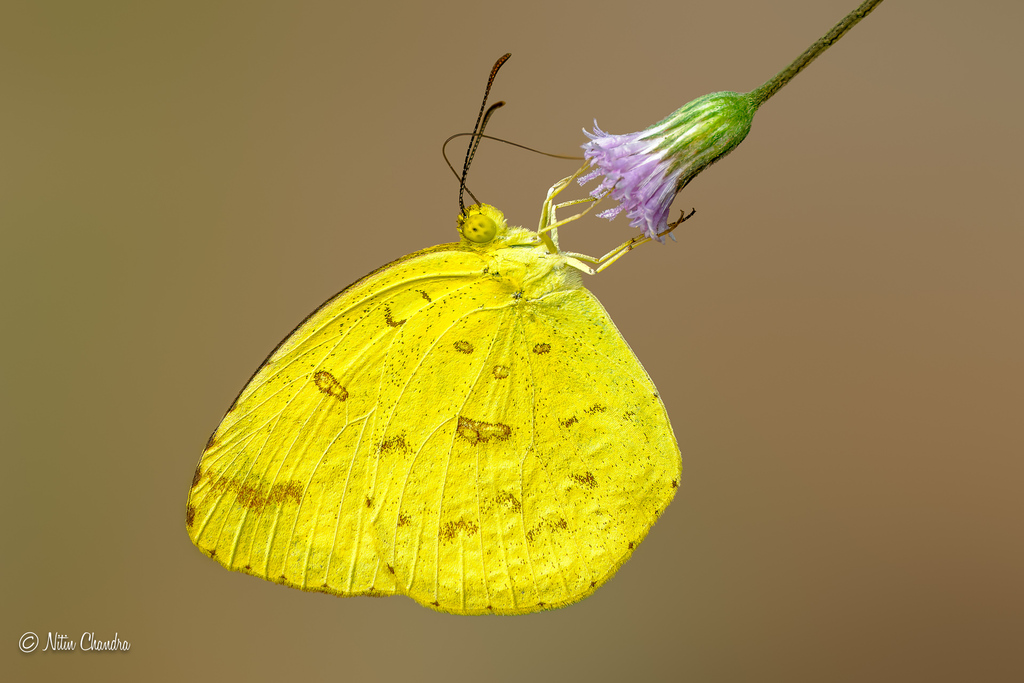
Common Grass Yellow
Eurema hecabe
Eurema hecabe, a.k.a. the large grass yellow or common grass yellow, is a small pierid butterfly species found in Asia and Africa. They are found flying close to the ground and are found in open grass and scrub habitats. It is simply known as "the grass yellow" in parts of its range; the general term otherwise refers to the entire genus Eurema.
From the article Eurema hecabe on Wikipedia (CC BY-SA), quoted section by section
Description
The common grass yellow exhibits seasonal polyphenism. The lepidopteran has a darker summer morph, triggered by a long day exceeding 13 hours in duration, while the shorter diurnal period of 12 hours or less induces a fairer morph in the post-monsoon period.
Male. Upperside (dorsal surface): yellow, variable in tint from sulphur to rich lemon yellow according to season and locality. Forewing: apex and termen deep black, this colour continued narrowly along the costal margin to base of wing, near which it often becomes diffuse; the inner margin of the black area from costa to vein 4 very oblique and irregular, between veins 2 and 4 excavate on the inner side, this excavation outwardly rounded between the veins and inwardly toothed on vein 3; below vein 2 the black area is suddenly dilated into a square spot which occupies the whole of the tornal angle; the inner margin of this dilatation is variable, in the typical form slightly concave. …
What it does
Eggs are laid on Abrus precatorius, Falcataria moluccana, Acacia sp., Aeschynomene species and numerous other Leguminosae, Euphorbiaceae and Cucurbitaceae sp.. Studies suggest that the females can discriminate colours when choosing host plants for oviposition. Larva: "Long, green, rough, cylindrical, or slightly depressed, with a large head." Pupa: "Suspended by the tail and by a moderately long band; the abdominal segments are round, but the thorax is much compressed, the wing-cases uniting to form a deep sharp keel. The head-case terminates in a short pointed snout. Ordinarily the pupa is solitary and green, but sometimes on a twig in large numbers. Many Pierine and other larvae seek each others company at that time. Having selected a dead branch of some neighbouring bush, they acquired the colour of their surroundings as nearly all Pierine and Papilionine pupae do to a greater or less extent." This species has been found to be parasitised by multiple strains of Wolbachia. These bacteria can alter the sex ratios of the species.
Wikipedia: “Life cycle”
Listen
Looking for field recordings…
Where it lives
Recorded sightings
—
geo-referenced records in GBIF, from museums, herbaria and field observers.
Drag the globe to turn it. Dots are where records exist, not a range map; darker means more records.
In the stacks
Searching the stacks…
Every page naming Eurema hecabe in the Biodiversity Heritage Library →
This page is assembled live from iNaturalist, GBIF, Wikipedia, the Source Library and the Internet Archive. It is not yet part of the hand-edited codex. iNaturalist taxon 51614.