- Plants
- ›Vascular Plants
- ›flowering plants
- ›Dicots
- ›Sunflowers, Bellflowers, Fanflowers, and Allies
- ›Sunflowers, Daisies, Asters, and Allies
- ›chicories, dandelions, and allies
- ›Lettuce, Chicory, Dandelion and Salsify Tribe
- ›Scolyminae
- ›Hymenonema
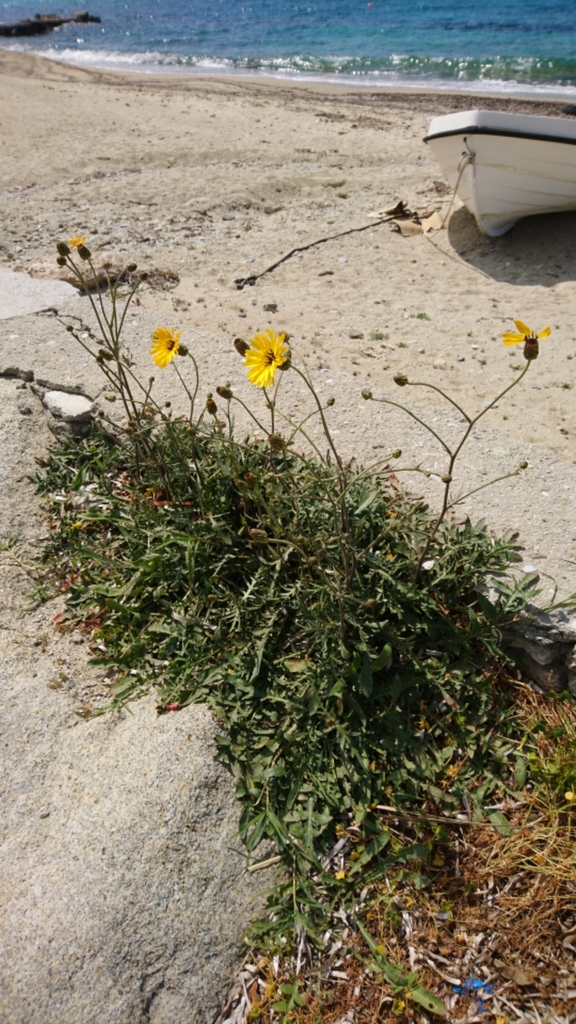
Hymenonema graecum
Hymenonema graecum is a perennial herbaceous plant of 20–70 cm, that rests with its buds at or just under the surface of the soil (a so-called hemicryptophyte). The Greek vernacular name is Αδραλίδα (Adralida), meaning "handsome Lida". The leaves are pinnate, and may be up to 1 cm wide. The ligulate flowers are yellow. The species is an endemic of Greece.
From the article Hymenonema graecum on Wikipedia (CC BY-SA), quoted section by section
Description
Hymenonema graecum is a perennial herb with glandular, rough but softly hairy shoots. It has twenty chromosomes (2n = 20). The rosette consists of pinnately lobed leaves, the end-lobe largest, oval, with a rounded tip, and segments often with teeth. Few small leaves on the stem are slightly pinnate and linear further up. The plant is of average height (20–70 cm). It usually has 1-3 yellow inflorescences (heads) per stem, each on a peduncle of 10–30 cm. The narrow yellow ligulate florets with five short teeth at the tip sometimes have a whitish base, the tube being hairy. The fruits (or cypselas) are 4–5 mm long and stiffly hairy, and are topped by 12–14 mm long pappus scales. The hairless involucre consists of hairless, cartilaginous bracts (or phyllaries) with papery, sometimes serrated edges. Those on the outside are oval, the inner phyllaries are narrower.
Differences with related species. The genus Hymenonema contains two species, H. laconicum, which is known from the southern Peloponnesos and H. graecum. H. graecum has yellow florets with yellow anther tubes, which sit on 3½-5 mm long and ¾-1¾ mm thick, sparsely hairy cypselas, encircled by pappus that differs maximally 5 mm in length, and basal leaves with a narrow top segment of usually 3–10 mm. H. …
Range & habitat
This species is endemic to Greece, and is only known from the Cyclades and doubtfully from western Crete. It grows on rocky soils, under scrubs, in dry meadows, along roads and at the seaside. The species is tolerant to moderately increased salinity.
== References ==
Wikipedia: “Distribution and habitat”
Where it lives
Recorded sightings
—
geo-referenced records in GBIF, from museums, herbaria and field observers.
Drag the globe to turn it. Dots are where records exist, not a range map; darker means more records.
In the stacks
Searching the stacks…
Every page naming Hymenonema graecum in the Biodiversity Heritage Library →
This page is assembled live from iNaturalist, GBIF, Wikipedia, the Source Library and the Internet Archive. It is not yet part of the hand-edited codex. iNaturalist taxon 513619.