- Plants
- ›Vascular Plants
- ›flowering plants
- ›monocots
- ›lilies, supplejacks, and allies
- ›lily family
- ›mariposa and toad lilies
- ›Calochortus
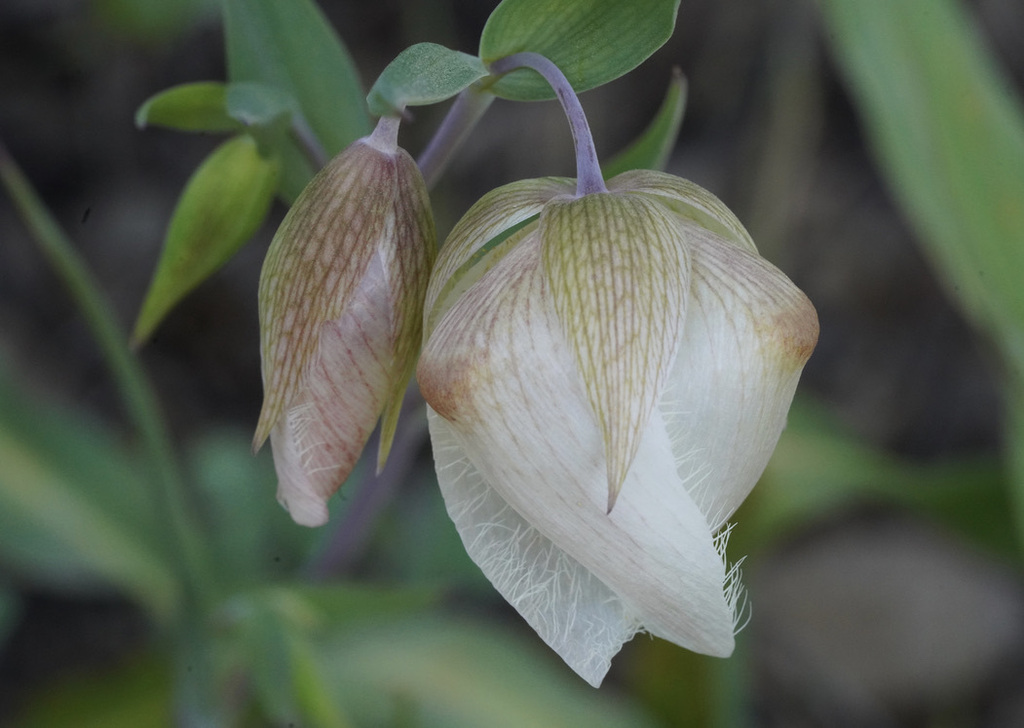
White Globe Lily
Calochortus albus
Calochortus albus is a North American species in the genus Calochortus in the family Liliaceae. It is also known by the common names fairy lantern, white fairy lantern, pink fairy lantern, lantern of the fairies, globe lily, white globe lily, white globe-tulip, alabaster tulip, Indian bells, satin bells, snowy lily-bell, and snow drops.
From the article Calochortus albus on Wikipedia (CC BY-SA), quoted section by section
Description
Widespread, variable species, blooming in winter and spring and going dormant after anthesis (flowering period) until the start of the autumn rains.
Height: 20– 30–60–80 cm high at maturity. Stems: Stems are erect, to arching, slender, glaucous, and simple to branching, reaching 7.5- 20- 70- 80 cm. Leaves: Leaves come in two types: cauline or basal (radical). One long basal leaf is present during blooming, along with several cauline leaves, and foliaceous bracts below the flowers. Basal/radical leaves: Basal leaves measure 20– 30– 50– 70 cm in length, 1–5 cm in width, and are lax, shiny, and persistent. Cauline leaves: 2-6 lanceolate to linear leaves, measuring 5– 15–25 cm in length. Inflorescences: Flowers are borne in groups of 1- 2- many. Bracts are generally paired, lanceolate, and measure 1–5 cm in length. Flowers: Delicate, pendent, nodding, 2–3 cm closed orbs of pearly white, to pink, to deep pink, to almost wine-red, occasionally greenish. Flowers from late March- April–June- early July. Though the flowers of C. albus may occasionally be flushed pink, those which are deep rose in colour and are found from the southwest San Francisco Bay to outer south coast ranges may be assignable to C. albus var. …
Range & habitat
Widespread in shady to open woods and scrub, partially shaded grasslands, exposed coastal bluffs, and is often found in rocky places. May be found in many plant communities below 5,000 ft or 2,000m, including foothill woodlands, yellow pine forests, and chaparral.
Wikipedia: “Habitat”
How it is grown
Light : Prefers sun to partial shade. Soil: Adaptable, but prefers well-drained soil. Water: Drought tolerant to moderate. During its dormant period, this species receives little or no rain in the wild. In cultivation, give a regular supply of water in the growing season, then the bulbs need to dry when the leaves begin to yellow. Premature autumn growth and poor drainage are often the causes of bulb loss. Zone: Hardy to -18 °C, and possibly as low as -23 °C. USDA zones 9-10.
Wikipedia: “Cultivation”
In human culture
Albus comes from Latin, and means 'white' or 'bright'. Calochortus is derived from Greek meaning 'beautiful grass', a reference to the characteristic grass-like foliage of the genus.
Wikipedia: “Etymology”
Where it lives
Recorded sightings
—
geo-referenced records in GBIF, from museums, herbaria and field observers.
Drag the globe to turn it. Dots are where records exist, not a range map; darker means more records.
In the stacks
Searching the stacks…
Every page naming Calochortus albus in the Biodiversity Heritage Library →
This page is assembled live from iNaturalist, GBIF, Wikipedia, the Source Library and the Internet Archive. It is not yet part of the hand-edited codex. iNaturalist taxon 51315.